Event submissions
Published
This submission belongs to the session 1. Exposure Routes / Exposome of Emerging Contaminants and Materials in the Environment of the event The 3rd International Online Conference on Toxics
Published date
04 Sep, 2026
Academic Editor
'%3e%3cpath%20d='M12.6657%2010.9104C12.4185%2010.325%2012.0599%209.79327%2011.6097%209.34482C11.1609%208.89508%2010.6293%208.5365%2010.0442%208.28888C10.0389%208.28626%2010.0337%208.28495%2010.0285%208.28233C10.8446%207.69279%2011.3752%206.73249%2011.3752%205.64904C11.3752%203.8542%209.92103%202.39999%208.1262%202.39999C6.33136%202.39999%204.87715%203.8542%204.87715%205.64904C4.87715%206.73249%205.40774%207.69279%206.22393%208.28364C6.21869%208.28626%206.21345%208.28757%206.20821%208.29019C5.62129%208.5378%205.09463%208.89284%204.64265%209.34613C4.1929%209.79493%203.83432%2010.3266%203.58671%2010.9117C3.34345%2011.4845%203.21226%2012.0987%203.20023%2012.7209C3.19988%2012.7349%203.20233%2012.7488%203.20744%2012.7619C3.21255%2012.7749%203.22022%2012.7867%203.22998%2012.7968C3.23975%2012.8068%203.25142%2012.8147%203.26431%2012.8202C3.2772%2012.8256%203.29105%2012.8284%203.30504%2012.8284H4.09109C4.14874%2012.8284%204.19459%2012.7825%204.1959%2012.7262C4.2221%2011.7148%204.62823%2010.7676%205.34617%2010.0497C6.08899%209.30683%207.0755%208.89808%208.1262%208.89808C9.17689%208.89808%2010.1634%209.30683%2010.9062%2010.0497C11.6242%2010.7676%2012.0303%2011.7148%2012.0565%2012.7262C12.0578%2012.7838%2012.1037%2012.8284%2012.1613%2012.8284H12.9474C12.9613%2012.8284%2012.9752%2012.8256%2012.9881%2012.8202C13.001%2012.8147%2013.0126%2012.8068%2013.0224%2012.7968C13.0322%2012.7867%2013.0398%2012.7749%2013.0449%2012.7619C13.0501%2012.7488%2013.0525%2012.7349%2013.0522%2012.7209C13.0391%2012.0947%2012.9094%2011.4855%2012.6657%2010.9104ZM8.1262%207.9024C7.52486%207.9024%206.9589%207.6679%206.53312%207.24211C6.10733%206.81633%205.87283%206.25037%205.87283%205.64904C5.87283%205.0477%206.10733%204.48174%206.53312%204.05596C6.9589%203.63018%207.52486%203.39567%208.1262%203.39567C8.72753%203.39567%209.29349%203.63018%209.71927%204.05596C10.1451%204.48174%2010.3796%205.0477%2010.3796%205.64904C10.3796%206.25037%2010.1451%206.81633%209.71927%207.24211C9.29349%207.6679%208.72753%207.9024%208.1262%207.9024Z'%20fill='%235D1EE1'/%3e%3c/g%3e%3c/svg%3e) Natalia Garcia-Reyero
Natalia Garcia-ReyeroCitation
Lacrimioara Senila, Eniko KOVACS, Marin Senila, PVC, CTA, and PLA-based polymer inclusion membranes for selective removal of metal ions from wastewater, in Proceedings of The 3rd International Online Conference on Toxics, 9 September–11 September 2026, MDPI: Basel, Switzerland
Share
Email
Facebook
Twitter
LinkedIn
PVC, CTA, and PLA-based polymer inclusion membranes for selective removal of metal ions from wastewater
'%3e%3cpath%20d='M12.6647%2010.9104C12.4176%2010.325%2012.0589%209.7933%2011.6088%209.34485C11.16%208.89511%2010.6283%208.53653%2010.0432%208.28891C10.038%208.28629%2010.0327%208.28498%2010.0275%208.28236C10.8437%207.69282%2011.3743%206.73252%2011.3743%205.64907C11.3743%203.85423%209.92005%202.40002%208.12522%202.40002C6.33038%202.40002%204.87618%203.85423%204.87618%205.64907C4.87618%206.73252%205.40677%207.69282%206.22296%208.28367C6.21772%208.28629%206.21248%208.2876%206.20724%208.29022C5.62031%208.53783%205.09365%208.89287%204.64167%209.34616C4.19192%209.79496%203.83334%2010.3266%203.58573%2010.9117C3.34247%2011.4846%203.21128%2012.0987%203.19925%2012.721C3.1989%2012.735%203.20135%2012.7489%203.20646%2012.7619C3.21157%2012.7749%203.21924%2012.7868%203.22901%2012.7968C3.23877%2012.8068%203.25045%2012.8148%203.26334%2012.8202C3.27623%2012.8256%203.29007%2012.8284%203.30406%2012.8284H4.09012C4.14776%2012.8284%204.19362%2012.7825%204.19493%2012.7262C4.22113%2011.7148%204.62726%2010.7676%205.34519%2010.0497C6.08802%209.30686%207.07452%208.89811%208.12522%208.89811C9.17592%208.89811%2010.1624%209.30686%2010.9052%2010.0497C11.6232%2010.7676%2012.0293%2011.7148%2012.0555%2012.7262C12.0568%2012.7839%2012.1027%2012.8284%2012.1603%2012.8284H12.9464C12.9604%2012.8284%2012.9742%2012.8256%2012.9871%2012.8202C13%2012.8148%2013.0117%2012.8068%2013.0214%2012.7968C13.0312%2012.7868%2013.0389%2012.7749%2013.044%2012.7619C13.0491%2012.7489%2013.0515%2012.735%2013.0512%2012.721C13.0381%2012.0947%2012.9084%2011.4856%2012.6647%2010.9104ZM8.12522%207.90243C7.52388%207.90243%206.95792%207.66793%206.53214%207.24215C6.10636%206.81636%205.87185%206.2504%205.87185%205.64907C5.87185%205.04773%206.10636%204.48177%206.53214%204.05599C6.95792%203.63021%207.52388%203.3957%208.12522%203.3957C8.72655%203.3957%209.29252%203.63021%209.7183%204.05599C10.1441%204.48177%2010.3786%205.04773%2010.3786%205.64907C10.3786%206.2504%2010.1441%206.81636%209.7183%207.24215C9.29252%207.66793%208.72655%207.90243%208.12522%207.90243Z'%20fill='%235D1EE1'/%3e%3c/g%3e%3c/svg%3e)
Lacrimioara Senila 1
Eniko KOVACS 1

Marin Senila 1
1. INCDO-INOE 2000, Research Institute for Analytical Instrumentation, Cluj-Napoca
Abstract
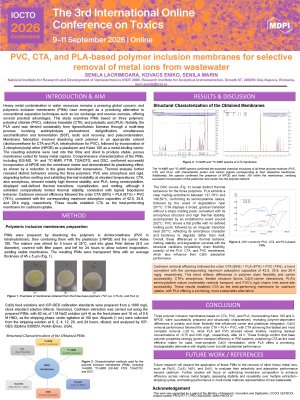
In recent years, polymeric inclusion membranes (PIMs) have offered promising solutions to the global concern of heavy metal contamination in water resources. PIMs offer many advantages over traditional separation methods such as ion exchange or reverse osmosis. This study investigates PIMs incorporating polyvinyl chloride (PVC), cellulose triacetate (CTA), and polylactic acid (PLA). The PLA was sustainably produced from lignocellulosic biomass via autohydrolysis pretreatment, delignification, simultaneous saccharification and fermentation (SSF) of the resulting cellulose, lactic acid recovery, and polycondensation. Membranes were fabricated by dissolving the polymers in dichloromethane (PVC in tetrahydrofuran), incorporating 2-nitrophenyloctyl ether (NPOE) as a plasticizer and Chelex 100 as a carrier, casting the solutions into thin films, and evaporating the solvents to yield stable, porous structures suitable for heavy metal removal. The membranes were comprehensively characterized using electrospray ionization mass spectrometry (ESI-MS), proton nuclear magnetic resonance (1H-NMR), 13C-NMR, Fourier-transform infrared (FTIR) spectroscopy, thermogravimetric analysis (TGA/DTG), and differential scanning calorimetry (DSC). DSC revealed NPOE's plasticizing effect, which lowered the glass transition temperature. Thermal stability analysis revealed distinct degradation behaviors among the membranes. DSC analysis confirms the differences among the three polymers: PVC, CTA, and PLA. PVC is an amorphous, rigid polymer that degrades before melting , whereas CTA is an amorphous polymer with very high thermal stability. PLA is a semicrystalline polymer that shows well-defined thermal transitions, including the glass transition temperature, crystallization temperature upon cooling, and melting temperature of the crystalline phase, but with limited thermal stability. Thus, PLA displays typical behavior of thermally processable biopolymers. In terms of performance, the membranes demonstrated significant efficiency in cadmium removal, with removal efficiencies of 95% (CTA), 87% (PLA), and 74% (PVC). The maximum adsorption capacities were 42.5 mg/g for CTA, 35.8 mg/g for PLA, and 28.4 mg/g for PVC, indicating the superior performance of the CTA membrane.
Keywords
polymers
polymeric inclusion membrane
metals
wastewater
Poster
SENILA_Poster_2026.pdf
Microplastics Pollution in Selected Groundwater Sources in Ibadan, Nigeria
Improved Prediction of Chemical Carcinogenicity Based on Hybrid In Silico/In Vitro Methodology