Event submissions
Published
This submission belongs to the session 1. Exposure Routes / Exposome of Emerging Contaminants and Materials in the Environment of the event The 3rd International Online Conference on Toxics
Published date
04 Sep, 2026
Academic Editor
'%3e%3cpath%20d='M12.6657%2010.9104C12.4185%2010.325%2012.0599%209.79327%2011.6097%209.34482C11.1609%208.89508%2010.6293%208.5365%2010.0442%208.28888C10.0389%208.28626%2010.0337%208.28495%2010.0285%208.28233C10.8446%207.69279%2011.3752%206.73249%2011.3752%205.64904C11.3752%203.8542%209.92103%202.39999%208.1262%202.39999C6.33136%202.39999%204.87715%203.8542%204.87715%205.64904C4.87715%206.73249%205.40774%207.69279%206.22393%208.28364C6.21869%208.28626%206.21345%208.28757%206.20821%208.29019C5.62129%208.5378%205.09463%208.89284%204.64265%209.34613C4.1929%209.79493%203.83432%2010.3266%203.58671%2010.9117C3.34345%2011.4845%203.21226%2012.0987%203.20023%2012.7209C3.19988%2012.7349%203.20233%2012.7488%203.20744%2012.7619C3.21255%2012.7749%203.22022%2012.7867%203.22998%2012.7968C3.23975%2012.8068%203.25142%2012.8147%203.26431%2012.8202C3.2772%2012.8256%203.29105%2012.8284%203.30504%2012.8284H4.09109C4.14874%2012.8284%204.19459%2012.7825%204.1959%2012.7262C4.2221%2011.7148%204.62823%2010.7676%205.34617%2010.0497C6.08899%209.30683%207.0755%208.89808%208.1262%208.89808C9.17689%208.89808%2010.1634%209.30683%2010.9062%2010.0497C11.6242%2010.7676%2012.0303%2011.7148%2012.0565%2012.7262C12.0578%2012.7838%2012.1037%2012.8284%2012.1613%2012.8284H12.9474C12.9613%2012.8284%2012.9752%2012.8256%2012.9881%2012.8202C13.001%2012.8147%2013.0126%2012.8068%2013.0224%2012.7968C13.0322%2012.7867%2013.0398%2012.7749%2013.0449%2012.7619C13.0501%2012.7488%2013.0525%2012.7349%2013.0522%2012.7209C13.0391%2012.0947%2012.9094%2011.4855%2012.6657%2010.9104ZM8.1262%207.9024C7.52486%207.9024%206.9589%207.6679%206.53312%207.24211C6.10733%206.81633%205.87283%206.25037%205.87283%205.64904C5.87283%205.0477%206.10733%204.48174%206.53312%204.05596C6.9589%203.63018%207.52486%203.39567%208.1262%203.39567C8.72753%203.39567%209.29349%203.63018%209.71927%204.05596C10.1451%204.48174%2010.3796%205.0477%2010.3796%205.64904C10.3796%206.25037%2010.1451%206.81633%209.71927%207.24211C9.29349%207.6679%208.72753%207.9024%208.1262%207.9024Z'%20fill='%235D1EE1'/%3e%3c/g%3e%3c/svg%3e) Carlos Barata
Carlos BarataCitation
Anca Becze, Liliana Vanda Babalau-Fuss, Dorina Simedru, Nicos Larkos, Bulent Bayram, Lucian Dordai, Adaptive Monitoring of Climate-Driven Contaminant Pulses: An Integrated Analytical and AI Framework, in Proceedings of The 3rd International Online Conference on Toxics, 9 September–11 September 2026, MDPI: Basel, Switzerland
Share
Email
Facebook
Twitter
LinkedIn
Adaptive Monitoring of Climate-Driven Contaminant Pulses: An Integrated Analytical and AI Framework

Anca Becze 1
'%3e%3cpath%20d='M12.6647%2010.9104C12.4176%2010.325%2012.0589%209.7933%2011.6088%209.34485C11.16%208.89511%2010.6283%208.53653%2010.0432%208.28891C10.038%208.28629%2010.0327%208.28498%2010.0275%208.28236C10.8437%207.69282%2011.3743%206.73252%2011.3743%205.64907C11.3743%203.85423%209.92005%202.40002%208.12522%202.40002C6.33038%202.40002%204.87618%203.85423%204.87618%205.64907C4.87618%206.73252%205.40677%207.69282%206.22296%208.28367C6.21772%208.28629%206.21248%208.2876%206.20724%208.29022C5.62031%208.53783%205.09365%208.89287%204.64167%209.34616C4.19192%209.79496%203.83334%2010.3266%203.58573%2010.9117C3.34247%2011.4846%203.21128%2012.0987%203.19925%2012.721C3.1989%2012.735%203.20135%2012.7489%203.20646%2012.7619C3.21157%2012.7749%203.21924%2012.7868%203.22901%2012.7968C3.23877%2012.8068%203.25045%2012.8148%203.26334%2012.8202C3.27623%2012.8256%203.29007%2012.8284%203.30406%2012.8284H4.09012C4.14776%2012.8284%204.19362%2012.7825%204.19493%2012.7262C4.22113%2011.7148%204.62726%2010.7676%205.34519%2010.0497C6.08802%209.30686%207.07452%208.89811%208.12522%208.89811C9.17592%208.89811%2010.1624%209.30686%2010.9052%2010.0497C11.6232%2010.7676%2012.0293%2011.7148%2012.0555%2012.7262C12.0568%2012.7839%2012.1027%2012.8284%2012.1603%2012.8284H12.9464C12.9604%2012.8284%2012.9742%2012.8256%2012.9871%2012.8202C13%2012.8148%2013.0117%2012.8068%2013.0214%2012.7968C13.0312%2012.7868%2013.0389%2012.7749%2013.044%2012.7619C13.0491%2012.7489%2013.0515%2012.735%2013.0512%2012.721C13.0381%2012.0947%2012.9084%2011.4856%2012.6647%2010.9104ZM8.12522%207.90243C7.52388%207.90243%206.95792%207.66793%206.53214%207.24215C6.10636%206.81636%205.87185%206.2504%205.87185%205.64907C5.87185%205.04773%206.10636%204.48177%206.53214%204.05599C6.95792%203.63021%207.52388%203.3957%208.12522%203.3957C8.72655%203.3957%209.29252%203.63021%209.7183%204.05599C10.1441%204.48177%2010.3786%205.04773%2010.3786%205.64907C10.3786%206.2504%2010.1441%206.81636%209.7183%207.24215C9.29252%207.66793%208.72655%207.90243%208.12522%207.90243Z'%20fill='%235D1EE1'/%3e%3c/g%3e%3c/svg%3e)
Liliana Vanda Babalau-Fuss 1

Dorina Simedru 1
Nicos Larkos 2
Bulent Bayram 3
Lucian Dordai 1
1. National Institute for Research and Development of Optoelectronics INOE 2000, Research Institute for Analytical Instrumentation, 67 Donath Street, 400293 Cluj-Napoca
2. Aristotle University of Thessaloniki, Faculty of Agriculture Forestry and Natural Environment, School of Agriculture, Thessaloniki
3. ViFrameAI, Çifte Havuzlar Ristrict, ESENLER-ISTANBUL
Abstract
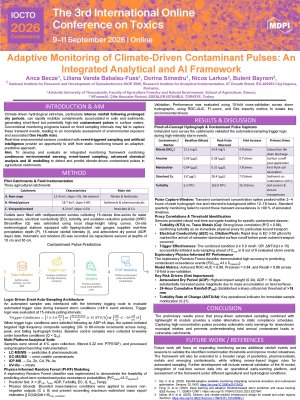
Climate-driven hydrological extremes, such as high-intensity precipitation following drought, rapidly mobilize contaminants from soils and sediments into aquatic ecosystems. These transient "contaminant pulses" frequently escape detection by conventional quarterly monitoring but pose acute risks to ecosystem integrity and human health. Under the One Health framework, capturing these episodic events is critical for accurate risk assessment. This study proposes an adaptive monitoring framework that integrates real-time environmental sensing with event-triggered sampling and artificial intelligence (AI). Continuous sensor data, including conductivity, turbidity, oxidation-reduction potential (ORP), water temperature, and rainfall intensity, serve as proxies to trigger high-resolution analytical characterization using LC-MS/MS, GC-MS/MS, and ICP-MS. The workflow targets diverse contaminants, including pesticides, pharmaceuticals, heavy metals, and antibiotic resistance markers. Preliminary results were obtained from pilot monitoring campaigns conducted at three agricultural catchments with contrasting land-use characteristics. These observations indicate that post-rainfall runoff events can increase pesticide and nutrient concentrations by 3-10 times baseline levels. Nitrate concentrations frequently exceeded 40-60 mg/L, while significant metal mobilization was observed during first-flush events following prolonged dry periods. To manage the resulting high-frequency dataset, a physics-informed Random Forest model was developed to identify contamination patterns and predict short-term exceedance probabilities. Key predictors included cumulative rainfall, rainfall intensity, antecedent dry period duration, turbidity, conductivity, streamflow, and soil moisture. Initial model outputs suggest that rainfall events exceeding 15 mm within 24 hours represent a critical threshold associated with elevated contamination risk. By transitioning from static compliance monitoring to a predictive, climate-responsive framework, this approach enhances early-warning systems for vulnerable catchments. The integration of advanced analytics, real-time sensing, and AI provides the high-resolution data necessary to protect the interconnected health of aquatic ecosystems, wildlife, and human populations in an era of increasing climatic instability.
Keywords
One Health
emerging contaminants
surface water monitoring
contaminant pulses
adaptive sampling
climate change
exposome
environmental toxicology
AI modelling
event-based monitoring
LC-MS/MS
environmental risk assessment
Poster
Becze.pdf
Improved Prediction of Chemical Carcinogenicity Based on Hybrid In Silico/In Vitro Methodology
Environmental Monitoring of Perfluoro octane Sulfonate and Perfluorooctanoic Acid in Khanpur Stream, Pakistan: Implications for Human and Ecosystem Health