Event submissions
Published
This submission belongs to the session 1. Exposure Routes / Exposome of Emerging Contaminants and Materials in the Environment of the event The 3rd International Online Conference on Toxics
Published date
04 Sep, 2026
Academic Editor
'%3e%3cpath%20d='M12.6657%2010.9104C12.4185%2010.325%2012.0599%209.79327%2011.6097%209.34482C11.1609%208.89508%2010.6293%208.5365%2010.0442%208.28888C10.0389%208.28626%2010.0337%208.28495%2010.0285%208.28233C10.8446%207.69279%2011.3752%206.73249%2011.3752%205.64904C11.3752%203.8542%209.92103%202.39999%208.1262%202.39999C6.33136%202.39999%204.87715%203.8542%204.87715%205.64904C4.87715%206.73249%205.40774%207.69279%206.22393%208.28364C6.21869%208.28626%206.21345%208.28757%206.20821%208.29019C5.62129%208.5378%205.09463%208.89284%204.64265%209.34613C4.1929%209.79493%203.83432%2010.3266%203.58671%2010.9117C3.34345%2011.4845%203.21226%2012.0987%203.20023%2012.7209C3.19988%2012.7349%203.20233%2012.7488%203.20744%2012.7619C3.21255%2012.7749%203.22022%2012.7867%203.22998%2012.7968C3.23975%2012.8068%203.25142%2012.8147%203.26431%2012.8202C3.2772%2012.8256%203.29105%2012.8284%203.30504%2012.8284H4.09109C4.14874%2012.8284%204.19459%2012.7825%204.1959%2012.7262C4.2221%2011.7148%204.62823%2010.7676%205.34617%2010.0497C6.08899%209.30683%207.0755%208.89808%208.1262%208.89808C9.17689%208.89808%2010.1634%209.30683%2010.9062%2010.0497C11.6242%2010.7676%2012.0303%2011.7148%2012.0565%2012.7262C12.0578%2012.7838%2012.1037%2012.8284%2012.1613%2012.8284H12.9474C12.9613%2012.8284%2012.9752%2012.8256%2012.9881%2012.8202C13.001%2012.8147%2013.0126%2012.8068%2013.0224%2012.7968C13.0322%2012.7867%2013.0398%2012.7749%2013.0449%2012.7619C13.0501%2012.7488%2013.0525%2012.7349%2013.0522%2012.7209C13.0391%2012.0947%2012.9094%2011.4855%2012.6657%2010.9104ZM8.1262%207.9024C7.52486%207.9024%206.9589%207.6679%206.53312%207.24211C6.10733%206.81633%205.87283%206.25037%205.87283%205.64904C5.87283%205.0477%206.10733%204.48174%206.53312%204.05596C6.9589%203.63018%207.52486%203.39567%208.1262%203.39567C8.72753%203.39567%209.29349%203.63018%209.71927%204.05596C10.1451%204.48174%2010.3796%205.0477%2010.3796%205.64904C10.3796%206.25037%2010.1451%206.81633%209.71927%207.24211C9.29349%207.6679%208.72753%207.9024%208.1262%207.9024Z'%20fill='%235D1EE1'/%3e%3c/g%3e%3c/svg%3e) Natalia Garcia-Reyero
Natalia Garcia-ReyeroCitation
Emilia Neag, Rodolfo Llanos-Lizcano, Simion Bogdan Angyus, Zamfira Stupar, Cecilia Roman, Removal of ammonium from aqueous solutions using low-cost adsorbents, in Proceedings of The 3rd International Online Conference on Toxics, 9 September–11 September 2026, MDPI: Basel, Switzerland
Share
Email
Facebook
Twitter
LinkedIn
Removal of ammonium from aqueous solutions using low-cost adsorbents
'%3e%3cpath%20d='M12.6647%2010.9104C12.4176%2010.325%2012.0589%209.7933%2011.6088%209.34485C11.16%208.89511%2010.6283%208.53653%2010.0432%208.28891C10.038%208.28629%2010.0327%208.28498%2010.0275%208.28236C10.8437%207.69282%2011.3743%206.73252%2011.3743%205.64907C11.3743%203.85423%209.92005%202.40002%208.12522%202.40002C6.33038%202.40002%204.87618%203.85423%204.87618%205.64907C4.87618%206.73252%205.40677%207.69282%206.22296%208.28367C6.21772%208.28629%206.21248%208.2876%206.20724%208.29022C5.62031%208.53783%205.09365%208.89287%204.64167%209.34616C4.19192%209.79496%203.83334%2010.3266%203.58573%2010.9117C3.34247%2011.4846%203.21128%2012.0987%203.19925%2012.721C3.1989%2012.735%203.20135%2012.7489%203.20646%2012.7619C3.21157%2012.7749%203.21924%2012.7868%203.22901%2012.7968C3.23877%2012.8068%203.25045%2012.8148%203.26334%2012.8202C3.27623%2012.8256%203.29007%2012.8284%203.30406%2012.8284H4.09012C4.14776%2012.8284%204.19362%2012.7825%204.19493%2012.7262C4.22113%2011.7148%204.62726%2010.7676%205.34519%2010.0497C6.08802%209.30686%207.07452%208.89811%208.12522%208.89811C9.17592%208.89811%2010.1624%209.30686%2010.9052%2010.0497C11.6232%2010.7676%2012.0293%2011.7148%2012.0555%2012.7262C12.0568%2012.7839%2012.1027%2012.8284%2012.1603%2012.8284H12.9464C12.9604%2012.8284%2012.9742%2012.8256%2012.9871%2012.8202C13%2012.8148%2013.0117%2012.8068%2013.0214%2012.7968C13.0312%2012.7868%2013.0389%2012.7749%2013.044%2012.7619C13.0491%2012.7489%2013.0515%2012.735%2013.0512%2012.721C13.0381%2012.0947%2012.9084%2011.4856%2012.6647%2010.9104ZM8.12522%207.90243C7.52388%207.90243%206.95792%207.66793%206.53214%207.24215C6.10636%206.81636%205.87185%206.2504%205.87185%205.64907C5.87185%205.04773%206.10636%204.48177%206.53214%204.05599C6.95792%203.63021%207.52388%203.3957%208.12522%203.3957C8.72655%203.3957%209.29252%203.63021%209.7183%204.05599C10.1441%204.48177%2010.3786%205.04773%2010.3786%205.64907C10.3786%206.2504%2010.1441%206.81636%209.7183%207.24215C9.29252%207.66793%208.72655%207.90243%208.12522%207.90243Z'%20fill='%235D1EE1'/%3e%3c/g%3e%3c/svg%3e)
Emilia Neag 1
Rodolfo Llanos-Lizcano 1
Simion Bogdan Angyus 1
Zamfira Stupar 1
Cecilia Roman 1
1. INCDO-INOE 2000, Research Institute for Analytical Instrumentation, ICIA, Cluj-Napoca
Abstract
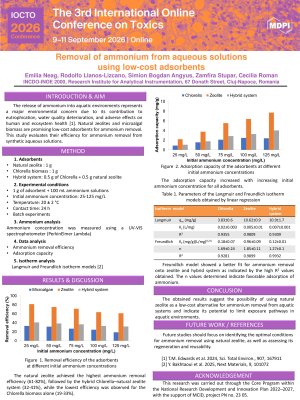
The excessive release of ammonium into aquatic environments represents a major environmental concern because of its contribution to eutrophication, water quality deterioration, and adverse effects on human and ecosystem health [1]. Natural adsorbents, such as zeolites and microalgae biomass, represent a promising alternative for ammonium removal from aquatic systems. This study aimed to comparatively evaluate the ammonium removal efficiency from synthetic aqueous solutions using low-cost adsorbents.
The experiments were performed under batch conditions, contacting 1 g of adsorbent with 100 mL ammonium solutions at initial concentrations of 25-125 mg/L at room temperature for 24 h. Single adsorbent systems contained 1 g of dried Chlorella biomass or natural zeolite, while the hybrid microalgae-zeolite system consisted of 0.5 g of Chlorella biomass and 0.5 g of natural zeolite. The ammonium concentrations, before and after treatment, were determined using a PerkinElmer Lambda ultraviolet-visible spectrophotometer. The adsorption capacity and removal efficiency were calculated. Equilibrium data were further analyzed using the Langmuir and Freundlich isotherm models through linear regression analysis.
In the studied range of concentration, the highest ammonium removal efficiency was achieved by natural zeolite (61-81%), followed by the hybrid Chlorella–natural zeolite system (32-41%), while the lowest efficiency was observed for the Chlorella biomass alone (19-33%). The isotherms parameters indicated favorable adsorption of ammonium onto natural zeolite, suggesting its suitability for ammonium removal.
The obtained results suggest the possibility of using natural zeolite as a low-cost alternative for ammonium removal from aquatic systems and indicate its potential to limit exposure pathways in aquatic environments.
Acknowledgement. This research was carried out through the Core Program within the National Research Development and Innovation Plan 2022–2027, with the support of MCID, project PN no. 23 05.
References
[1] T.M. Edwards et al. 2024, Sci. Total Environ. 907 167911
Keywords
zeolite
ammonium
microalgae
Poster
poster_Sciforum-193412.pdf
Environmental Monitoring of Perfluoro octane Sulfonate and Perfluorooctanoic Acid in Khanpur Stream, Pakistan: Implications for Human and Ecosystem Health
Ecological Risk Assessment of Soils Near Abandoned Pb–Zn Mines in Nigeria