Event submissions
Published
This submission belongs to the session 1. Exposure Routes / Exposome of Emerging Contaminants and Materials in the Environment of the event The 3rd International Online Conference on Toxics
Published date
04 Sep, 2026
Academic Editor
'%3e%3cpath%20d='M12.6657%2010.9104C12.4185%2010.325%2012.0599%209.79327%2011.6097%209.34482C11.1609%208.89508%2010.6293%208.5365%2010.0442%208.28888C10.0389%208.28626%2010.0337%208.28495%2010.0285%208.28233C10.8446%207.69279%2011.3752%206.73249%2011.3752%205.64904C11.3752%203.8542%209.92103%202.39999%208.1262%202.39999C6.33136%202.39999%204.87715%203.8542%204.87715%205.64904C4.87715%206.73249%205.40774%207.69279%206.22393%208.28364C6.21869%208.28626%206.21345%208.28757%206.20821%208.29019C5.62129%208.5378%205.09463%208.89284%204.64265%209.34613C4.1929%209.79493%203.83432%2010.3266%203.58671%2010.9117C3.34345%2011.4845%203.21226%2012.0987%203.20023%2012.7209C3.19988%2012.7349%203.20233%2012.7488%203.20744%2012.7619C3.21255%2012.7749%203.22022%2012.7867%203.22998%2012.7968C3.23975%2012.8068%203.25142%2012.8147%203.26431%2012.8202C3.2772%2012.8256%203.29105%2012.8284%203.30504%2012.8284H4.09109C4.14874%2012.8284%204.19459%2012.7825%204.1959%2012.7262C4.2221%2011.7148%204.62823%2010.7676%205.34617%2010.0497C6.08899%209.30683%207.0755%208.89808%208.1262%208.89808C9.17689%208.89808%2010.1634%209.30683%2010.9062%2010.0497C11.6242%2010.7676%2012.0303%2011.7148%2012.0565%2012.7262C12.0578%2012.7838%2012.1037%2012.8284%2012.1613%2012.8284H12.9474C12.9613%2012.8284%2012.9752%2012.8256%2012.9881%2012.8202C13.001%2012.8147%2013.0126%2012.8068%2013.0224%2012.7968C13.0322%2012.7867%2013.0398%2012.7749%2013.0449%2012.7619C13.0501%2012.7488%2013.0525%2012.7349%2013.0522%2012.7209C13.0391%2012.0947%2012.9094%2011.4855%2012.6657%2010.9104ZM8.1262%207.9024C7.52486%207.9024%206.9589%207.6679%206.53312%207.24211C6.10733%206.81633%205.87283%206.25037%205.87283%205.64904C5.87283%205.0477%206.10733%204.48174%206.53312%204.05596C6.9589%203.63018%207.52486%203.39567%208.1262%203.39567C8.72753%203.39567%209.29349%203.63018%209.71927%204.05596C10.1451%204.48174%2010.3796%205.0477%2010.3796%205.64904C10.3796%206.25037%2010.1451%206.81633%209.71927%207.24211C9.29349%207.6679%208.72753%207.9024%208.1262%207.9024Z'%20fill='%235D1EE1'/%3e%3c/g%3e%3c/svg%3e) Natalia Garcia-Reyero
Natalia Garcia-ReyeroCitation
Marin Senila, DEVELOPMENT OF A PASSIVE SAMPLER BASED ON POLYMER INCLUSION MEMBRANE FOR UPTAKE OF CU(II) IN WASTEWATER, in Proceedings of The 3rd International Online Conference on Toxics, 9 September–11 September 2026, MDPI: Basel, Switzerland
Share
Email
Facebook
Twitter
LinkedIn
DEVELOPMENT OF A PASSIVE SAMPLER BASED ON POLYMER INCLUSION MEMBRANE FOR UPTAKE OF CU(II) IN WASTEWATER

Marin Senila 1
1. INCDO INOE 2000, Research Institute for Analytical Instrumentation, 67 Donath St., 400293 Cluj-Napoca
Abstract
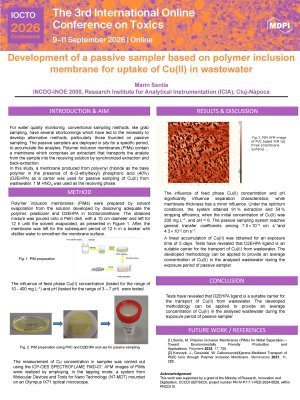
For water quality monitoring, conventional sampling methods, like grab sampling, have several shortcomings which have led to the necessity to develop alternative methods, particularly those founded on passive sampling. The passive samplers are deployed in situ for a specific period, to accumulate the analytes. Polymer inclusion membranes (PIMs) contain a membrane which comprises an extractant that transports the analyte from the sample into the receiving solution by synchronized extraction and back-extraction. In this study, a membrane produced from polyvinyl chloride as the base polymer in the presence of di-(2-ethylhexyl) phosphoric acid (40%) (D2EHPA) as a carrier was used for passive sampling of Cu(II) from wastewater. 1 M HNO3 was used as the receiving phase. The influence of feed phase Cu(II) concentration (tested for the range of 10 - 400 mg L−1) and pH (tested for the range of 3 – 7 pH) and significantly influence separation characteristics, while membrane thickness has a minor influence. Under the optimum conditions, the system attained 91 % extraction and 54 % stripping efficiency, when the initial concentration of Cu(II) was 200 mg L−1, and pH = 6. The passive sampling system reaches general transfer coefficients among 7.5 × 10⁻³ cm s−1and 4.3 × 10⁻² cm s−1. A linear accumulation of Cu(II) was obtained for an exposure time of 5 days. Tests have revealed that D2EHPA ligand is an suitable carrier for the transport of Cu(II) from wastewater. The developed methodology can be applied to provide an average concentration of Cu(II) in the analysed wastewater during the exposure period of passive sampler.
Keywords
Copper
heavy metals
passive sampling
polymer inclusion membrane
wastewater
Poster
SenilaM_poster.pdf
Ecological Risk Assessment of Soils Near Abandoned Pb–Zn Mines in Nigeria
Multispecies Physiological Disruption by Metabolic Contaminants and Sweeteners: Implications for Aquatic Ecosystem Functioning