Event submissions
Published
This submission belongs to the session 1. Exposure Routes / Exposome of Emerging Contaminants and Materials in the Environment of the event The 3rd International Online Conference on Toxics
Published date
04 Sep, 2026
Academic Editor
'%3e%3cpath%20d='M12.6657%2010.9104C12.4185%2010.325%2012.0599%209.79327%2011.6097%209.34482C11.1609%208.89508%2010.6293%208.5365%2010.0442%208.28888C10.0389%208.28626%2010.0337%208.28495%2010.0285%208.28233C10.8446%207.69279%2011.3752%206.73249%2011.3752%205.64904C11.3752%203.8542%209.92103%202.39999%208.1262%202.39999C6.33136%202.39999%204.87715%203.8542%204.87715%205.64904C4.87715%206.73249%205.40774%207.69279%206.22393%208.28364C6.21869%208.28626%206.21345%208.28757%206.20821%208.29019C5.62129%208.5378%205.09463%208.89284%204.64265%209.34613C4.1929%209.79493%203.83432%2010.3266%203.58671%2010.9117C3.34345%2011.4845%203.21226%2012.0987%203.20023%2012.7209C3.19988%2012.7349%203.20233%2012.7488%203.20744%2012.7619C3.21255%2012.7749%203.22022%2012.7867%203.22998%2012.7968C3.23975%2012.8068%203.25142%2012.8147%203.26431%2012.8202C3.2772%2012.8256%203.29105%2012.8284%203.30504%2012.8284H4.09109C4.14874%2012.8284%204.19459%2012.7825%204.1959%2012.7262C4.2221%2011.7148%204.62823%2010.7676%205.34617%2010.0497C6.08899%209.30683%207.0755%208.89808%208.1262%208.89808C9.17689%208.89808%2010.1634%209.30683%2010.9062%2010.0497C11.6242%2010.7676%2012.0303%2011.7148%2012.0565%2012.7262C12.0578%2012.7838%2012.1037%2012.8284%2012.1613%2012.8284H12.9474C12.9613%2012.8284%2012.9752%2012.8256%2012.9881%2012.8202C13.001%2012.8147%2013.0126%2012.8068%2013.0224%2012.7968C13.0322%2012.7867%2013.0398%2012.7749%2013.0449%2012.7619C13.0501%2012.7488%2013.0525%2012.7349%2013.0522%2012.7209C13.0391%2012.0947%2012.9094%2011.4855%2012.6657%2010.9104ZM8.1262%207.9024C7.52486%207.9024%206.9589%207.6679%206.53312%207.24211C6.10733%206.81633%205.87283%206.25037%205.87283%205.64904C5.87283%205.0477%206.10733%204.48174%206.53312%204.05596C6.9589%203.63018%207.52486%203.39567%208.1262%203.39567C8.72753%203.39567%209.29349%203.63018%209.71927%204.05596C10.1451%204.48174%2010.3796%205.0477%2010.3796%205.64904C10.3796%206.25037%2010.1451%206.81633%209.71927%207.24211C9.29349%207.6679%208.72753%207.9024%208.1262%207.9024Z'%20fill='%235D1EE1'/%3e%3c/g%3e%3c/svg%3e) Carlos Barata
Carlos BarataCitation
Ramona Zgavarogea, Nadia Paun, Violeta Niculescu, Ana Nature, Diana Ionela Popescu (Stegarus), Trace Element Bioaccumulation in Meat and Bone Samples: Environmental Exposure, Nutritional Relevance and Food Chain Transfer, in Proceedings of The 3rd International Online Conference on Toxics, 9 September–11 September 2026, MDPI: Basel, Switzerland
Share
Email
Facebook
Twitter
LinkedIn
Trace Element Bioaccumulation in Meat and Bone Samples: Environmental Exposure, Nutritional Relevance and Food Chain Transfer

Ramona Zgavarogea 1
'%3e%3cpath%20d='M12.6647%2010.9104C12.4176%2010.325%2012.0589%209.7933%2011.6088%209.34485C11.16%208.89511%2010.6283%208.53653%2010.0432%208.28891C10.038%208.28629%2010.0327%208.28498%2010.0275%208.28236C10.8437%207.69282%2011.3743%206.73252%2011.3743%205.64907C11.3743%203.85423%209.92005%202.40002%208.12522%202.40002C6.33038%202.40002%204.87618%203.85423%204.87618%205.64907C4.87618%206.73252%205.40677%207.69282%206.22296%208.28367C6.21772%208.28629%206.21248%208.2876%206.20724%208.29022C5.62031%208.53783%205.09365%208.89287%204.64167%209.34616C4.19192%209.79496%203.83334%2010.3266%203.58573%2010.9117C3.34247%2011.4846%203.21128%2012.0987%203.19925%2012.721C3.1989%2012.735%203.20135%2012.7489%203.20646%2012.7619C3.21157%2012.7749%203.21924%2012.7868%203.22901%2012.7968C3.23877%2012.8068%203.25045%2012.8148%203.26334%2012.8202C3.27623%2012.8256%203.29007%2012.8284%203.30406%2012.8284H4.09012C4.14776%2012.8284%204.19362%2012.7825%204.19493%2012.7262C4.22113%2011.7148%204.62726%2010.7676%205.34519%2010.0497C6.08802%209.30686%207.07452%208.89811%208.12522%208.89811C9.17592%208.89811%2010.1624%209.30686%2010.9052%2010.0497C11.6232%2010.7676%2012.0293%2011.7148%2012.0555%2012.7262C12.0568%2012.7839%2012.1027%2012.8284%2012.1603%2012.8284H12.9464C12.9604%2012.8284%2012.9742%2012.8256%2012.9871%2012.8202C13%2012.8148%2013.0117%2012.8068%2013.0214%2012.7968C13.0312%2012.7868%2013.0389%2012.7749%2013.044%2012.7619C13.0491%2012.7489%2013.0515%2012.735%2013.0512%2012.721C13.0381%2012.0947%2012.9084%2011.4856%2012.6647%2010.9104ZM8.12522%207.90243C7.52388%207.90243%206.95792%207.66793%206.53214%207.24215C6.10636%206.81636%205.87185%206.2504%205.87185%205.64907C5.87185%205.04773%206.10636%204.48177%206.53214%204.05599C6.95792%203.63021%207.52388%203.3957%208.12522%203.3957C8.72655%203.3957%209.29252%203.63021%209.7183%204.05599C10.1441%204.48177%2010.3786%205.04773%2010.3786%205.64907C10.3786%206.2504%2010.1441%206.81636%209.7183%207.24215C9.29252%207.66793%208.72655%207.90243%208.12522%207.90243Z'%20fill='%235D1EE1'/%3e%3c/g%3e%3c/svg%3e)
Nadia Paun 1

Violeta Niculescu 1
Ana Nature 1
Diana Ionela Popescu (Stegarus) 1
1. National Research and Development Institute for Cryogenic and Isotopic Technologies—ICSI Ramnicu Vâlcea, 4th Uzinei Street, P.O. Box Raureni 7, 240050 Ramnicu Valcea, Romania
Abstract
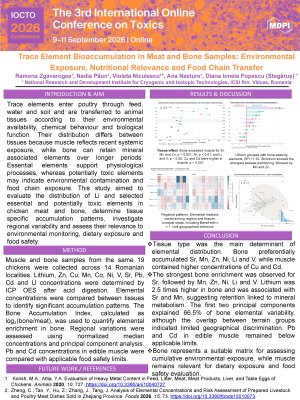
Trace elements present in the environment are transferred through the food chain and may accumulate in animal tissues depending on their biological role, chemical behaviour, and environmental availability. This study investigated the distribution and bioaccumulation of lithium (Li) together with essential and potentially toxic elements (Zn, Cu, Mn, Co, Ni, V, Sr, Pb, Cd, and U) in meat and bone samples collected from different geographical regions of Romania. The research focused on the relationship between environmental exposure, tissue-specific accumulation, and the potential contribution of animal-derived foods to dietary trace element intake. The results demonstrated a distinct tissue-dependent distribution pattern for most analyzed elements. Bone samples exhibited significantly higher concentrations of lithium, strontium, manganese, zinc, and other mineral-associated elements compared to muscle tissue, indicating preferential accumulation within mineralized structures. Lithium concentrations in bone were substantially higher than in meat, suggesting long-term retention and possible incorporation into the hydroxyapatite matrix through ionic substitution mechanisms. Positive associations observed between lithium, strontium, and manganese in bone samples suggest common pathways related to mineral metabolism and skeletal incorporation. In contrast, meat samples showed relatively low and homogeneous lithium concentrations, reflecting systemic exposure and recent dietary intake rather than structural accumulation. Potentially toxic elements, including Pb and Cd, were detected at concentrations below maximum permissible limits, indicating low contamination levels and absence of significant food safety risks. Regional differences in elemental composition highlighted the influence of local geochemical conditions on trace-element transfer through the food chain and tissue bioaccumulation. The findings demonstrate that animal-derived foods contribute to dietary lithium intake and provide valuable information regarding environmental exposure pathways and trace-element accumulation in biological systems.
Keywords
bioaccumulation
environmental exposure
food chain transfer
animal-derived foods
Poster
IOCTO2026_Zgavarogea_Ramona.pdf
Multispecies Physiological Disruption by Metabolic Contaminants and Sweeteners: Implications for Aquatic Ecosystem Functioning
µSPEED microextraction of veterinary antibiotics in environmental water samples by UPLC