Event submissions
Published
This submission belongs to the session 1. Exposure Routes / Exposome of Emerging Contaminants and Materials in the Environment of the event The 3rd International Online Conference on Toxics
Published date
04 Sep, 2026
Academic Editor
'%3e%3cpath%20d='M12.6657%2010.9104C12.4185%2010.325%2012.0599%209.79327%2011.6097%209.34482C11.1609%208.89508%2010.6293%208.5365%2010.0442%208.28888C10.0389%208.28626%2010.0337%208.28495%2010.0285%208.28233C10.8446%207.69279%2011.3752%206.73249%2011.3752%205.64904C11.3752%203.8542%209.92103%202.39999%208.1262%202.39999C6.33136%202.39999%204.87715%203.8542%204.87715%205.64904C4.87715%206.73249%205.40774%207.69279%206.22393%208.28364C6.21869%208.28626%206.21345%208.28757%206.20821%208.29019C5.62129%208.5378%205.09463%208.89284%204.64265%209.34613C4.1929%209.79493%203.83432%2010.3266%203.58671%2010.9117C3.34345%2011.4845%203.21226%2012.0987%203.20023%2012.7209C3.19988%2012.7349%203.20233%2012.7488%203.20744%2012.7619C3.21255%2012.7749%203.22022%2012.7867%203.22998%2012.7968C3.23975%2012.8068%203.25142%2012.8147%203.26431%2012.8202C3.2772%2012.8256%203.29105%2012.8284%203.30504%2012.8284H4.09109C4.14874%2012.8284%204.19459%2012.7825%204.1959%2012.7262C4.2221%2011.7148%204.62823%2010.7676%205.34617%2010.0497C6.08899%209.30683%207.0755%208.89808%208.1262%208.89808C9.17689%208.89808%2010.1634%209.30683%2010.9062%2010.0497C11.6242%2010.7676%2012.0303%2011.7148%2012.0565%2012.7262C12.0578%2012.7838%2012.1037%2012.8284%2012.1613%2012.8284H12.9474C12.9613%2012.8284%2012.9752%2012.8256%2012.9881%2012.8202C13.001%2012.8147%2013.0126%2012.8068%2013.0224%2012.7968C13.0322%2012.7867%2013.0398%2012.7749%2013.0449%2012.7619C13.0501%2012.7488%2013.0525%2012.7349%2013.0522%2012.7209C13.0391%2012.0947%2012.9094%2011.4855%2012.6657%2010.9104ZM8.1262%207.9024C7.52486%207.9024%206.9589%207.6679%206.53312%207.24211C6.10733%206.81633%205.87283%206.25037%205.87283%205.64904C5.87283%205.0477%206.10733%204.48174%206.53312%204.05596C6.9589%203.63018%207.52486%203.39567%208.1262%203.39567C8.72753%203.39567%209.29349%203.63018%209.71927%204.05596C10.1451%204.48174%2010.3796%205.0477%2010.3796%205.64904C10.3796%206.25037%2010.1451%206.81633%209.71927%207.24211C9.29349%207.6679%208.72753%207.9024%208.1262%207.9024Z'%20fill='%235D1EE1'/%3e%3c/g%3e%3c/svg%3e) Natalia Garcia-Reyero
Natalia Garcia-ReyeroCitation
Joanna Antos, Laura García-Cansino, María Ángeles García, Dobrochna Ginter-Kramarczyk, María Luisa Marina, Joanna Zembrzuska, José S. Câmara, Jorge A. M. Pereira, µSPEED microextraction of veterinary antibiotics in environmental water samples by UPLC, in Proceedings of The 3rd International Online Conference on Toxics, 9 September–11 September 2026, MDPI: Basel, Switzerland
Share
Email
Facebook
Twitter
LinkedIn
µSPEED microextraction of veterinary antibiotics in environmental water samples by UPLC
'%3e%3cpath%20d='M12.6647%2010.9104C12.4176%2010.325%2012.0589%209.7933%2011.6088%209.34485C11.16%208.89511%2010.6283%208.53653%2010.0432%208.28891C10.038%208.28629%2010.0327%208.28498%2010.0275%208.28236C10.8437%207.69282%2011.3743%206.73252%2011.3743%205.64907C11.3743%203.85423%209.92005%202.40002%208.12522%202.40002C6.33038%202.40002%204.87618%203.85423%204.87618%205.64907C4.87618%206.73252%205.40677%207.69282%206.22296%208.28367C6.21772%208.28629%206.21248%208.2876%206.20724%208.29022C5.62031%208.53783%205.09365%208.89287%204.64167%209.34616C4.19192%209.79496%203.83334%2010.3266%203.58573%2010.9117C3.34247%2011.4846%203.21128%2012.0987%203.19925%2012.721C3.1989%2012.735%203.20135%2012.7489%203.20646%2012.7619C3.21157%2012.7749%203.21924%2012.7868%203.22901%2012.7968C3.23877%2012.8068%203.25045%2012.8148%203.26334%2012.8202C3.27623%2012.8256%203.29007%2012.8284%203.30406%2012.8284H4.09012C4.14776%2012.8284%204.19362%2012.7825%204.19493%2012.7262C4.22113%2011.7148%204.62726%2010.7676%205.34519%2010.0497C6.08802%209.30686%207.07452%208.89811%208.12522%208.89811C9.17592%208.89811%2010.1624%209.30686%2010.9052%2010.0497C11.6232%2010.7676%2012.0293%2011.7148%2012.0555%2012.7262C12.0568%2012.7839%2012.1027%2012.8284%2012.1603%2012.8284H12.9464C12.9604%2012.8284%2012.9742%2012.8256%2012.9871%2012.8202C13%2012.8148%2013.0117%2012.8068%2013.0214%2012.7968C13.0312%2012.7868%2013.0389%2012.7749%2013.044%2012.7619C13.0491%2012.7489%2013.0515%2012.735%2013.0512%2012.721C13.0381%2012.0947%2012.9084%2011.4856%2012.6647%2010.9104ZM8.12522%207.90243C7.52388%207.90243%206.95792%207.66793%206.53214%207.24215C6.10636%206.81636%205.87185%206.2504%205.87185%205.64907C5.87185%205.04773%206.10636%204.48177%206.53214%204.05599C6.95792%203.63021%207.52388%203.3957%208.12522%203.3957C8.72655%203.3957%209.29252%203.63021%209.7183%204.05599C10.1441%204.48177%2010.3786%205.04773%2010.3786%205.64907C10.3786%206.2504%2010.1441%206.81636%209.7183%207.24215C9.29252%207.66793%208.72655%207.90243%208.12522%207.90243Z'%20fill='%235D1EE1'/%3e%3c/g%3e%3c/svg%3e)
Joanna Antos 1,2
Laura García-Cansino 2,3
María Ángeles García 3,4
Dobrochna Ginter-Kramarczyk 1
María Luisa Marina 3,5

Joanna Zembrzuska 6
José S. Câmara 7,8

Jorge A. M. Pereira 7
1. Department of Water Supply and Bioeconomy, Faculty of Environmental Engineering and Energy, Poznan University of Technology, Berdychowo 4, 60-965 Poznan
2. CQM – Centro de Química da Madeira, Universidade da Madeira, Campus da Penteada, 9020-105 Funchal, Portugal
3. Universidad de Alcalá, Departamento de Química Analítica, Química Física e Ingeniería Química, Ctra. Madrid-Barcelona Km. 33.600, 28871, Alcalá de Henares, Madrid
4. Universidad de Alcalá, Instituto de Investigación Química Andrés M. del Río, Ctra. Madrid-Barcelona Km. 33.600, 28871, Alcalá de Henares, Madrid
5. Universidad de Alcalá, Instituto de Investigación Química Andrés M. del Río, Ctra. Madrid-Barcelona Km. 33.600, 28871, Alcalá de Henares, Madrid, Spain
6. Faculty of Chemical Technology Institute of Chemistry and Technical Electrochemistry, Berdychowo 4, 60-965 Poznan
7. CQM – Centro de Química da Madeira, Universidade da Madeira, Campus da Penteada, 9020-105 Funchal
8. Faculdade de Ciências Exatas e Engenharia da Universidade da Madeira, Campus Universitário da Penteada, 9000-390, Funchal, Portugal
Abstract
The pharmaceutical industry is one of the fastest-growing sectors. Antibiotics are widely used in human and veterinary medicine. A significant fraction of administered antibiotics is excreted unchanged and enters the environment via manure application, wastewater discharge, and improper disposal. Their presence in aquatic systems is of increasing concern due to ecological risks and the development of antimicrobial resistance. Therefore, there is a strong need for rapid, sensitive, and environmentally friendly analytical methods for their determination in environmental waters [1-4].
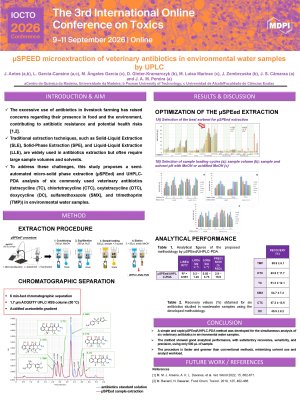
A miniaturized and semi-automated solid-phase microextraction procedure based on µSPEed technology was developed and coupled with ultraperformance liquid chromatography (UPLC) with UV detection. Six veterinary antibiotics were selected for analysis: tetracycline, chlortetracycline, oxytetracycline, doxycycline, sulfamethoxazole, and trimethoprim. The extraction procedure used a PS/DVB-RP sorbent cartridge. The cartridge was conditioned with 250 µL of MeOH, equilibrated with 250 µL of H₂O, and then 500 µL of the sample was loaded three times. The elution step was performed in two cycles using 50 µL of acidified MeOH. The total extraction time was 6 minutes per sample.
The developed method showed excellent chromatographic performance. Good linearity was obtained for all analytes (R² > 0.99). Limits of detection ranged from 0.30 to 1.23 µg/L, while limits of quantification were between 0.92 and 3.73 µg/L. Recoveries ranged from 46% to 86%. The method was successfully applied to environmental water samples collected from Madeira Island, where no target antibiotics were detected.
The proposed method enables fast, efficient, and environmentally friendly determination of veterinary antibiotics in water samples. The approach significantly reduces solvent consumption and sample volume while maintaining good analytical performance. The semi-automated format improves reproducibility and reduces analyst workload, making it a suitable tool for routine environmental monitoring.
Keywords
antibiotics
water environment
UPLC
pharmaceuticals
Poster
poster conference Antos.pdf
Trace Element Bioaccumulation in Meat and Bone Samples: Environmental Exposure, Nutritional Relevance and Food Chain Transfer
Bioaccessibility of Metals and Metalloids in Microplastics: In Vitro Digestive Simulation Under Fed Conditions