Event submissions
Published
This submission belongs to the session 1. Exposure Routes / Exposome of Emerging Contaminants and Materials in the Environment of the event The 3rd International Online Conference on Toxics
Published date
04 Sep, 2026
Academic Editor
'%3e%3cpath%20d='M12.6657%2010.9104C12.4185%2010.325%2012.0599%209.79327%2011.6097%209.34482C11.1609%208.89508%2010.6293%208.5365%2010.0442%208.28888C10.0389%208.28626%2010.0337%208.28495%2010.0285%208.28233C10.8446%207.69279%2011.3752%206.73249%2011.3752%205.64904C11.3752%203.8542%209.92103%202.39999%208.1262%202.39999C6.33136%202.39999%204.87715%203.8542%204.87715%205.64904C4.87715%206.73249%205.40774%207.69279%206.22393%208.28364C6.21869%208.28626%206.21345%208.28757%206.20821%208.29019C5.62129%208.5378%205.09463%208.89284%204.64265%209.34613C4.1929%209.79493%203.83432%2010.3266%203.58671%2010.9117C3.34345%2011.4845%203.21226%2012.0987%203.20023%2012.7209C3.19988%2012.7349%203.20233%2012.7488%203.20744%2012.7619C3.21255%2012.7749%203.22022%2012.7867%203.22998%2012.7968C3.23975%2012.8068%203.25142%2012.8147%203.26431%2012.8202C3.2772%2012.8256%203.29105%2012.8284%203.30504%2012.8284H4.09109C4.14874%2012.8284%204.19459%2012.7825%204.1959%2012.7262C4.2221%2011.7148%204.62823%2010.7676%205.34617%2010.0497C6.08899%209.30683%207.0755%208.89808%208.1262%208.89808C9.17689%208.89808%2010.1634%209.30683%2010.9062%2010.0497C11.6242%2010.7676%2012.0303%2011.7148%2012.0565%2012.7262C12.0578%2012.7838%2012.1037%2012.8284%2012.1613%2012.8284H12.9474C12.9613%2012.8284%2012.9752%2012.8256%2012.9881%2012.8202C13.001%2012.8147%2013.0126%2012.8068%2013.0224%2012.7968C13.0322%2012.7867%2013.0398%2012.7749%2013.0449%2012.7619C13.0501%2012.7488%2013.0525%2012.7349%2013.0522%2012.7209C13.0391%2012.0947%2012.9094%2011.4855%2012.6657%2010.9104ZM8.1262%207.9024C7.52486%207.9024%206.9589%207.6679%206.53312%207.24211C6.10733%206.81633%205.87283%206.25037%205.87283%205.64904C5.87283%205.0477%206.10733%204.48174%206.53312%204.05596C6.9589%203.63018%207.52486%203.39567%208.1262%203.39567C8.72753%203.39567%209.29349%203.63018%209.71927%204.05596C10.1451%204.48174%2010.3796%205.0477%2010.3796%205.64904C10.3796%206.25037%2010.1451%206.81633%209.71927%207.24211C9.29349%207.6679%208.72753%207.9024%208.1262%207.9024Z'%20fill='%235D1EE1'/%3e%3c/g%3e%3c/svg%3e) Rakesh Kanda
Rakesh KandaCitation
Catarina Guimarães, Sandra Nogueira, Mafalda Ferreira, Reza Jafarzadeh, Sara C. Antunes, Multiple Drivers of the Spatial Heterogeneity of Microplastics in Dam-Influenced Freshwater Systems, in Proceedings of The 3rd International Online Conference on Toxics, 9 September–11 September 2026, MDPI: Basel, Switzerland
Share
Email
Facebook
Twitter
LinkedIn
Multiple Drivers of the Spatial Heterogeneity of Microplastics in Dam-Influenced Freshwater Systems
'%3e%3cpath%20d='M12.6647%2010.9104C12.4176%2010.325%2012.0589%209.7933%2011.6088%209.34485C11.16%208.89511%2010.6283%208.53653%2010.0432%208.28891C10.038%208.28629%2010.0327%208.28498%2010.0275%208.28236C10.8437%207.69282%2011.3743%206.73252%2011.3743%205.64907C11.3743%203.85423%209.92005%202.40002%208.12522%202.40002C6.33038%202.40002%204.87618%203.85423%204.87618%205.64907C4.87618%206.73252%205.40677%207.69282%206.22296%208.28367C6.21772%208.28629%206.21248%208.2876%206.20724%208.29022C5.62031%208.53783%205.09365%208.89287%204.64167%209.34616C4.19192%209.79496%203.83334%2010.3266%203.58573%2010.9117C3.34247%2011.4846%203.21128%2012.0987%203.19925%2012.721C3.1989%2012.735%203.20135%2012.7489%203.20646%2012.7619C3.21157%2012.7749%203.21924%2012.7868%203.22901%2012.7968C3.23877%2012.8068%203.25045%2012.8148%203.26334%2012.8202C3.27623%2012.8256%203.29007%2012.8284%203.30406%2012.8284H4.09012C4.14776%2012.8284%204.19362%2012.7825%204.19493%2012.7262C4.22113%2011.7148%204.62726%2010.7676%205.34519%2010.0497C6.08802%209.30686%207.07452%208.89811%208.12522%208.89811C9.17592%208.89811%2010.1624%209.30686%2010.9052%2010.0497C11.6232%2010.7676%2012.0293%2011.7148%2012.0555%2012.7262C12.0568%2012.7839%2012.1027%2012.8284%2012.1603%2012.8284H12.9464C12.9604%2012.8284%2012.9742%2012.8256%2012.9871%2012.8202C13%2012.8148%2013.0117%2012.8068%2013.0214%2012.7968C13.0312%2012.7868%2013.0389%2012.7749%2013.044%2012.7619C13.0491%2012.7489%2013.0515%2012.735%2013.0512%2012.721C13.0381%2012.0947%2012.9084%2011.4856%2012.6647%2010.9104ZM8.12522%207.90243C7.52388%207.90243%206.95792%207.66793%206.53214%207.24215C6.10636%206.81636%205.87185%206.2504%205.87185%205.64907C5.87185%205.04773%206.10636%204.48177%206.53214%204.05599C6.95792%203.63021%207.52388%203.3957%208.12522%203.3957C8.72655%203.3957%209.29252%203.63021%209.7183%204.05599C10.1441%204.48177%2010.3786%205.04773%2010.3786%205.64907C10.3786%206.2504%2010.1441%206.81636%209.7183%207.24215C9.29252%207.66793%208.72655%207.90243%208.12522%207.90243Z'%20fill='%235D1EE1'/%3e%3c/g%3e%3c/svg%3e)
Catarina Guimarães 1
Sandra Nogueira 1,2
Mafalda Ferreira 3
Reza Jafarzadeh 3

Sara C. Antunes 1,4
1. FCUP-Department of Biology, Faculty of Sciences of the University of Porto, Porto
2. CIIMAR - Interdisciplinary Centre of Marine and Environmental Research, University of Porto, Matosinhos, Portugal
3. FEUP-Faculty of Engineering, University of Porto, Porto
4. CIIMAR - Interdisciplinary Centre of Marine and Environmental Research, University of Porto, Matosinhos
Abstract
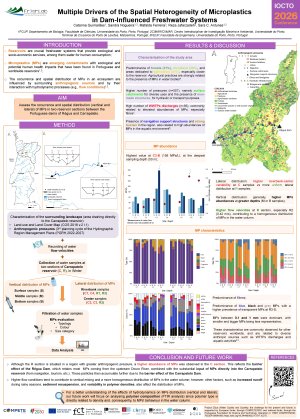
Reservoirs are crucial freshwater systems that provide ecological and socio-economic services; however, they are increasingly threatened by anthropogenic pressures, particularly microplastics (MPs) pollution. Beyond MPs’ occurrence, it is essential to investigate their sources, spatial distribution, and interaction with hydrodynamic processes to inform effective environmental management. This study aimed to assess the occurrence and spatial distribution (vertical and transversal) of MPs in two reservoir sections between the Portuguese dams of Régua and Carrapatelo. Water samples were collected at marginal and central-channel sampling sites, at three depths per site, and flow conditions were recorded. MPs were quantified and characterized according to type, colour, size, and polymer composition. Surrounding land use, land cover, and anthropogenic pressures, were evaluated. MPs were detected at all sampling sites and depths. Although the dominant MP characteristics - type (fibres), colour (blue) and size category (0.1-0.5 mm) - were consistent across sections, their vertical distribution patterns differed. Régua section exhibited higher MP abundances at greater depths (> 77 %), while for Carrapatelo section this trend was mainly observed in central-channel sites, associated to higher flow conditions (promoting resuspension of MPs deposited in the sediment). Different transversal distribution patterns were also observed: in Régua, MP abundance was relatively similar between marginal and central-channel sites (34 to 55 MPs/L), whereas Carrapatelo showed greater transversal variability (47 to 101 MPs/L), with the highest MP abundance (158 MPs/L) recorded at the greatest depth at one of the central-channel sites. Overall, although the upstream area is more urbanized (Régua), higher MP abundances were observed in the Carrapatelo section, which may reflect the cumulative downstream transport of MPs along the Douro River, compounded by the barrier effect of the dam, as well as the influence of navigation and tourism activities directly affecting the downstream region.
Keywords
emerging contaminants
reservoirs
hydrodynamics
water pollution
land use and land cover
Poster
poster iocto2026_Catarina_VF.pdf
Bioaccessibility of Metals and Metalloids in Microplastics: In Vitro Digestive Simulation Under Fed Conditions
Effects of tributyltin exposure on endothelium-dependent coronary vasodilation in female rats