Event submissions
Published
This submission belongs to the session 1. Exposure Routes / Exposome of Emerging Contaminants and Materials in the Environment of the event The 3rd International Online Conference on Toxics
Published date
04 Sep, 2026
Academic Editor
'%3e%3cpath%20d='M12.6657%2010.9104C12.4185%2010.325%2012.0599%209.79327%2011.6097%209.34482C11.1609%208.89508%2010.6293%208.5365%2010.0442%208.28888C10.0389%208.28626%2010.0337%208.28495%2010.0285%208.28233C10.8446%207.69279%2011.3752%206.73249%2011.3752%205.64904C11.3752%203.8542%209.92103%202.39999%208.1262%202.39999C6.33136%202.39999%204.87715%203.8542%204.87715%205.64904C4.87715%206.73249%205.40774%207.69279%206.22393%208.28364C6.21869%208.28626%206.21345%208.28757%206.20821%208.29019C5.62129%208.5378%205.09463%208.89284%204.64265%209.34613C4.1929%209.79493%203.83432%2010.3266%203.58671%2010.9117C3.34345%2011.4845%203.21226%2012.0987%203.20023%2012.7209C3.19988%2012.7349%203.20233%2012.7488%203.20744%2012.7619C3.21255%2012.7749%203.22022%2012.7867%203.22998%2012.7968C3.23975%2012.8068%203.25142%2012.8147%203.26431%2012.8202C3.2772%2012.8256%203.29105%2012.8284%203.30504%2012.8284H4.09109C4.14874%2012.8284%204.19459%2012.7825%204.1959%2012.7262C4.2221%2011.7148%204.62823%2010.7676%205.34617%2010.0497C6.08899%209.30683%207.0755%208.89808%208.1262%208.89808C9.17689%208.89808%2010.1634%209.30683%2010.9062%2010.0497C11.6242%2010.7676%2012.0303%2011.7148%2012.0565%2012.7262C12.0578%2012.7838%2012.1037%2012.8284%2012.1613%2012.8284H12.9474C12.9613%2012.8284%2012.9752%2012.8256%2012.9881%2012.8202C13.001%2012.8147%2013.0126%2012.8068%2013.0224%2012.7968C13.0322%2012.7867%2013.0398%2012.7749%2013.0449%2012.7619C13.0501%2012.7488%2013.0525%2012.7349%2013.0522%2012.7209C13.0391%2012.0947%2012.9094%2011.4855%2012.6657%2010.9104ZM8.1262%207.9024C7.52486%207.9024%206.9589%207.6679%206.53312%207.24211C6.10733%206.81633%205.87283%206.25037%205.87283%205.64904C5.87283%205.0477%206.10733%204.48174%206.53312%204.05596C6.9589%203.63018%207.52486%203.39567%208.1262%203.39567C8.72753%203.39567%209.29349%203.63018%209.71927%204.05596C10.1451%204.48174%2010.3796%205.0477%2010.3796%205.64904C10.3796%206.25037%2010.1451%206.81633%209.71927%207.24211C9.29349%207.6679%208.72753%207.9024%208.1262%207.9024Z'%20fill='%235D1EE1'/%3e%3c/g%3e%3c/svg%3e) Carlos Barata
Carlos BarataCitation
Marina Bastante-Rabadán, Karina Boltes, Antonio Berná, Combined Exposure to Ciprofloxacin and Polystyrene Microplastics: Responses of Aquatic Organisms and Electroactive Bacteria, in Proceedings of The 3rd International Online Conference on Toxics, 9 September–11 September 2026, MDPI: Basel, Switzerland
Share
Email
Facebook
Twitter
LinkedIn
Combined Exposure to Ciprofloxacin and Polystyrene Microplastics: Responses of Aquatic Organisms and Electroactive Bacteria
'%3e%3cpath%20d='M12.6647%2010.9104C12.4176%2010.325%2012.0589%209.7933%2011.6088%209.34485C11.16%208.89511%2010.6283%208.53653%2010.0432%208.28891C10.038%208.28629%2010.0327%208.28498%2010.0275%208.28236C10.8437%207.69282%2011.3743%206.73252%2011.3743%205.64907C11.3743%203.85423%209.92005%202.40002%208.12522%202.40002C6.33038%202.40002%204.87618%203.85423%204.87618%205.64907C4.87618%206.73252%205.40677%207.69282%206.22296%208.28367C6.21772%208.28629%206.21248%208.2876%206.20724%208.29022C5.62031%208.53783%205.09365%208.89287%204.64167%209.34616C4.19192%209.79496%203.83334%2010.3266%203.58573%2010.9117C3.34247%2011.4846%203.21128%2012.0987%203.19925%2012.721C3.1989%2012.735%203.20135%2012.7489%203.20646%2012.7619C3.21157%2012.7749%203.21924%2012.7868%203.22901%2012.7968C3.23877%2012.8068%203.25045%2012.8148%203.26334%2012.8202C3.27623%2012.8256%203.29007%2012.8284%203.30406%2012.8284H4.09012C4.14776%2012.8284%204.19362%2012.7825%204.19493%2012.7262C4.22113%2011.7148%204.62726%2010.7676%205.34519%2010.0497C6.08802%209.30686%207.07452%208.89811%208.12522%208.89811C9.17592%208.89811%2010.1624%209.30686%2010.9052%2010.0497C11.6232%2010.7676%2012.0293%2011.7148%2012.0555%2012.7262C12.0568%2012.7839%2012.1027%2012.8284%2012.1603%2012.8284H12.9464C12.9604%2012.8284%2012.9742%2012.8256%2012.9871%2012.8202C13%2012.8148%2013.0117%2012.8068%2013.0214%2012.7968C13.0312%2012.7868%2013.0389%2012.7749%2013.044%2012.7619C13.0491%2012.7489%2013.0515%2012.735%2013.0512%2012.721C13.0381%2012.0947%2012.9084%2011.4856%2012.6647%2010.9104ZM8.12522%207.90243C7.52388%207.90243%206.95792%207.66793%206.53214%207.24215C6.10636%206.81636%205.87185%206.2504%205.87185%205.64907C5.87185%205.04773%206.10636%204.48177%206.53214%204.05599C6.95792%203.63021%207.52388%203.3957%208.12522%203.3957C8.72655%203.3957%209.29252%203.63021%209.7183%204.05599C10.1441%204.48177%2010.3786%205.04773%2010.3786%205.64907C10.3786%206.2504%2010.1441%206.81636%209.7183%207.24215C9.29252%207.66793%208.72655%207.90243%208.12522%207.90243Z'%20fill='%235D1EE1'/%3e%3c/g%3e%3c/svg%3e)
Marina Bastante-Rabadán 1

Karina Boltes 1

Antonio Berná 2
1. Universidad de Alcalá, Departamento de Química Analítica, Química Física e Ingeniería Química, Campus Científica Tecnológico, Ctra. A-II km 33.6, 28805 Alcalá de Henares, Madrid
2. Instituto Madrileño de Estudios Avanzados (IMDEA) Water Institute, Avda. Punto Com, 2, 28805 Alcalá de Henares, Madrid
Abstract
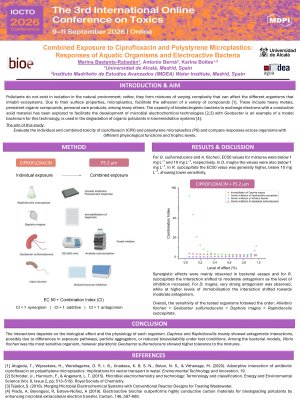
Combined pollution by microplastics and antibiotics is an increasing environmental concern due to their widespread occurrence in aquatic ecosystems and their potential interactions with biological communities. This study evaluated the acute toxicity of individual and combined toxicity of polystyrene microplastics (PS, 2–5 µm) and ciprofloxacin (CPX) on the electroactive bacteria Geobacter sulfurreducens, commonly used in bioelectrochemical systems (BES) for wastewater treatment, and three aquatic model organisms representing different trophic levels: Aliivibrio fischeri, Raphidocelis subcapitata and Daphnia magna. Acute ecotoxicological assays were carried out to calculate the Effective Concentration (EC). Combined toxicity was assessed using the combination index (CI)-isobologram method to identify synergistic, additive, or antagonistic interactions.
For G. sulfurreducens and A. fischeri, EC50 values for mixtures were below 1 mg L⁻¹ and 10 mg L⁻¹, respectively. In D. magna the values were also below 1 mg L⁻¹. In R. subcapitata the EC50 value was generally higher, below 10 mg L⁻¹, showing lower sensitivity. Synergistic effects were mainly observed in bacterial assays and for R. subcapitata the interaction shifted to moderate antagonism as the level of inhibition increased. For D. magna, very strong antagonism was observed, while at higher levels of immobilisation the interaction shifted towards moderate antagonism.
Overall, the sensitivity of the tested organisms followed the order: Aliivibrio fischeri > Geobacter sulfurreducens > Daphnia magna > Raphidocelis subcapitata. The mixture of CPX with 2 µm PS produced the strongest toxic effects, particularly in bacterial systems, suggesting that smaller microplastics enhance contaminant stress more efficiently than larger particles.
Keywords
Ecotoxicity
Acute toxicity
Daphnia magna
Raphidocelis subcapitata
Aliivibrio fischeri
Geobacter sulfurreducens
Electroactive bacteria
Emergent Pollutants
Antibiotics
Microplastics
Poster
BASTANTE-RABADAN_POSTER-IOCTO2026.pdf
Effects of tributyltin exposure on endothelium-dependent coronary vasodilation in female rats
Single and combined neurotoxic effects of chlorpyrifos and perfluorohexanesulfonic acid (PFHxS) in developing zebrafish (Danio rerio)