Event submissions
Published
This submission belongs to the session 1. Exposure Routes / Exposome of Emerging Contaminants and Materials in the Environment of the event The 3rd International Online Conference on Toxics
Published date
04 Sep, 2026
Academic Editor
'%3e%3cpath%20d='M12.6657%2010.9104C12.4185%2010.325%2012.0599%209.79327%2011.6097%209.34482C11.1609%208.89508%2010.6293%208.5365%2010.0442%208.28888C10.0389%208.28626%2010.0337%208.28495%2010.0285%208.28233C10.8446%207.69279%2011.3752%206.73249%2011.3752%205.64904C11.3752%203.8542%209.92103%202.39999%208.1262%202.39999C6.33136%202.39999%204.87715%203.8542%204.87715%205.64904C4.87715%206.73249%205.40774%207.69279%206.22393%208.28364C6.21869%208.28626%206.21345%208.28757%206.20821%208.29019C5.62129%208.5378%205.09463%208.89284%204.64265%209.34613C4.1929%209.79493%203.83432%2010.3266%203.58671%2010.9117C3.34345%2011.4845%203.21226%2012.0987%203.20023%2012.7209C3.19988%2012.7349%203.20233%2012.7488%203.20744%2012.7619C3.21255%2012.7749%203.22022%2012.7867%203.22998%2012.7968C3.23975%2012.8068%203.25142%2012.8147%203.26431%2012.8202C3.2772%2012.8256%203.29105%2012.8284%203.30504%2012.8284H4.09109C4.14874%2012.8284%204.19459%2012.7825%204.1959%2012.7262C4.2221%2011.7148%204.62823%2010.7676%205.34617%2010.0497C6.08899%209.30683%207.0755%208.89808%208.1262%208.89808C9.17689%208.89808%2010.1634%209.30683%2010.9062%2010.0497C11.6242%2010.7676%2012.0303%2011.7148%2012.0565%2012.7262C12.0578%2012.7838%2012.1037%2012.8284%2012.1613%2012.8284H12.9474C12.9613%2012.8284%2012.9752%2012.8256%2012.9881%2012.8202C13.001%2012.8147%2013.0126%2012.8068%2013.0224%2012.7968C13.0322%2012.7867%2013.0398%2012.7749%2013.0449%2012.7619C13.0501%2012.7488%2013.0525%2012.7349%2013.0522%2012.7209C13.0391%2012.0947%2012.9094%2011.4855%2012.6657%2010.9104ZM8.1262%207.9024C7.52486%207.9024%206.9589%207.6679%206.53312%207.24211C6.10733%206.81633%205.87283%206.25037%205.87283%205.64904C5.87283%205.0477%206.10733%204.48174%206.53312%204.05596C6.9589%203.63018%207.52486%203.39567%208.1262%203.39567C8.72753%203.39567%209.29349%203.63018%209.71927%204.05596C10.1451%204.48174%2010.3796%205.0477%2010.3796%205.64904C10.3796%206.25037%2010.1451%206.81633%209.71927%207.24211C9.29349%207.6679%208.72753%207.9024%208.1262%207.9024Z'%20fill='%235D1EE1'/%3e%3c/g%3e%3c/svg%3e) Carlos Barata
Carlos BarataCitation
MABEL DIAZ-CUBILLA, Pedro Letón, Karina Boltes, Multiparametric Assessment of Microbial Viability in Anaerobic Reactors Exposed to Emerging Contaminants Using Flow Cytometry and Fluorescence Microscopy, in Proceedings of The 3rd International Online Conference on Toxics, 9 September–11 September 2026, MDPI: Basel, Switzerland
Share
Email
Facebook
Twitter
LinkedIn
Multiparametric Assessment of Microbial Viability in Anaerobic Reactors Exposed to Emerging Contaminants Using Flow Cytometry and Fluorescence Microscopy
'%3e%3cpath%20d='M12.6647%2010.9104C12.4176%2010.325%2012.0589%209.7933%2011.6088%209.34485C11.16%208.89511%2010.6283%208.53653%2010.0432%208.28891C10.038%208.28629%2010.0327%208.28498%2010.0275%208.28236C10.8437%207.69282%2011.3743%206.73252%2011.3743%205.64907C11.3743%203.85423%209.92005%202.40002%208.12522%202.40002C6.33038%202.40002%204.87618%203.85423%204.87618%205.64907C4.87618%206.73252%205.40677%207.69282%206.22296%208.28367C6.21772%208.28629%206.21248%208.2876%206.20724%208.29022C5.62031%208.53783%205.09365%208.89287%204.64167%209.34616C4.19192%209.79496%203.83334%2010.3266%203.58573%2010.9117C3.34247%2011.4846%203.21128%2012.0987%203.19925%2012.721C3.1989%2012.735%203.20135%2012.7489%203.20646%2012.7619C3.21157%2012.7749%203.21924%2012.7868%203.22901%2012.7968C3.23877%2012.8068%203.25045%2012.8148%203.26334%2012.8202C3.27623%2012.8256%203.29007%2012.8284%203.30406%2012.8284H4.09012C4.14776%2012.8284%204.19362%2012.7825%204.19493%2012.7262C4.22113%2011.7148%204.62726%2010.7676%205.34519%2010.0497C6.08802%209.30686%207.07452%208.89811%208.12522%208.89811C9.17592%208.89811%2010.1624%209.30686%2010.9052%2010.0497C11.6232%2010.7676%2012.0293%2011.7148%2012.0555%2012.7262C12.0568%2012.7839%2012.1027%2012.8284%2012.1603%2012.8284H12.9464C12.9604%2012.8284%2012.9742%2012.8256%2012.9871%2012.8202C13%2012.8148%2013.0117%2012.8068%2013.0214%2012.7968C13.0312%2012.7868%2013.0389%2012.7749%2013.044%2012.7619C13.0491%2012.7489%2013.0515%2012.735%2013.0512%2012.721C13.0381%2012.0947%2012.9084%2011.4856%2012.6647%2010.9104ZM8.12522%207.90243C7.52388%207.90243%206.95792%207.66793%206.53214%207.24215C6.10636%206.81636%205.87185%206.2504%205.87185%205.64907C5.87185%205.04773%206.10636%204.48177%206.53214%204.05599C6.95792%203.63021%207.52388%203.3957%208.12522%203.3957C8.72655%203.3957%209.29252%203.63021%209.7183%204.05599C10.1441%204.48177%2010.3786%205.04773%2010.3786%205.64907C10.3786%206.2504%2010.1441%206.81636%209.7183%207.24215C9.29252%207.66793%208.72655%207.90243%208.12522%207.90243Z'%20fill='%235D1EE1'/%3e%3c/g%3e%3c/svg%3e)
MABEL DIAZ-CUBILLA 1,2,3
Pedro Letón 1,4

Karina Boltes 1,4
1. Departamento de Química Analítica, Química Física e Ingeniería Química- Universidad de Alcalá –Alcalá de Henares (Madrid)- CP 28871- España
2. Facultad de Ciencias Exactas y Naturales-Universidad Nacional de Asunción- San Lorenzo- CP 1804- Paraguay
3. Consejo Nacional de Ciencia y Tecnología (CONACYT) - Asunción - CP 001417- Paraguay
4. Instituto IMDEA Agua, Parque Científico Tecnológico, 28805 Alcalá de Henares, España
Abstract
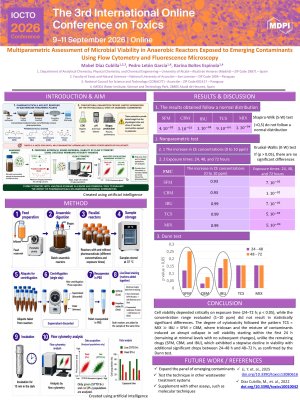
Emerging contaminants (ECs), including sulfamethoxazole, carbamazepine, ibuprofen, and triclosan, are increasingly detected in wastewater treatment systems and may compromise microbial communities involved in anaerobic processes. Conventional culture-based methods provide limited information on the physiological status of these communities, highlighting the need for rapid multiparametric approaches to assess contaminant-induced stress. In this study, anaerobic reactors were exposed to individual ECs and to a combined mixture (MIX) at concentrations ranging from 1 to 10 mg/L for 24–72 h. Microbial viability was evaluated by flow cytometry using Live/Dead staining with SYTO9/propidium iodide (PI), and the results were complemented by fluorescence microscopy. Statistical analyses, including Shapiro–Wilk, Kruskal–Wallis, and Dunn’s post hoc tests, were applied to determine the effects of contaminant concentration and exposure time on microbial viability.
Contaminant concentration did not produce statistically significant changes in microbial viability under the tested conditions (p > 0.05). In contrast, exposure time emerged as a critical factor affecting microbial health, with triclosan (TCS) and MIX treatments causing the greatest reductions in viable cell populations and alterations in cytometric profiles. Dunn’s post hoc analysis revealed significant differences in reactors exposed to sulfamethoxazole, carbamazepine, and ibuprofen, whereas TCS and MIX showed comparable toxicity patterns. Fluorescence microscopy confirmed a progressive decrease in the viable/non-viable cell ratio over time, particularly in reactors exposed to TCS and MIX.
These findings indicate that exposure time, rather than nominal contaminant concentration, was the main driver of microbial viability loss in anaerobic reactors under the tested conditions. The combined use of flow cytometry and fluorescence microscopy provides a robust early-warning framework for monitoring microbial stress in wastewater treatment systems. This approach contributes to a better understanding of the differential toxicity of emerging contaminants and supports the development of advanced monitoring strategies for protecting microbial functions essential to environmental health.
Keywords
emerging contaminants
flow cytometry
fluorescence microscopy
microbial viability
anaerobic reactors
wastewater treatment
triclosan
Poster
Template IOCTO 2026 MDC.pdf
Polycyclic Aromatic Hydrocarbons and Sugarcane Workers in Guatemalan
Comparative Assessment of Contrast Enhancement Properties of Gadolinium-Based MRI Contrast Agents