Event submissions
Published
This submission belongs to the session 1. Exposure Routes / Exposome of Emerging Contaminants and Materials in the Environment of the event The 3rd International Online Conference on Toxics
Published date
04 Sep, 2026
Academic Editor
'%3e%3cpath%20d='M12.6657%2010.9104C12.4185%2010.325%2012.0599%209.79327%2011.6097%209.34482C11.1609%208.89508%2010.6293%208.5365%2010.0442%208.28888C10.0389%208.28626%2010.0337%208.28495%2010.0285%208.28233C10.8446%207.69279%2011.3752%206.73249%2011.3752%205.64904C11.3752%203.8542%209.92103%202.39999%208.1262%202.39999C6.33136%202.39999%204.87715%203.8542%204.87715%205.64904C4.87715%206.73249%205.40774%207.69279%206.22393%208.28364C6.21869%208.28626%206.21345%208.28757%206.20821%208.29019C5.62129%208.5378%205.09463%208.89284%204.64265%209.34613C4.1929%209.79493%203.83432%2010.3266%203.58671%2010.9117C3.34345%2011.4845%203.21226%2012.0987%203.20023%2012.7209C3.19988%2012.7349%203.20233%2012.7488%203.20744%2012.7619C3.21255%2012.7749%203.22022%2012.7867%203.22998%2012.7968C3.23975%2012.8068%203.25142%2012.8147%203.26431%2012.8202C3.2772%2012.8256%203.29105%2012.8284%203.30504%2012.8284H4.09109C4.14874%2012.8284%204.19459%2012.7825%204.1959%2012.7262C4.2221%2011.7148%204.62823%2010.7676%205.34617%2010.0497C6.08899%209.30683%207.0755%208.89808%208.1262%208.89808C9.17689%208.89808%2010.1634%209.30683%2010.9062%2010.0497C11.6242%2010.7676%2012.0303%2011.7148%2012.0565%2012.7262C12.0578%2012.7838%2012.1037%2012.8284%2012.1613%2012.8284H12.9474C12.9613%2012.8284%2012.9752%2012.8256%2012.9881%2012.8202C13.001%2012.8147%2013.0126%2012.8068%2013.0224%2012.7968C13.0322%2012.7867%2013.0398%2012.7749%2013.0449%2012.7619C13.0501%2012.7488%2013.0525%2012.7349%2013.0522%2012.7209C13.0391%2012.0947%2012.9094%2011.4855%2012.6657%2010.9104ZM8.1262%207.9024C7.52486%207.9024%206.9589%207.6679%206.53312%207.24211C6.10733%206.81633%205.87283%206.25037%205.87283%205.64904C5.87283%205.0477%206.10733%204.48174%206.53312%204.05596C6.9589%203.63018%207.52486%203.39567%208.1262%203.39567C8.72753%203.39567%209.29349%203.63018%209.71927%204.05596C10.1451%204.48174%2010.3796%205.0477%2010.3796%205.64904C10.3796%206.25037%2010.1451%206.81633%209.71927%207.24211C9.29349%207.6679%208.72753%207.9024%208.1262%207.9024Z'%20fill='%235D1EE1'/%3e%3c/g%3e%3c/svg%3e) Carlos Barata
Carlos BarataCitation
Piotr Kowalczyk, Kornelia Kadac-Czapska, Beata Bochentyn, Natalia Nowak, Justyna Ośko, Małgorzata Grembecka, A Simple Method for Quantifying and Characterizing Microplastics at Ultra-Low Concentrations, in Proceedings of The 3rd International Online Conference on Toxics, 9 September–11 September 2026, MDPI: Basel, Switzerland
Share
Email
Facebook
Twitter
LinkedIn
A Simple Method for Quantifying and Characterizing Microplastics at Ultra-Low Concentrations

Piotr Kowalczyk 1

Kornelia Kadac-Czapska 1
'%3e%3cpath%20d='M12.6647%2010.9104C12.4176%2010.325%2012.0589%209.7933%2011.6088%209.34485C11.16%208.89511%2010.6283%208.53653%2010.0432%208.28891C10.038%208.28629%2010.0327%208.28498%2010.0275%208.28236C10.8437%207.69282%2011.3743%206.73252%2011.3743%205.64907C11.3743%203.85423%209.92005%202.40002%208.12522%202.40002C6.33038%202.40002%204.87618%203.85423%204.87618%205.64907C4.87618%206.73252%205.40677%207.69282%206.22296%208.28367C6.21772%208.28629%206.21248%208.2876%206.20724%208.29022C5.62031%208.53783%205.09365%208.89287%204.64167%209.34616C4.19192%209.79496%203.83334%2010.3266%203.58573%2010.9117C3.34247%2011.4846%203.21128%2012.0987%203.19925%2012.721C3.1989%2012.735%203.20135%2012.7489%203.20646%2012.7619C3.21157%2012.7749%203.21924%2012.7868%203.22901%2012.7968C3.23877%2012.8068%203.25045%2012.8148%203.26334%2012.8202C3.27623%2012.8256%203.29007%2012.8284%203.30406%2012.8284H4.09012C4.14776%2012.8284%204.19362%2012.7825%204.19493%2012.7262C4.22113%2011.7148%204.62726%2010.7676%205.34519%2010.0497C6.08802%209.30686%207.07452%208.89811%208.12522%208.89811C9.17592%208.89811%2010.1624%209.30686%2010.9052%2010.0497C11.6232%2010.7676%2012.0293%2011.7148%2012.0555%2012.7262C12.0568%2012.7839%2012.1027%2012.8284%2012.1603%2012.8284H12.9464C12.9604%2012.8284%2012.9742%2012.8256%2012.9871%2012.8202C13%2012.8148%2013.0117%2012.8068%2013.0214%2012.7968C13.0312%2012.7868%2013.0389%2012.7749%2013.044%2012.7619C13.0491%2012.7489%2013.0515%2012.735%2013.0512%2012.721C13.0381%2012.0947%2012.9084%2011.4856%2012.6647%2010.9104ZM8.12522%207.90243C7.52388%207.90243%206.95792%207.66793%206.53214%207.24215C6.10636%206.81636%205.87185%206.2504%205.87185%205.64907C5.87185%205.04773%206.10636%204.48177%206.53214%204.05599C6.95792%203.63021%207.52388%203.3957%208.12522%203.3957C8.72655%203.3957%209.29252%203.63021%209.7183%204.05599C10.1441%204.48177%2010.3786%205.04773%2010.3786%205.64907C10.3786%206.2504%2010.1441%206.81636%209.7183%207.24215C9.29252%207.66793%208.72655%207.90243%208.12522%207.90243Z'%20fill='%235D1EE1'/%3e%3c/g%3e%3c/svg%3e)
Beata Bochentyn 2
Natalia Nowak 1
Justyna Ośko 1
Małgorzata Grembecka 1
1. Department of Bromatology, Faculty of Pharmacy, Medical University of Gdańsk, Gdańsk
2. Institute of Nanotechnology and Materials Engineering, Faculty of Applied Physics and Mathematics, Division of New Functional Materials for Energy Conversion, Gdańsk University of Technology, Gdańsk
Abstract
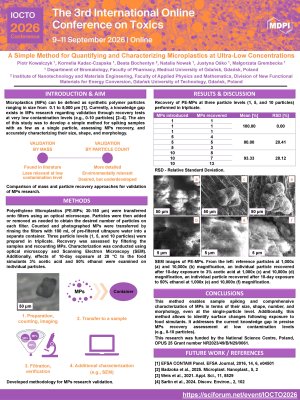
Introduction: Microplastics (MPs) can be defined as synthetic polymer particles ranging in size from 0.1 to 5,000 µm [1]. Currently, a knowledge gap exists in MPs research regarding validation through recovery tests at very low contamination levels (e.g., 0-10 particles) [2–4]. The aim of this study was to develop a simple method for spiking samples with as few as a single particle, while enabling accurate characterization of their size, shape, and morphology.
Methods: Polyethylene MPs (fragments, approximately 30-150 µm in size) were transferred onto filters using an optical microscope and metal tweezers. Particles were then added or removed until the desired number was reached. Counted and photographed MPs were transferred by rinsing the filters with 100 mL of pre-filtered ultrapure water into a separate container. Three particle levels (1, 5, and 10 particles) were prepared in triplicate. Recovery was assessed by filtering the samples and recounting MPs. Characterization was conducted using optical microscopy and scanning electron microscopy.
Results: The recovery testing method was successfully developed, and characterization of MPs was performed. Particle recoveries of 100.00% ± 0.00%, 80.00% ± 20.41%, and 93.33% ± 28.12% were achieved for 1, 5, and 10 particles respectively.
Conclusions: Our method enables sample spiking and full characterization of MPs based on their size, shape, and number, including at the single-particle level. It addresses the current knowledge gap in precise MPs recovery assessment at low contamination levels (e.g., 0-10 particles).
This research was funded by the National Science Center, Poland, OPUS 25 Grant number NR2023/49/B/N29/0061.
Literature:
[1] EFSA CONTAM Panel. EFSA Journal, 2016, 14, 6, e04501
[2] Badzoka et al., 2025. Microplast. Nanoplast., 5, 2
[3] Weis et al., 2021. Appl. Sci., 11, 8529
[4] Sarlin et al., 2024. Discov. Environ., 2, 102
Keywords
Microplastics
recovery
characterization
optical microscopy
scanning electron microscopy
Poster
Poster_A Simple Method for Quantifying and Characterizing Microplastics at Ultra-Low Concentrations_ Kowalczyk et al..pdf
Hidden Losses: Do Isolation Protocols Degrade Microplastics in Food Analysis?
Environmental Implications of Caffeine Exposure on Terrestrial Plant Establishment.