Event submissions
Published
This submission belongs to the session 1. Exposure Routes / Exposome of Emerging Contaminants and Materials in the Environment of the event The 3rd International Online Conference on Toxics
Published date
04 Sep, 2026
Academic Editor
'%3e%3cpath%20d='M12.6657%2010.9104C12.4185%2010.325%2012.0599%209.79327%2011.6097%209.34482C11.1609%208.89508%2010.6293%208.5365%2010.0442%208.28888C10.0389%208.28626%2010.0337%208.28495%2010.0285%208.28233C10.8446%207.69279%2011.3752%206.73249%2011.3752%205.64904C11.3752%203.8542%209.92103%202.39999%208.1262%202.39999C6.33136%202.39999%204.87715%203.8542%204.87715%205.64904C4.87715%206.73249%205.40774%207.69279%206.22393%208.28364C6.21869%208.28626%206.21345%208.28757%206.20821%208.29019C5.62129%208.5378%205.09463%208.89284%204.64265%209.34613C4.1929%209.79493%203.83432%2010.3266%203.58671%2010.9117C3.34345%2011.4845%203.21226%2012.0987%203.20023%2012.7209C3.19988%2012.7349%203.20233%2012.7488%203.20744%2012.7619C3.21255%2012.7749%203.22022%2012.7867%203.22998%2012.7968C3.23975%2012.8068%203.25142%2012.8147%203.26431%2012.8202C3.2772%2012.8256%203.29105%2012.8284%203.30504%2012.8284H4.09109C4.14874%2012.8284%204.19459%2012.7825%204.1959%2012.7262C4.2221%2011.7148%204.62823%2010.7676%205.34617%2010.0497C6.08899%209.30683%207.0755%208.89808%208.1262%208.89808C9.17689%208.89808%2010.1634%209.30683%2010.9062%2010.0497C11.6242%2010.7676%2012.0303%2011.7148%2012.0565%2012.7262C12.0578%2012.7838%2012.1037%2012.8284%2012.1613%2012.8284H12.9474C12.9613%2012.8284%2012.9752%2012.8256%2012.9881%2012.8202C13.001%2012.8147%2013.0126%2012.8068%2013.0224%2012.7968C13.0322%2012.7867%2013.0398%2012.7749%2013.0449%2012.7619C13.0501%2012.7488%2013.0525%2012.7349%2013.0522%2012.7209C13.0391%2012.0947%2012.9094%2011.4855%2012.6657%2010.9104ZM8.1262%207.9024C7.52486%207.9024%206.9589%207.6679%206.53312%207.24211C6.10733%206.81633%205.87283%206.25037%205.87283%205.64904C5.87283%205.0477%206.10733%204.48174%206.53312%204.05596C6.9589%203.63018%207.52486%203.39567%208.1262%203.39567C8.72753%203.39567%209.29349%203.63018%209.71927%204.05596C10.1451%204.48174%2010.3796%205.0477%2010.3796%205.64904C10.3796%206.25037%2010.1451%206.81633%209.71927%207.24211C9.29349%207.6679%208.72753%207.9024%208.1262%207.9024Z'%20fill='%235D1EE1'/%3e%3c/g%3e%3c/svg%3e) Natalia Garcia-Reyero
Natalia Garcia-ReyeroCitation
Franciele Domingos, Bianca Ribeiro Martins, Milena Moreira Grilo, Guilherme Edson de Souza, Akemi Okasaki, Leonardo Mendes, Higor Lemes, Larissa Fonseca Andrade Vieira, Environmental Implications of Caffeine Exposure on Terrestrial Plant Establishment, in Proceedings of The 3rd International Online Conference on Toxics, 9 September–11 September 2026, MDPI: Basel, Switzerland
Share
Email
Facebook
Twitter
LinkedIn
Environmental Implications of Caffeine Exposure on Terrestrial Plant Establishment
'%3e%3cpath%20d='M12.6647%2010.9104C12.4176%2010.325%2012.0589%209.7933%2011.6088%209.34485C11.16%208.89511%2010.6283%208.53653%2010.0432%208.28891C10.038%208.28629%2010.0327%208.28498%2010.0275%208.28236C10.8437%207.69282%2011.3743%206.73252%2011.3743%205.64907C11.3743%203.85423%209.92005%202.40002%208.12522%202.40002C6.33038%202.40002%204.87618%203.85423%204.87618%205.64907C4.87618%206.73252%205.40677%207.69282%206.22296%208.28367C6.21772%208.28629%206.21248%208.2876%206.20724%208.29022C5.62031%208.53783%205.09365%208.89287%204.64167%209.34616C4.19192%209.79496%203.83334%2010.3266%203.58573%2010.9117C3.34247%2011.4846%203.21128%2012.0987%203.19925%2012.721C3.1989%2012.735%203.20135%2012.7489%203.20646%2012.7619C3.21157%2012.7749%203.21924%2012.7868%203.22901%2012.7968C3.23877%2012.8068%203.25045%2012.8148%203.26334%2012.8202C3.27623%2012.8256%203.29007%2012.8284%203.30406%2012.8284H4.09012C4.14776%2012.8284%204.19362%2012.7825%204.19493%2012.7262C4.22113%2011.7148%204.62726%2010.7676%205.34519%2010.0497C6.08802%209.30686%207.07452%208.89811%208.12522%208.89811C9.17592%208.89811%2010.1624%209.30686%2010.9052%2010.0497C11.6232%2010.7676%2012.0293%2011.7148%2012.0555%2012.7262C12.0568%2012.7839%2012.1027%2012.8284%2012.1603%2012.8284H12.9464C12.9604%2012.8284%2012.9742%2012.8256%2012.9871%2012.8202C13%2012.8148%2013.0117%2012.8068%2013.0214%2012.7968C13.0312%2012.7868%2013.0389%2012.7749%2013.044%2012.7619C13.0491%2012.7489%2013.0515%2012.735%2013.0512%2012.721C13.0381%2012.0947%2012.9084%2011.4856%2012.6647%2010.9104ZM8.12522%207.90243C7.52388%207.90243%206.95792%207.66793%206.53214%207.24215C6.10636%206.81636%205.87185%206.2504%205.87185%205.64907C5.87185%205.04773%206.10636%204.48177%206.53214%204.05599C6.95792%203.63021%207.52388%203.3957%208.12522%203.3957C8.72655%203.3957%209.29252%203.63021%209.7183%204.05599C10.1441%204.48177%2010.3786%205.04773%2010.3786%205.64907C10.3786%206.2504%2010.1441%206.81636%209.7183%207.24215C9.29252%207.66793%208.72655%207.90243%208.12522%207.90243Z'%20fill='%235D1EE1'/%3e%3c/g%3e%3c/svg%3e)
Franciele Domingos 1
Bianca Ribeiro Martins 2
Milena Moreira Grilo 2
Guilherme Edson de Souza 2
Akemi Okasaki 3
Leonardo Mendes 3
Higor Lemes 4

Larissa Fonseca Andrade Vieira 1,3
1. Applied Botany Sector, Department of Biology, Federal University of Lavras, Lavras
2. Department of Biology, Federal University of Lavras, Lavras
3. Applied Ecology Section, Department of Ecology, Federal University of Lavras, Lavras, Brazil
4. Environmental Engineering Section, Department of Engineering, Federal University of Lavras, Lavras
Abstract
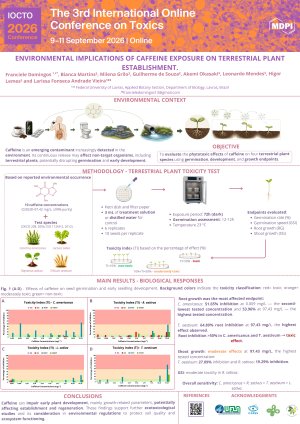
Background: The ecotoxicological assessment of caffeine is essential to understand its potential impacts on non-target organisms and to support environmental risk assessment. Caffeine is an emerging contaminant widely detected in aquatic and terrestrial environments due to human consumption and its continuous release via domestic and industrial effluents. Its persistence may affect non-target organisms, including terrestrial plants, by altering physiological and developmental processes. Objective: To evaluate the phytotoxic effects of caffeine on four terrestrial plant species (C. americanus, Triticum aestivum, Lactuca sativa, and Raphanus sativus) using germination, development, and growth endpoints. Methods: Bioassays were conducted following OECD 208 and ISO 18763 guidelines under controlled dark conditions for 72 h. Ten caffeine concentrations (0.0028–97.42 mg/L, ≥99% purity) were tested per species, with six replicates per treatment and ten seeds per replicate. Germination and early seedling development parameters were evaluated after exposure. Effect percentages were calculated and doses classified as non-toxic, moderately toxic, or toxic based on EC₁₀ and EC₅₀ thresholds. A final toxicity index was derived from the integrated response of all endpoints for each species. Results: The strongest effects were observed in root and shoot growth. Root inhibition exceeded 50% in C. americanus and T. aestivum (53.96% and 64.89%), classifying caffeine as toxic for this endpoint. Shoot growth inhibition remained below 50% but showed moderate effects, particularly in T. aestivum (27.09%) and R. sativus (19.29%). In the GSI endpoint, caffeine showed moderate toxicity for C. americanus. Integrated analysis indicated higher sensitivity in C. americanus, followed by R. sativus, T. aestivum, and L. sativa. Conclusions: Caffeine can impair early plant development, mainly growth-related parameters, potentially affecting establishment and regeneration. These findings support further ecotoxicological studies and its consideration in environmental regulations to protect soil quality and ecosystem functioning.
Keywords
ecotoxicology
non-target
germination
growth
Poster
Banner toxics.pdf
A Simple Method for Quantifying and Characterizing Microplastics at Ultra-Low Concentrations
Blood and Urine Heavy Metal Level in E-Waste and Non-E-Waste Workers