Event submissions
Published
This submission belongs to the session 5. Risk Assessment, Policy, and Environmental Justice in Chemical Safety of the event The 3rd International Online Conference on Toxics
Published date
04 Sep, 2026
Academic Editor
'%3e%3cpath%20d='M12.6657%2010.9104C12.4185%2010.325%2012.0599%209.79327%2011.6097%209.34482C11.1609%208.89508%2010.6293%208.5365%2010.0442%208.28888C10.0389%208.28626%2010.0337%208.28495%2010.0285%208.28233C10.8446%207.69279%2011.3752%206.73249%2011.3752%205.64904C11.3752%203.8542%209.92103%202.39999%208.1262%202.39999C6.33136%202.39999%204.87715%203.8542%204.87715%205.64904C4.87715%206.73249%205.40774%207.69279%206.22393%208.28364C6.21869%208.28626%206.21345%208.28757%206.20821%208.29019C5.62129%208.5378%205.09463%208.89284%204.64265%209.34613C4.1929%209.79493%203.83432%2010.3266%203.58671%2010.9117C3.34345%2011.4845%203.21226%2012.0987%203.20023%2012.7209C3.19988%2012.7349%203.20233%2012.7488%203.20744%2012.7619C3.21255%2012.7749%203.22022%2012.7867%203.22998%2012.7968C3.23975%2012.8068%203.25142%2012.8147%203.26431%2012.8202C3.2772%2012.8256%203.29105%2012.8284%203.30504%2012.8284H4.09109C4.14874%2012.8284%204.19459%2012.7825%204.1959%2012.7262C4.2221%2011.7148%204.62823%2010.7676%205.34617%2010.0497C6.08899%209.30683%207.0755%208.89808%208.1262%208.89808C9.17689%208.89808%2010.1634%209.30683%2010.9062%2010.0497C11.6242%2010.7676%2012.0303%2011.7148%2012.0565%2012.7262C12.0578%2012.7838%2012.1037%2012.8284%2012.1613%2012.8284H12.9474C12.9613%2012.8284%2012.9752%2012.8256%2012.9881%2012.8202C13.001%2012.8147%2013.0126%2012.8068%2013.0224%2012.7968C13.0322%2012.7867%2013.0398%2012.7749%2013.0449%2012.7619C13.0501%2012.7488%2013.0525%2012.7349%2013.0522%2012.7209C13.0391%2012.0947%2012.9094%2011.4855%2012.6657%2010.9104ZM8.1262%207.9024C7.52486%207.9024%206.9589%207.6679%206.53312%207.24211C6.10733%206.81633%205.87283%206.25037%205.87283%205.64904C5.87283%205.0477%206.10733%204.48174%206.53312%204.05596C6.9589%203.63018%207.52486%203.39567%208.1262%203.39567C8.72753%203.39567%209.29349%203.63018%209.71927%204.05596C10.1451%204.48174%2010.3796%205.0477%2010.3796%205.64904C10.3796%206.25037%2010.1451%206.81633%209.71927%207.24211C9.29349%207.6679%208.72753%207.9024%208.1262%207.9024Z'%20fill='%235D1EE1'/%3e%3c/g%3e%3c/svg%3e) Gunnar Toft
Gunnar ToftCitation
Hadia Benhalima, Issam Nessaibia, Khaled Benabbas, Tabet Trirat, Mohamed Chouafa, Hana Sbartai, Environmental and Health Risk Assessment of Heavy Metal Soil Contamination: A Pilot Study of the El-Karma Industrial Site (Annaba, Algeria), in Proceedings of The 3rd International Online Conference on Toxics, 9 September–11 September 2026, MDPI: Basel, Switzerland
Share
Email
Facebook
Twitter
LinkedIn
Environmental and Health Risk Assessment of Heavy Metal Soil Contamination: A Pilot Study of the El-Karma Industrial Site (Annaba, Algeria)
'%3e%3cpath%20d='M12.6647%2010.9104C12.4176%2010.325%2012.0589%209.7933%2011.6088%209.34485C11.16%208.89511%2010.6283%208.53653%2010.0432%208.28891C10.038%208.28629%2010.0327%208.28498%2010.0275%208.28236C10.8437%207.69282%2011.3743%206.73252%2011.3743%205.64907C11.3743%203.85423%209.92005%202.40002%208.12522%202.40002C6.33038%202.40002%204.87618%203.85423%204.87618%205.64907C4.87618%206.73252%205.40677%207.69282%206.22296%208.28367C6.21772%208.28629%206.21248%208.2876%206.20724%208.29022C5.62031%208.53783%205.09365%208.89287%204.64167%209.34616C4.19192%209.79496%203.83334%2010.3266%203.58573%2010.9117C3.34247%2011.4846%203.21128%2012.0987%203.19925%2012.721C3.1989%2012.735%203.20135%2012.7489%203.20646%2012.7619C3.21157%2012.7749%203.21924%2012.7868%203.22901%2012.7968C3.23877%2012.8068%203.25045%2012.8148%203.26334%2012.8202C3.27623%2012.8256%203.29007%2012.8284%203.30406%2012.8284H4.09012C4.14776%2012.8284%204.19362%2012.7825%204.19493%2012.7262C4.22113%2011.7148%204.62726%2010.7676%205.34519%2010.0497C6.08802%209.30686%207.07452%208.89811%208.12522%208.89811C9.17592%208.89811%2010.1624%209.30686%2010.9052%2010.0497C11.6232%2010.7676%2012.0293%2011.7148%2012.0555%2012.7262C12.0568%2012.7839%2012.1027%2012.8284%2012.1603%2012.8284H12.9464C12.9604%2012.8284%2012.9742%2012.8256%2012.9871%2012.8202C13%2012.8148%2013.0117%2012.8068%2013.0214%2012.7968C13.0312%2012.7868%2013.0389%2012.7749%2013.044%2012.7619C13.0491%2012.7489%2013.0515%2012.735%2013.0512%2012.721C13.0381%2012.0947%2012.9084%2011.4856%2012.6647%2010.9104ZM8.12522%207.90243C7.52388%207.90243%206.95792%207.66793%206.53214%207.24215C6.10636%206.81636%205.87185%206.2504%205.87185%205.64907C5.87185%205.04773%206.10636%204.48177%206.53214%204.05599C6.95792%203.63021%207.52388%203.3957%208.12522%203.3957C8.72655%203.3957%209.29252%203.63021%209.7183%204.05599C10.1441%204.48177%2010.3786%205.04773%2010.3786%205.64907C10.3786%206.2504%2010.1441%206.81636%209.7183%207.24215C9.29252%207.66793%208.72655%207.90243%208.12522%207.90243Z'%20fill='%235D1EE1'/%3e%3c/g%3e%3c/svg%3e)
Hadia Benhalima 1
Issam Nessaibia 1,2
Khaled Benabbas 1
Tabet Trirat 1
Mohamed Chouafa 1
Hana Sbartai 3
1. Environmental Research Center CRE, Badji-Mokhtar Annaba University, Annaba, 23000
2. Gabinetto Di Psicologia (REFLETO), Via Francesco Saverio Nitti 28, 00195, Rome, Italy
3. Laboratory of Cellular Toxicology, Department of Biology, Faculty of Sciences, Badji Mokhtar University, Annaba
Abstract
Introduction: Contamination of agricultural soil by hazardous environmental toxins from industrial activities is a major concern. In Algeria, Annaba’s municipality faces severe environmental degradation driven by the El-Hadjar steel complex, posing critical public health risks through soil and groundwater pollution.
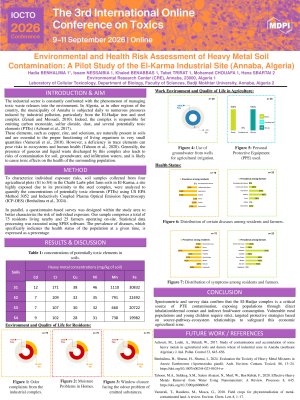
Methods: To characterize individual exposure risks, soil samples collected from four agricultural plots (S1 to S4) in El-Karma, a site highly exposed due to its proximity to the steel complex, were analyzed to quantify the concentrations of potentially toxic elements (PTEs). Concurrently, a questionnaire-based toxicological survey was conducted in the study area among 75 residents and 25 farmers operating at the site. The survey evaluated health effects from inhaling or ingesting suspended particulate matter, dermal contact with toxic soil, and consuming contaminated groundwater.
Results: Soil analyses confirmed significant PTE contamination. Spectrometry quantified concentrations (mg/kg) of Cd, Cr, Cu, Ni, Mn, and Fe, respectively, showing higher levels in parcel S1 closer to the source: S1 (12, 171, 38, 46, 1110, 30832); S2 (7, 109, 32, 35, 791, 22492); S3 (7, 107, 30, 32, 660, 20722); and S4 (9, 102, 28, 31, 738, 19982). The survey revealed that 71% of residents experience foul odors from volatile organic compounds, forcing 72% to close windows, while 76% report high indoor humidity. Participants reported health problems like respiratory diseases, cancers, hypertension, and diabetes, indicating that continuous inhalation of industrial emissions acts as a direct chronic stressor. Among farmers, 64% work eight hours daily and 100% rely on well water for irrigation, though all use protective equipment.
Conclusions: Spectrometric and survey data confirm that the El-Hadjar complex is a critical source of PTE contamination, exposing populations through direct inhalation/dermal contact and indirect food/water consumption. Vulnerable rural populations and young children require strict, targeted protective strategies based on source-pathway-ecosystem relationships to safeguard this economic agricultural zone.
Keywords
Environmental risk assessment
soil contamination
heavy metals
toxicological survey
public health.
Poster
Poster survey.pdf
Methodological Approaches to a Biological Model for Validating Health Damage Criteria Following Wildfire Smoke Exposure
Accounting for Non-Additive Effects in Multicomponent Aquatic Systems: Implications for Environmental Risk Assessment of Chemical Mixtures