Event submissions
Published
This submission belongs to the session 5. Risk Assessment, Policy, and Environmental Justice in Chemical Safety of the event The 3rd International Online Conference on Toxics
Published date
04 Sep, 2026
Academic Editor
'%3e%3cpath%20d='M12.6657%2010.9104C12.4185%2010.325%2012.0599%209.79327%2011.6097%209.34482C11.1609%208.89508%2010.6293%208.5365%2010.0442%208.28888C10.0389%208.28626%2010.0337%208.28495%2010.0285%208.28233C10.8446%207.69279%2011.3752%206.73249%2011.3752%205.64904C11.3752%203.8542%209.92103%202.39999%208.1262%202.39999C6.33136%202.39999%204.87715%203.8542%204.87715%205.64904C4.87715%206.73249%205.40774%207.69279%206.22393%208.28364C6.21869%208.28626%206.21345%208.28757%206.20821%208.29019C5.62129%208.5378%205.09463%208.89284%204.64265%209.34613C4.1929%209.79493%203.83432%2010.3266%203.58671%2010.9117C3.34345%2011.4845%203.21226%2012.0987%203.20023%2012.7209C3.19988%2012.7349%203.20233%2012.7488%203.20744%2012.7619C3.21255%2012.7749%203.22022%2012.7867%203.22998%2012.7968C3.23975%2012.8068%203.25142%2012.8147%203.26431%2012.8202C3.2772%2012.8256%203.29105%2012.8284%203.30504%2012.8284H4.09109C4.14874%2012.8284%204.19459%2012.7825%204.1959%2012.7262C4.2221%2011.7148%204.62823%2010.7676%205.34617%2010.0497C6.08899%209.30683%207.0755%208.89808%208.1262%208.89808C9.17689%208.89808%2010.1634%209.30683%2010.9062%2010.0497C11.6242%2010.7676%2012.0303%2011.7148%2012.0565%2012.7262C12.0578%2012.7838%2012.1037%2012.8284%2012.1613%2012.8284H12.9474C12.9613%2012.8284%2012.9752%2012.8256%2012.9881%2012.8202C13.001%2012.8147%2013.0126%2012.8068%2013.0224%2012.7968C13.0322%2012.7867%2013.0398%2012.7749%2013.0449%2012.7619C13.0501%2012.7488%2013.0525%2012.7349%2013.0522%2012.7209C13.0391%2012.0947%2012.9094%2011.4855%2012.6657%2010.9104ZM8.1262%207.9024C7.52486%207.9024%206.9589%207.6679%206.53312%207.24211C6.10733%206.81633%205.87283%206.25037%205.87283%205.64904C5.87283%205.0477%206.10733%204.48174%206.53312%204.05596C6.9589%203.63018%207.52486%203.39567%208.1262%203.39567C8.72753%203.39567%209.29349%203.63018%209.71927%204.05596C10.1451%204.48174%2010.3796%205.0477%2010.3796%205.64904C10.3796%206.25037%2010.1451%206.81633%209.71927%207.24211C9.29349%207.6679%208.72753%207.9024%208.1262%207.9024Z'%20fill='%235D1EE1'/%3e%3c/g%3e%3c/svg%3e) Gunnar Toft
Gunnar ToftCitation
Zamfira Stupar, Anca Becze, Vanda Babalau-Fuss, Emilia Neag, Loredana Suciu, Integrated mycological and HPLC analysis of aflatoxins in wheat caryopses under storage conditions, in Proceedings of The 3rd International Online Conference on Toxics, 9 September–11 September 2026, MDPI: Basel, Switzerland
Share
Email
Facebook
Twitter
LinkedIn
Integrated mycological and HPLC analysis of aflatoxins in wheat caryopses under storage conditions
'%3e%3cpath%20d='M12.6647%2010.9104C12.4176%2010.325%2012.0589%209.7933%2011.6088%209.34485C11.16%208.89511%2010.6283%208.53653%2010.0432%208.28891C10.038%208.28629%2010.0327%208.28498%2010.0275%208.28236C10.8437%207.69282%2011.3743%206.73252%2011.3743%205.64907C11.3743%203.85423%209.92005%202.40002%208.12522%202.40002C6.33038%202.40002%204.87618%203.85423%204.87618%205.64907C4.87618%206.73252%205.40677%207.69282%206.22296%208.28367C6.21772%208.28629%206.21248%208.2876%206.20724%208.29022C5.62031%208.53783%205.09365%208.89287%204.64167%209.34616C4.19192%209.79496%203.83334%2010.3266%203.58573%2010.9117C3.34247%2011.4846%203.21128%2012.0987%203.19925%2012.721C3.1989%2012.735%203.20135%2012.7489%203.20646%2012.7619C3.21157%2012.7749%203.21924%2012.7868%203.22901%2012.7968C3.23877%2012.8068%203.25045%2012.8148%203.26334%2012.8202C3.27623%2012.8256%203.29007%2012.8284%203.30406%2012.8284H4.09012C4.14776%2012.8284%204.19362%2012.7825%204.19493%2012.7262C4.22113%2011.7148%204.62726%2010.7676%205.34519%2010.0497C6.08802%209.30686%207.07452%208.89811%208.12522%208.89811C9.17592%208.89811%2010.1624%209.30686%2010.9052%2010.0497C11.6232%2010.7676%2012.0293%2011.7148%2012.0555%2012.7262C12.0568%2012.7839%2012.1027%2012.8284%2012.1603%2012.8284H12.9464C12.9604%2012.8284%2012.9742%2012.8256%2012.9871%2012.8202C13%2012.8148%2013.0117%2012.8068%2013.0214%2012.7968C13.0312%2012.7868%2013.0389%2012.7749%2013.044%2012.7619C13.0491%2012.7489%2013.0515%2012.735%2013.0512%2012.721C13.0381%2012.0947%2012.9084%2011.4856%2012.6647%2010.9104ZM8.12522%207.90243C7.52388%207.90243%206.95792%207.66793%206.53214%207.24215C6.10636%206.81636%205.87185%206.2504%205.87185%205.64907C5.87185%205.04773%206.10636%204.48177%206.53214%204.05599C6.95792%203.63021%207.52388%203.3957%208.12522%203.3957C8.72655%203.3957%209.29252%203.63021%209.7183%204.05599C10.1441%204.48177%2010.3786%205.04773%2010.3786%205.64907C10.3786%206.2504%2010.1441%206.81636%209.7183%207.24215C9.29252%207.66793%208.72655%207.90243%208.12522%207.90243Z'%20fill='%235D1EE1'/%3e%3c/g%3e%3c/svg%3e)
Zamfira Stupar 1

Anca Becze 1
Vanda Babalau-Fuss 1
Emilia Neag 1
Loredana Suciu 2
1. INCDO-INOE 2000, Research Institute for Analytical Instrumentation, 67 Donath Street, Cluj-Napoca
2. Department of Plant Culture, University of Agricultural Sciences and Veterinary Medicine, 3-5 Manastur Street, Cluj-Napoca
Abstract
Introduction: Aflatoxins are among the most hazardous mycotoxins contaminating cereals, representing a major concern for food safety due to their potent hepatotoxic and carcinogenic effects. Their occurrence in wheat is strongly influenced by environmental factors and post-harvest storage conditions, highlighting the need for sensitive and reliable analytical methods for contamination monitoring, risk assessment, and compliance with food safety regulations.
Methods: This study assessed fungal contamination and aflatoxin presence in wheat caryopses from four cultivars grown in north-central Romania. A standardized analytical method was applied, including methanol-water extraction, immunoaffinity column clean-up, and quantification of aflatoxins B1, B2, G1, and G2 by reversed-phase HPLC with fluorescence detection and post-column derivatization. Chromatographic separation was carried out under isocratic conditions using a water-acetonitrile-methanol mobile phase at 30°C and a flow rate of 0.7 ml/min, with fluorescence detection at 360/440 nm.
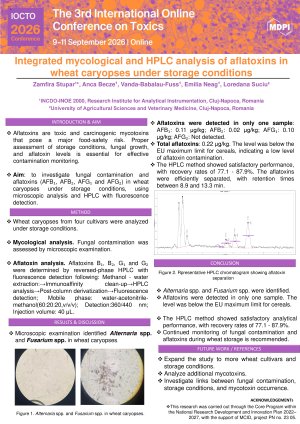
Results: Optimized chromatographic conditions (water-acetonitrile-methanol 60:20:20, v/v/v; 0.25 ml/min; 40 μl injection) ensured efficient separation of aflatoxins, with retention times of 13.3, 11.4, 10.3, and 8.9 min for B1, B2, G1, and G2, respectively. Microscopic analysis identified Alternaria and Fusarium species. Aflatoxins were detected in only one sample, with concentrations of 0.11 μg/kg (B1), 0.02 μg/kg (B2), and 0.10 μg/kg (G1), while G2 was not detected, resulting in a total level of 0.22 μg/kg, below the EU maximum limit for cereals. Recovery rates ranged from 77.1% to 87.9%, confirming adequate method performance.
Conclusions: The study confirms the presence of Alternaria and Fusarium spp. in wheat caryopses, while aflatoxins were detected only in one sample at low levels. These findings indicate a low contamination risk and full compliance with food safety standards. The validated HPLC method proved robust and reliable for routine aflatoxin monitoring, supporting its use in food control programs. Continued surveillance and improved post-harvest practices remain essential to ensure long-term mycotoxin risk mitigation.
Keywords
wheat caryopses
fungal contamination
HPLC
aflatoxins
Poster
Poster Zamfira Stupar.pdf
Accounting for Non-Additive Effects in Multicomponent Aquatic Systems: Implications for Environmental Risk Assessment of Chemical Mixtures
Distinct Toxicological Profiles of Pesticide Metabolites Compared to Parent Compounds: Evidence from a Zebrafish Model