Event submissions
Published
This submission belongs to the session 5. Risk Assessment, Policy, and Environmental Justice in Chemical Safety of the event The 3rd International Online Conference on Toxics
Published date
04 Sep, 2026
Academic Editor
'%3e%3cpath%20d='M12.6657%2010.9104C12.4185%2010.325%2012.0599%209.79327%2011.6097%209.34482C11.1609%208.89508%2010.6293%208.5365%2010.0442%208.28888C10.0389%208.28626%2010.0337%208.28495%2010.0285%208.28233C10.8446%207.69279%2011.3752%206.73249%2011.3752%205.64904C11.3752%203.8542%209.92103%202.39999%208.1262%202.39999C6.33136%202.39999%204.87715%203.8542%204.87715%205.64904C4.87715%206.73249%205.40774%207.69279%206.22393%208.28364C6.21869%208.28626%206.21345%208.28757%206.20821%208.29019C5.62129%208.5378%205.09463%208.89284%204.64265%209.34613C4.1929%209.79493%203.83432%2010.3266%203.58671%2010.9117C3.34345%2011.4845%203.21226%2012.0987%203.20023%2012.7209C3.19988%2012.7349%203.20233%2012.7488%203.20744%2012.7619C3.21255%2012.7749%203.22022%2012.7867%203.22998%2012.7968C3.23975%2012.8068%203.25142%2012.8147%203.26431%2012.8202C3.2772%2012.8256%203.29105%2012.8284%203.30504%2012.8284H4.09109C4.14874%2012.8284%204.19459%2012.7825%204.1959%2012.7262C4.2221%2011.7148%204.62823%2010.7676%205.34617%2010.0497C6.08899%209.30683%207.0755%208.89808%208.1262%208.89808C9.17689%208.89808%2010.1634%209.30683%2010.9062%2010.0497C11.6242%2010.7676%2012.0303%2011.7148%2012.0565%2012.7262C12.0578%2012.7838%2012.1037%2012.8284%2012.1613%2012.8284H12.9474C12.9613%2012.8284%2012.9752%2012.8256%2012.9881%2012.8202C13.001%2012.8147%2013.0126%2012.8068%2013.0224%2012.7968C13.0322%2012.7867%2013.0398%2012.7749%2013.0449%2012.7619C13.0501%2012.7488%2013.0525%2012.7349%2013.0522%2012.7209C13.0391%2012.0947%2012.9094%2011.4855%2012.6657%2010.9104ZM8.1262%207.9024C7.52486%207.9024%206.9589%207.6679%206.53312%207.24211C6.10733%206.81633%205.87283%206.25037%205.87283%205.64904C5.87283%205.0477%206.10733%204.48174%206.53312%204.05596C6.9589%203.63018%207.52486%203.39567%208.1262%203.39567C8.72753%203.39567%209.29349%203.63018%209.71927%204.05596C10.1451%204.48174%2010.3796%205.0477%2010.3796%205.64904C10.3796%206.25037%2010.1451%206.81633%209.71927%207.24211C9.29349%207.6679%208.72753%207.9024%208.1262%207.9024Z'%20fill='%235D1EE1'/%3e%3c/g%3e%3c/svg%3e) Gunnar Toft
Gunnar ToftCitation
Daniil N. Malyshev, Maxim Yu. Sinitsyn, Alexey V. Aksenov, Tatiana F. Sheshko, Valeriy M. Goncharov, Quantitative determination of toxic elements in imidazolium-based ionic liquids by inductively coupled plasma mass spectrometry, in Proceedings of The 3rd International Online Conference on Toxics, 9 September–11 September 2026, MDPI: Basel, Switzerland
Share
Email
Facebook
Twitter
LinkedIn
Quantitative determination of toxic elements in imidazolium-based ionic liquids by inductively coupled plasma mass spectrometry
'%3e%3cpath%20d='M12.6647%2010.9104C12.4176%2010.325%2012.0589%209.7933%2011.6088%209.34485C11.16%208.89511%2010.6283%208.53653%2010.0432%208.28891C10.038%208.28629%2010.0327%208.28498%2010.0275%208.28236C10.8437%207.69282%2011.3743%206.73252%2011.3743%205.64907C11.3743%203.85423%209.92005%202.40002%208.12522%202.40002C6.33038%202.40002%204.87618%203.85423%204.87618%205.64907C4.87618%206.73252%205.40677%207.69282%206.22296%208.28367C6.21772%208.28629%206.21248%208.2876%206.20724%208.29022C5.62031%208.53783%205.09365%208.89287%204.64167%209.34616C4.19192%209.79496%203.83334%2010.3266%203.58573%2010.9117C3.34247%2011.4846%203.21128%2012.0987%203.19925%2012.721C3.1989%2012.735%203.20135%2012.7489%203.20646%2012.7619C3.21157%2012.7749%203.21924%2012.7868%203.22901%2012.7968C3.23877%2012.8068%203.25045%2012.8148%203.26334%2012.8202C3.27623%2012.8256%203.29007%2012.8284%203.30406%2012.8284H4.09012C4.14776%2012.8284%204.19362%2012.7825%204.19493%2012.7262C4.22113%2011.7148%204.62726%2010.7676%205.34519%2010.0497C6.08802%209.30686%207.07452%208.89811%208.12522%208.89811C9.17592%208.89811%2010.1624%209.30686%2010.9052%2010.0497C11.6232%2010.7676%2012.0293%2011.7148%2012.0555%2012.7262C12.0568%2012.7839%2012.1027%2012.8284%2012.1603%2012.8284H12.9464C12.9604%2012.8284%2012.9742%2012.8256%2012.9871%2012.8202C13%2012.8148%2013.0117%2012.8068%2013.0214%2012.7968C13.0312%2012.7868%2013.0389%2012.7749%2013.044%2012.7619C13.0491%2012.7489%2013.0515%2012.735%2013.0512%2012.721C13.0381%2012.0947%2012.9084%2011.4856%2012.6647%2010.9104ZM8.12522%207.90243C7.52388%207.90243%206.95792%207.66793%206.53214%207.24215C6.10636%206.81636%205.87185%206.2504%205.87185%205.64907C5.87185%205.04773%206.10636%204.48177%206.53214%204.05599C6.95792%203.63021%207.52388%203.3957%208.12522%203.3957C8.72655%203.3957%209.29252%203.63021%209.7183%204.05599C10.1441%204.48177%2010.3786%205.04773%2010.3786%205.64907C10.3786%206.2504%2010.1441%206.81636%209.7183%207.24215C9.29252%207.66793%208.72655%207.90243%208.12522%207.90243Z'%20fill='%235D1EE1'/%3e%3c/g%3e%3c/svg%3e)
Daniil N. Malyshev 1
Maxim Yu. Sinitsyn 2
Alexey V. Aksenov 1
Tatiana F. Sheshko 1
Valeriy M. Goncharov 1
1. Department of Physical and Colloidal Chemistry, Faculty of Science, RUDN University, 6 Miklukho-Maklaya Street, 117198 Moscow
2. Analytical Chemistry Division, Department of Chemistry, Lomonosov Moscow State University, 1-3 Leninskie Gory, 119234, Moscow
Abstract
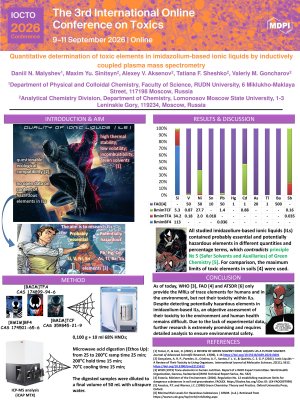
Introduction: Ionic liquids (ILs) represent a large class of compounds, among which imidazolium-based ILs are the most studied and commercially available solvents. Due to their high thermal stability, low volatility and incombustibility, they are classified as green solvents. Recently, the scientists have questioned their ecological compatibility. Nowadays, open data on the research of ionic liquids for, according to the WHO report, probably essential (Si, V, Ni, Sn) and potentially hazardous (Pb, Hg, Cd, As, Tl, Ba, Sb) elements to the environment and human health are absent. Ionic liquids were studied for these elements by inductively coupled plasma mass spectrometry (ICP-MS).
Methods: Ionic liquids [BMIM]BF4, [BMIM]TFA and [BMIM]TСF were examined within the research. Microwave acid digestion was carried out in the «Ethos Up» system («Milestone», Italy). Quantitative analysis was performed on ICP-MS «iCAP MTX» («Thermo Scientific», USA).
Results: [BMIM]BF4 contained Si (113 mg/kg), Pb (0.036 mg/kg), [BMIM]TFA - Si (34.2 mg/kg), V (0.18 mg/kg), Ni (2.0 mg/kg), Sn (0.018 mg/kg), Sb (0.035 mg/kg), [BMIM]TSF - Si (5.3 mg/kg), V (0.87 mg/kg), Ni (27.7 mg/kg), Pb (1.4 mg/kg), Cd (0.88 mg/kg), Sb (0.16 mg/kg), which contradicts principle № 5 (Safer Solvents and Auxiliaries) of Green Chemistry. For comparison, here are the maximum limits of toxic elements in soils (LEX-FAOC097999): Si, Sb – n/d, V, Ni, Pb – 50 mg/kg, Sn – 10 mg/kg, Hg – 0.5 mg/kg, Cd, Tl – 1 mg/kg, As – 20 mg/kg, Ba – 500 mg/kg.
Conclusions: As of today, ATSDR, FAO and WHO only provide the MRLs of trace elements for humans and in the environment, but not their toxicity within ILs. Despite detecting potentially hazardous elements in imidazolium-based ILs, an objective assessment of their toxicity to the environment and human health remains difficult. Due to the lack of experimental data, further research is extremely promising and requires detailed analysis to ensure environmental safety.
Keywords
ICP-MS
ionic liquids
green chemistry
environmental safety
Poster
Sciforum-189229_Poster.pdf
Microplastics in the muscle of marine fish from coastal China: occurrence and characteristics
Human Health Risk Assessment of Metal Exposure through Consumption of Various Fish Species in the Local Market, Muscat, Oman.