Event submissions
Published
This submission belongs to the session 5. Risk Assessment, Policy, and Environmental Justice in Chemical Safety of the event The 3rd International Online Conference on Toxics
Published date
04 Sep, 2026
Academic Editor
'%3e%3cpath%20d='M12.6657%2010.9104C12.4185%2010.325%2012.0599%209.79327%2011.6097%209.34482C11.1609%208.89508%2010.6293%208.5365%2010.0442%208.28888C10.0389%208.28626%2010.0337%208.28495%2010.0285%208.28233C10.8446%207.69279%2011.3752%206.73249%2011.3752%205.64904C11.3752%203.8542%209.92103%202.39999%208.1262%202.39999C6.33136%202.39999%204.87715%203.8542%204.87715%205.64904C4.87715%206.73249%205.40774%207.69279%206.22393%208.28364C6.21869%208.28626%206.21345%208.28757%206.20821%208.29019C5.62129%208.5378%205.09463%208.89284%204.64265%209.34613C4.1929%209.79493%203.83432%2010.3266%203.58671%2010.9117C3.34345%2011.4845%203.21226%2012.0987%203.20023%2012.7209C3.19988%2012.7349%203.20233%2012.7488%203.20744%2012.7619C3.21255%2012.7749%203.22022%2012.7867%203.22998%2012.7968C3.23975%2012.8068%203.25142%2012.8147%203.26431%2012.8202C3.2772%2012.8256%203.29105%2012.8284%203.30504%2012.8284H4.09109C4.14874%2012.8284%204.19459%2012.7825%204.1959%2012.7262C4.2221%2011.7148%204.62823%2010.7676%205.34617%2010.0497C6.08899%209.30683%207.0755%208.89808%208.1262%208.89808C9.17689%208.89808%2010.1634%209.30683%2010.9062%2010.0497C11.6242%2010.7676%2012.0303%2011.7148%2012.0565%2012.7262C12.0578%2012.7838%2012.1037%2012.8284%2012.1613%2012.8284H12.9474C12.9613%2012.8284%2012.9752%2012.8256%2012.9881%2012.8202C13.001%2012.8147%2013.0126%2012.8068%2013.0224%2012.7968C13.0322%2012.7867%2013.0398%2012.7749%2013.0449%2012.7619C13.0501%2012.7488%2013.0525%2012.7349%2013.0522%2012.7209C13.0391%2012.0947%2012.9094%2011.4855%2012.6657%2010.9104ZM8.1262%207.9024C7.52486%207.9024%206.9589%207.6679%206.53312%207.24211C6.10733%206.81633%205.87283%206.25037%205.87283%205.64904C5.87283%205.0477%206.10733%204.48174%206.53312%204.05596C6.9589%203.63018%207.52486%203.39567%208.1262%203.39567C8.72753%203.39567%209.29349%203.63018%209.71927%204.05596C10.1451%204.48174%2010.3796%205.0477%2010.3796%205.64904C10.3796%206.25037%2010.1451%206.81633%209.71927%207.24211C9.29349%207.6679%208.72753%207.9024%208.1262%207.9024Z'%20fill='%235D1EE1'/%3e%3c/g%3e%3c/svg%3e) Gunnar Toft
Gunnar ToftCitation
Ana O. S. Jorge, M. A. Prieto, M. Beatriz P. P. Oliveira, Speciation Uncertainty as the Dominant Driver of Arsenic Risk Characterization in Tuna: A Probabilistic Sensitivity Analysis, in Proceedings of The 3rd International Online Conference on Toxics, 9 September–11 September 2026, MDPI: Basel, Switzerland
Share
Email
Facebook
Twitter
LinkedIn
Speciation Uncertainty as the Dominant Driver of Arsenic Risk Characterization in Tuna: A Probabilistic Sensitivity Analysis
'%3e%3cpath%20d='M12.6647%2010.9104C12.4176%2010.325%2012.0589%209.7933%2011.6088%209.34485C11.16%208.89511%2010.6283%208.53653%2010.0432%208.28891C10.038%208.28629%2010.0327%208.28498%2010.0275%208.28236C10.8437%207.69282%2011.3743%206.73252%2011.3743%205.64907C11.3743%203.85423%209.92005%202.40002%208.12522%202.40002C6.33038%202.40002%204.87618%203.85423%204.87618%205.64907C4.87618%206.73252%205.40677%207.69282%206.22296%208.28367C6.21772%208.28629%206.21248%208.2876%206.20724%208.29022C5.62031%208.53783%205.09365%208.89287%204.64167%209.34616C4.19192%209.79496%203.83334%2010.3266%203.58573%2010.9117C3.34247%2011.4846%203.21128%2012.0987%203.19925%2012.721C3.1989%2012.735%203.20135%2012.7489%203.20646%2012.7619C3.21157%2012.7749%203.21924%2012.7868%203.22901%2012.7968C3.23877%2012.8068%203.25045%2012.8148%203.26334%2012.8202C3.27623%2012.8256%203.29007%2012.8284%203.30406%2012.8284H4.09012C4.14776%2012.8284%204.19362%2012.7825%204.19493%2012.7262C4.22113%2011.7148%204.62726%2010.7676%205.34519%2010.0497C6.08802%209.30686%207.07452%208.89811%208.12522%208.89811C9.17592%208.89811%2010.1624%209.30686%2010.9052%2010.0497C11.6232%2010.7676%2012.0293%2011.7148%2012.0555%2012.7262C12.0568%2012.7839%2012.1027%2012.8284%2012.1603%2012.8284H12.9464C12.9604%2012.8284%2012.9742%2012.8256%2012.9871%2012.8202C13%2012.8148%2013.0117%2012.8068%2013.0214%2012.7968C13.0312%2012.7868%2013.0389%2012.7749%2013.044%2012.7619C13.0491%2012.7489%2013.0515%2012.735%2013.0512%2012.721C13.0381%2012.0947%2012.9084%2011.4856%2012.6647%2010.9104ZM8.12522%207.90243C7.52388%207.90243%206.95792%207.66793%206.53214%207.24215C6.10636%206.81636%205.87185%206.2504%205.87185%205.64907C5.87185%205.04773%206.10636%204.48177%206.53214%204.05599C6.95792%203.63021%207.52388%203.3957%208.12522%203.3957C8.72655%203.3957%209.29252%203.63021%209.7183%204.05599C10.1441%204.48177%2010.3786%205.04773%2010.3786%205.64907C10.3786%206.2504%2010.1441%206.81636%209.7183%207.24215C9.29252%207.66793%208.72655%207.90243%208.12522%207.90243Z'%20fill='%235D1EE1'/%3e%3c/g%3e%3c/svg%3e)
Ana O. S. Jorge 1,2,3

M. A. Prieto 2,3

M. Beatriz P. P. Oliveira 1
1. REQUIMTE/LAQV, Department of Chemical Sciences, Faculty of Pharmacy, University of Porto, R. Jorge Viterbo Ferreira 228, 4050-313 Porto
2. Instituto de Agroecoloxía e Alimentación (IAA), Universidade de Vigo, Nutrition and Food Group (NuFoG), Campus Auga, 32004 Ourense, Spain
3. Nutrition and Food Group (NuFoG), Galicia Sur Health Research Institute (IIS Galicia Sur), SERGAS-UVIGO, 36213 Vigo, Spain
Abstract
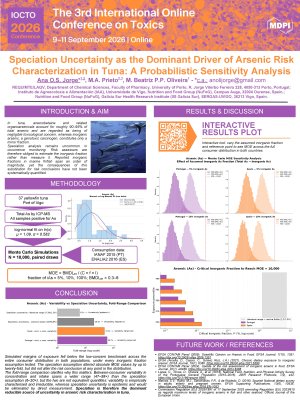
Arsenic (As) is common in marine fish, predominantly as arsenobetaine and other organic forms of negligible toxicological concern. Inorganic arsenic, the species of regulatory relevance, typically constitutes only a minor fraction of total arsenic in pelagic fish such as tuna, yet speciation data are frequently unavailable in occurrence monitoring programmes, forcing risk assessors to rely on assumed inorganic fractions. The magnitude of uncertainty introduced by this assumption, and its influence on risk conclusions, remains poorly characterised. This study quantified the impact of speciation uncertainty on probabilistic inorganic arsenic risk characterisation in Portuguese and Spanish adult tuna consumers. Total arsenic concentrations were determined by ICP-MS/OES in 37 yellowfin tuna samples collected at the Port of Vigo and fitted to a log-normal distribution. Consumption data from IAN-AF 2015 (Portugal) and ENALIA2 2016 (Spain) were modelled as gamma distributions fitted by percentile matching to national dietary survey summary statistics. Monte Carlo simulation (n = 10,000 iterations) was performed independently under three inorganic arsenic fraction assumptions: 100% (fully conservative), 10%, and 5%, the latter two reflecting values reported in the literature for marine fish. Under the fully conservative scenario, median margins of exposure (MOE) against the upper BMDL₀₁ were 21 and 37 for Portugal and Spain respectively, with no iterations exceeding the low-concern threshold of MOE = 10,000. Even under the most realistic assumption of 5%, median MOEs of 432 and 742 remained far below 10,000, with fewer than 2% of simulated exposures classified as low concern in either population. Speciation assumption drives substantial variation in absolute MOE values but does not alter the fundamental risk conclusion: inorganic arsenic exposure from tuna consumption warrants concern across the full consumer distribution regardless of the fraction applied.
Keywords
arsenic speciation
dietary risk assessment
margin of exposure
Monte Carlo simulation
tuna
probabilistic exposure assessment
Poster
IOCTO_2026_poster.pdf
Human Health Risk Assessment of Metal Exposure through Consumption of Various Fish Species in the Local Market, Muscat, Oman.
Genotoxicity Biomarkers in Healthcare Workers Occupationally Exposed to Antineoplastic Drugs: A Systematic Review and Meta-Analysis