Event submissions
Published
This submission belongs to the session 5. Risk Assessment, Policy, and Environmental Justice in Chemical Safety of the event The 3rd International Online Conference on Toxics
Published date
04 Sep, 2026
Academic Editor
'%3e%3cpath%20d='M12.6657%2010.9104C12.4185%2010.325%2012.0599%209.79327%2011.6097%209.34482C11.1609%208.89508%2010.6293%208.5365%2010.0442%208.28888C10.0389%208.28626%2010.0337%208.28495%2010.0285%208.28233C10.8446%207.69279%2011.3752%206.73249%2011.3752%205.64904C11.3752%203.8542%209.92103%202.39999%208.1262%202.39999C6.33136%202.39999%204.87715%203.8542%204.87715%205.64904C4.87715%206.73249%205.40774%207.69279%206.22393%208.28364C6.21869%208.28626%206.21345%208.28757%206.20821%208.29019C5.62129%208.5378%205.09463%208.89284%204.64265%209.34613C4.1929%209.79493%203.83432%2010.3266%203.58671%2010.9117C3.34345%2011.4845%203.21226%2012.0987%203.20023%2012.7209C3.19988%2012.7349%203.20233%2012.7488%203.20744%2012.7619C3.21255%2012.7749%203.22022%2012.7867%203.22998%2012.7968C3.23975%2012.8068%203.25142%2012.8147%203.26431%2012.8202C3.2772%2012.8256%203.29105%2012.8284%203.30504%2012.8284H4.09109C4.14874%2012.8284%204.19459%2012.7825%204.1959%2012.7262C4.2221%2011.7148%204.62823%2010.7676%205.34617%2010.0497C6.08899%209.30683%207.0755%208.89808%208.1262%208.89808C9.17689%208.89808%2010.1634%209.30683%2010.9062%2010.0497C11.6242%2010.7676%2012.0303%2011.7148%2012.0565%2012.7262C12.0578%2012.7838%2012.1037%2012.8284%2012.1613%2012.8284H12.9474C12.9613%2012.8284%2012.9752%2012.8256%2012.9881%2012.8202C13.001%2012.8147%2013.0126%2012.8068%2013.0224%2012.7968C13.0322%2012.7867%2013.0398%2012.7749%2013.0449%2012.7619C13.0501%2012.7488%2013.0525%2012.7349%2013.0522%2012.7209C13.0391%2012.0947%2012.9094%2011.4855%2012.6657%2010.9104ZM8.1262%207.9024C7.52486%207.9024%206.9589%207.6679%206.53312%207.24211C6.10733%206.81633%205.87283%206.25037%205.87283%205.64904C5.87283%205.0477%206.10733%204.48174%206.53312%204.05596C6.9589%203.63018%207.52486%203.39567%208.1262%203.39567C8.72753%203.39567%209.29349%203.63018%209.71927%204.05596C10.1451%204.48174%2010.3796%205.0477%2010.3796%205.64904C10.3796%206.25037%2010.1451%206.81633%209.71927%207.24211C9.29349%207.6679%208.72753%207.9024%208.1262%207.9024Z'%20fill='%235D1EE1'/%3e%3c/g%3e%3c/svg%3e) Carlos Barata
Carlos BarataCitation
Brian Turyahabwe, Joseph G. Omole, Nita-wills G. Udom, Godswill J. Udom, Chemical Pollution by Potentially Toxic Elements in the Mubuku Irrigation Scheme, Uganda: A Stochastic Human Exposure-Risk Modeling and Environmental Health Implications, in Proceedings of The 3rd International Online Conference on Toxics, 9 September–11 September 2026, MDPI: Basel, Switzerland
Share
Email
Facebook
Twitter
LinkedIn
Chemical Pollution by Potentially Toxic Elements in the Mubuku Irrigation Scheme, Uganda: A Stochastic Human Exposure-Risk Modeling and Environmental Health Implications
'%3e%3cpath%20d='M12.6647%2010.9104C12.4176%2010.325%2012.0589%209.7933%2011.6088%209.34485C11.16%208.89511%2010.6283%208.53653%2010.0432%208.28891C10.038%208.28629%2010.0327%208.28498%2010.0275%208.28236C10.8437%207.69282%2011.3743%206.73252%2011.3743%205.64907C11.3743%203.85423%209.92005%202.40002%208.12522%202.40002C6.33038%202.40002%204.87618%203.85423%204.87618%205.64907C4.87618%206.73252%205.40677%207.69282%206.22296%208.28367C6.21772%208.28629%206.21248%208.2876%206.20724%208.29022C5.62031%208.53783%205.09365%208.89287%204.64167%209.34616C4.19192%209.79496%203.83334%2010.3266%203.58573%2010.9117C3.34247%2011.4846%203.21128%2012.0987%203.19925%2012.721C3.1989%2012.735%203.20135%2012.7489%203.20646%2012.7619C3.21157%2012.7749%203.21924%2012.7868%203.22901%2012.7968C3.23877%2012.8068%203.25045%2012.8148%203.26334%2012.8202C3.27623%2012.8256%203.29007%2012.8284%203.30406%2012.8284H4.09012C4.14776%2012.8284%204.19362%2012.7825%204.19493%2012.7262C4.22113%2011.7148%204.62726%2010.7676%205.34519%2010.0497C6.08802%209.30686%207.07452%208.89811%208.12522%208.89811C9.17592%208.89811%2010.1624%209.30686%2010.9052%2010.0497C11.6232%2010.7676%2012.0293%2011.7148%2012.0555%2012.7262C12.0568%2012.7839%2012.1027%2012.8284%2012.1603%2012.8284H12.9464C12.9604%2012.8284%2012.9742%2012.8256%2012.9871%2012.8202C13%2012.8148%2013.0117%2012.8068%2013.0214%2012.7968C13.0312%2012.7868%2013.0389%2012.7749%2013.044%2012.7619C13.0491%2012.7489%2013.0515%2012.735%2013.0512%2012.721C13.0381%2012.0947%2012.9084%2011.4856%2012.6647%2010.9104ZM8.12522%207.90243C7.52388%207.90243%206.95792%207.66793%206.53214%207.24215C6.10636%206.81636%205.87185%206.2504%205.87185%205.64907C5.87185%205.04773%206.10636%204.48177%206.53214%204.05599C6.95792%203.63021%207.52388%203.3957%208.12522%203.3957C8.72655%203.3957%209.29252%203.63021%209.7183%204.05599C10.1441%204.48177%2010.3786%205.04773%2010.3786%205.64907C10.3786%206.2504%2010.1441%206.81636%209.7183%207.24215C9.29252%207.66793%208.72655%207.90243%208.12522%207.90243Z'%20fill='%235D1EE1'/%3e%3c/g%3e%3c/svg%3e)
Brian Turyahabwe 1
Joseph G. Omole 2
Nita-wills G. Udom 3
Godswill J. Udom 4
1. Department of Pharmacology and Toxicology, School of Pharmacy, Kampala International University, Western Campus, Ishaka
2. Department of Physiological Sciences, Faculty of Basic Medical Sciences, Obafemi Awolowo University, Ile-Ife
3. Department of Public Health, Faculty of Science and Technology, Cavendish University, Kampala
4. Department of Pharmacology and Toxicology, Faculty of Pharmacy, Federal University Oye-Ekiti, PMB 373, Oye-Ekiti
Abstract
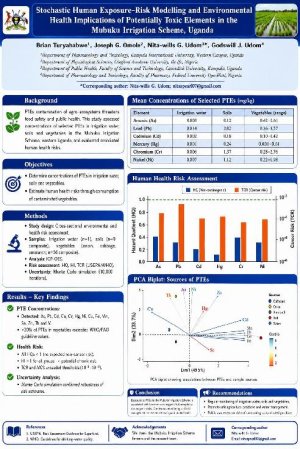
Anthropogenic activities in sub-Saharan Africa have increasingly contaminated agro-ecosystems with potentially toxic elements (PTEs), posing risks to food safety and public health. Study assessed the concentration, sources, and dietary health risks of 14 PTEs (As, Pb, Cd, Co, Cr, Hg, Ni, Cu, Fe, Mn, Se, Zn, Th, and V) in a point-source irrigation water (n = 1), agricultural soils (n = 9 composite samples), and commonly consumed vegetables (onion, cabbage, and amaranth; n = 24 composite samples) collected from the Mubuku Irrigation Scheme, western Uganda. Concentrations were determined using inductively coupled plasma–optical emission spectroscopy. Health risks were evaluated using deterministic non-carcinogenic (hazard quotient (HQ) and index (HI)) and carcinogenic (total cancer risk, TCR) assessments, complemented by Monte Carlo simulation (MCS; 10,000 iterations). More than 20% of detected PTEs in vegetables exceeded WHO/FAO limits. Arsenic (2.22–3.57 mg/kg), Pb (2.02–3.66 mg/kg), and Hg (0.42–0.61 mg/kg) consistently exceeded guideline values (0.1, 0.3, and 0.001 mg/kg, respectively), with the highest accumulation observed in amaranth. Irrigation water contained elevated As (1.56 mg/L) and Pb (2.73 mg/L). Estimated HI of PTEs indicated considerable non-carcinogenic risk (HI > 1) for all vegetables, driven primarily by Pb (HQ = 3.21–5.06) and As (HQ = 0.85–2.70) for adults (65–70 kg) and geriatrics (60 kg). Carcinogenic risk estimates (TCR = 5.72×10-⁴–2.99×10-³), including 50th (5.97×10⁻⁴–7.51×10⁻²) and upper-bound (95th) percentile (7.71×10⁻⁴–1.49×10⁻¹) stochastic outcomes, surpassed acceptable thresholds (10⁻⁶–10⁻⁴), indicating probable high lifetime cancer risks, exposure uncertainty and potential risk amplification among high-end consumers. Principal component analysis explained 83.2% of total variance, identifying mixed geogenic and anthropogenic sources, with soils and amaranth as dominant exposure pathways. This study provides the first integrated deterministic–probabilistic–multivariate assessment of PTE risks in a Ugandan irrigation scheme. The findings underscore urgent public health concerns and offer critical baseline evidence to support risk-informed management, targeted remediation, and sustainable agricultural policy interventions.
Keywords
Potentially toxic elements pollution
health risk assessment and analysis
stochastic modelling
vegetables
food safety
public health
Mubuku irrigation scheme
Poster
Mubuku_Irrigation_PTE_Research_Poster.pdf
Back to basics – a case of multidrug intoxication involving 6-APB, known on the black market as benzofury
Combined analysis of microplastic quantification and blood metabolomics for spotted seal mothers and their calves