Event submissions
Published
This submission belongs to the session 1. Exposure Routes / Exposome of Emerging Contaminants and Materials in the Environment of the event The 3rd International Online Conference on Toxics
Published date
04 Sep, 2026
Academic Editor
'%3e%3cpath%20d='M12.6657%2010.9104C12.4185%2010.325%2012.0599%209.79327%2011.6097%209.34482C11.1609%208.89508%2010.6293%208.5365%2010.0442%208.28888C10.0389%208.28626%2010.0337%208.28495%2010.0285%208.28233C10.8446%207.69279%2011.3752%206.73249%2011.3752%205.64904C11.3752%203.8542%209.92103%202.39999%208.1262%202.39999C6.33136%202.39999%204.87715%203.8542%204.87715%205.64904C4.87715%206.73249%205.40774%207.69279%206.22393%208.28364C6.21869%208.28626%206.21345%208.28757%206.20821%208.29019C5.62129%208.5378%205.09463%208.89284%204.64265%209.34613C4.1929%209.79493%203.83432%2010.3266%203.58671%2010.9117C3.34345%2011.4845%203.21226%2012.0987%203.20023%2012.7209C3.19988%2012.7349%203.20233%2012.7488%203.20744%2012.7619C3.21255%2012.7749%203.22022%2012.7867%203.22998%2012.7968C3.23975%2012.8068%203.25142%2012.8147%203.26431%2012.8202C3.2772%2012.8256%203.29105%2012.8284%203.30504%2012.8284H4.09109C4.14874%2012.8284%204.19459%2012.7825%204.1959%2012.7262C4.2221%2011.7148%204.62823%2010.7676%205.34617%2010.0497C6.08899%209.30683%207.0755%208.89808%208.1262%208.89808C9.17689%208.89808%2010.1634%209.30683%2010.9062%2010.0497C11.6242%2010.7676%2012.0303%2011.7148%2012.0565%2012.7262C12.0578%2012.7838%2012.1037%2012.8284%2012.1613%2012.8284H12.9474C12.9613%2012.8284%2012.9752%2012.8256%2012.9881%2012.8202C13.001%2012.8147%2013.0126%2012.8068%2013.0224%2012.7968C13.0322%2012.7867%2013.0398%2012.7749%2013.0449%2012.7619C13.0501%2012.7488%2013.0525%2012.7349%2013.0522%2012.7209C13.0391%2012.0947%2012.9094%2011.4855%2012.6657%2010.9104ZM8.1262%207.9024C7.52486%207.9024%206.9589%207.6679%206.53312%207.24211C6.10733%206.81633%205.87283%206.25037%205.87283%205.64904C5.87283%205.0477%206.10733%204.48174%206.53312%204.05596C6.9589%203.63018%207.52486%203.39567%208.1262%203.39567C8.72753%203.39567%209.29349%203.63018%209.71927%204.05596C10.1451%204.48174%2010.3796%205.0477%2010.3796%205.64904C10.3796%206.25037%2010.1451%206.81633%209.71927%207.24211C9.29349%207.6679%208.72753%207.9024%208.1262%207.9024Z'%20fill='%235D1EE1'/%3e%3c/g%3e%3c/svg%3e) Carlos Barata
Carlos BarataCitation
Jun Luo, Zexin Liu, Dan Xu, Combined analysis of microplastic quantification and blood metabolomics for spotted seal mothers and their calves, in Proceedings of The 3rd International Online Conference on Toxics, 9 September–11 September 2026, MDPI: Basel, Switzerland
Share
Email
Facebook
Twitter
LinkedIn
Combined analysis of microplastic quantification and blood metabolomics for spotted seal mothers and their calves
'%3e%3cpath%20d='M12.6647%2010.9104C12.4176%2010.325%2012.0589%209.7933%2011.6088%209.34485C11.16%208.89511%2010.6283%208.53653%2010.0432%208.28891C10.038%208.28629%2010.0327%208.28498%2010.0275%208.28236C10.8437%207.69282%2011.3743%206.73252%2011.3743%205.64907C11.3743%203.85423%209.92005%202.40002%208.12522%202.40002C6.33038%202.40002%204.87618%203.85423%204.87618%205.64907C4.87618%206.73252%205.40677%207.69282%206.22296%208.28367C6.21772%208.28629%206.21248%208.2876%206.20724%208.29022C5.62031%208.53783%205.09365%208.89287%204.64167%209.34616C4.19192%209.79496%203.83334%2010.3266%203.58573%2010.9117C3.34247%2011.4846%203.21128%2012.0987%203.19925%2012.721C3.1989%2012.735%203.20135%2012.7489%203.20646%2012.7619C3.21157%2012.7749%203.21924%2012.7868%203.22901%2012.7968C3.23877%2012.8068%203.25045%2012.8148%203.26334%2012.8202C3.27623%2012.8256%203.29007%2012.8284%203.30406%2012.8284H4.09012C4.14776%2012.8284%204.19362%2012.7825%204.19493%2012.7262C4.22113%2011.7148%204.62726%2010.7676%205.34519%2010.0497C6.08802%209.30686%207.07452%208.89811%208.12522%208.89811C9.17592%208.89811%2010.1624%209.30686%2010.9052%2010.0497C11.6232%2010.7676%2012.0293%2011.7148%2012.0555%2012.7262C12.0568%2012.7839%2012.1027%2012.8284%2012.1603%2012.8284H12.9464C12.9604%2012.8284%2012.9742%2012.8256%2012.9871%2012.8202C13%2012.8148%2013.0117%2012.8068%2013.0214%2012.7968C13.0312%2012.7868%2013.0389%2012.7749%2013.044%2012.7619C13.0491%2012.7489%2013.0515%2012.735%2013.0512%2012.721C13.0381%2012.0947%2012.9084%2011.4856%2012.6647%2010.9104ZM8.12522%207.90243C7.52388%207.90243%206.95792%207.66793%206.53214%207.24215C6.10636%206.81636%205.87185%206.2504%205.87185%205.64907C5.87185%205.04773%206.10636%204.48177%206.53214%204.05599C6.95792%203.63021%207.52388%203.3957%208.12522%203.3957C8.72655%203.3957%209.29252%203.63021%209.7183%204.05599C10.1441%204.48177%2010.3786%205.04773%2010.3786%205.64907C10.3786%206.2504%2010.1441%206.81636%209.7183%207.24215C9.29252%207.66793%208.72655%207.90243%208.12522%207.90243Z'%20fill='%235D1EE1'/%3e%3c/g%3e%3c/svg%3e)
Jun Luo 1
Zexin Liu 2
Dan Xu 1
1. College of Environmental Sciences and Engineering, Dalian Maritime University, Dalian, 116026
2. Dalian Sunasia Marine Biology Institute, Dalian 116023
Abstract
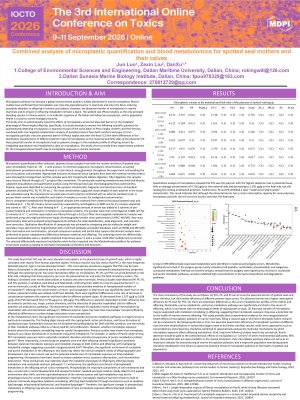
The present study set out with the objective of systematically revealing the impact of microplastics transplacent on the metabolic physiology of spotted seal offspring. To this end, microplastics were quantitatively detected in placental tissues from the same batch of spotted seal mothers and their fetuses. Furthermore, peripheral serum samples from mothers and pups were analysed and compared using non-targeted metabolomics techniques. The results demonstrated that PVC was the most prevalent polymer detected in placental tissue, with an average concentration of 4.718 μg/g on the maternal side, while the concentration decreased to 1.105 μg/g on the fetal side, yet still dominated among all detected polymers. Furthermore, PE and PS exhibited a clear "transfer from maternal to fetal side" characteristic; the average concentration of PE on the maternal side was 2.527 μg/g, while it decreased to 0.104 μg/g on the fetal side. This finding suggests that, despite the placental barrier's capacity to intercept certain polymers (including PVC, PS, and PE), microplastic particles can nevertheless traverse this barrier and gain entry into the fetus. At the metabolomics level, the study identified 499 differentially expressed metabolites in the serum of mothers and offspring. The analysis revealed that the offspring group exhibited a significant enrichment of metabolites, predominantly comprising small peptides, nucleotides, phospholipids, and metabolites of exogenous compounds. Multivariate statistical analysis demonstrated a clear separation of the metabolomic profiles of offspring and mothers along principal component 1 (PCA1, variance contribution rate 49.1%), and the PLS-DA model (R²Y=0.999, Q²=0.855) confirmed the systematic differences in the metabolomic profiles between mothers and offspring. Pathway enrichment analysis demonstrated significant enrichment in the nucleotide and purine metabolic pathways in offspring, with a high concentration in lysine biosynthesis and degradation pathways. This finding is highly consistent with the physiological state of offspring during rapid growth, active cell division, and tissue construction.
Keywords
Phoca largha
placental transfer
microplastics
blood metabolome
intergenerational effect
Poster
Combined analysis of microplastic quantification and blood metabolomics for spotted seal mothers and their calves.pdf
Chemical Pollution by Potentially Toxic Elements in the Mubuku Irrigation Scheme, Uganda: A Stochastic Human Exposure-Risk Modeling and Environmental Health Implications
Effects of Selenium on Iron Concentration and Catalase Activity in Mouse Liver under Aluminum Exposure