Event submissions
Published
This submission belongs to the session S1. Forest Ecology and Sustainable Management of the event The 5th International Electronic Conference on Forests
Published date
09 Sep, 2026
Academic Editor
'%3e%3cpath%20d='M12.6657%2010.9104C12.4185%2010.325%2012.0599%209.79327%2011.6097%209.34482C11.1609%208.89508%2010.6293%208.5365%2010.0442%208.28888C10.0389%208.28626%2010.0337%208.28495%2010.0285%208.28233C10.8446%207.69279%2011.3752%206.73249%2011.3752%205.64904C11.3752%203.8542%209.92103%202.39999%208.1262%202.39999C6.33136%202.39999%204.87715%203.8542%204.87715%205.64904C4.87715%206.73249%205.40774%207.69279%206.22393%208.28364C6.21869%208.28626%206.21345%208.28757%206.20821%208.29019C5.62129%208.5378%205.09463%208.89284%204.64265%209.34613C4.1929%209.79493%203.83432%2010.3266%203.58671%2010.9117C3.34345%2011.4845%203.21226%2012.0987%203.20023%2012.7209C3.19988%2012.7349%203.20233%2012.7488%203.20744%2012.7619C3.21255%2012.7749%203.22022%2012.7867%203.22998%2012.7968C3.23975%2012.8068%203.25142%2012.8147%203.26431%2012.8202C3.2772%2012.8256%203.29105%2012.8284%203.30504%2012.8284H4.09109C4.14874%2012.8284%204.19459%2012.7825%204.1959%2012.7262C4.2221%2011.7148%204.62823%2010.7676%205.34617%2010.0497C6.08899%209.30683%207.0755%208.89808%208.1262%208.89808C9.17689%208.89808%2010.1634%209.30683%2010.9062%2010.0497C11.6242%2010.7676%2012.0303%2011.7148%2012.0565%2012.7262C12.0578%2012.7838%2012.1037%2012.8284%2012.1613%2012.8284H12.9474C12.9613%2012.8284%2012.9752%2012.8256%2012.9881%2012.8202C13.001%2012.8147%2013.0126%2012.8068%2013.0224%2012.7968C13.0322%2012.7867%2013.0398%2012.7749%2013.0449%2012.7619C13.0501%2012.7488%2013.0525%2012.7349%2013.0522%2012.7209C13.0391%2012.0947%2012.9094%2011.4855%2012.6657%2010.9104ZM8.1262%207.9024C7.52486%207.9024%206.9589%207.6679%206.53312%207.24211C6.10733%206.81633%205.87283%206.25037%205.87283%205.64904C5.87283%205.0477%206.10733%204.48174%206.53312%204.05596C6.9589%203.63018%207.52486%203.39567%208.1262%203.39567C8.72753%203.39567%209.29349%203.63018%209.71927%204.05596C10.1451%204.48174%2010.3796%205.0477%2010.3796%205.64904C10.3796%206.25037%2010.1451%206.81633%209.71927%207.24211C9.29349%207.6679%208.72753%207.9024%208.1262%207.9024Z'%20fill='%235D1EE1'/%3e%3c/g%3e%3c/svg%3e) Giovanna Battipaglia
Giovanna BattipagliaCitation
Ericson Esquibel Coracero, Pastor Malabrigo, Persistence of Native Plant Assemblages in Forests Invaded by Swietenia macrophylla King (Meliaceae) in a Protected Landscape Buffer Zone: Implications for Biodiversity Conservation in the Philippines, in Proceedings of The 5th International Electronic Conference on Forests, 14 September–16 September 2026, MDPI: Basel, Switzerland
Share
Email
Facebook
Twitter
LinkedIn
Persistence of Native Plant Assemblages in Forests Invaded by Swietenia macrophylla King (Meliaceae) in a Protected Landscape Buffer Zone: Implications for Biodiversity Conservation in the Philippines
'%3e%3cpath%20d='M12.6647%2010.9104C12.4176%2010.325%2012.0589%209.7933%2011.6088%209.34485C11.16%208.89511%2010.6283%208.53653%2010.0432%208.28891C10.038%208.28629%2010.0327%208.28498%2010.0275%208.28236C10.8437%207.69282%2011.3743%206.73252%2011.3743%205.64907C11.3743%203.85423%209.92005%202.40002%208.12522%202.40002C6.33038%202.40002%204.87618%203.85423%204.87618%205.64907C4.87618%206.73252%205.40677%207.69282%206.22296%208.28367C6.21772%208.28629%206.21248%208.2876%206.20724%208.29022C5.62031%208.53783%205.09365%208.89287%204.64167%209.34616C4.19192%209.79496%203.83334%2010.3266%203.58573%2010.9117C3.34247%2011.4846%203.21128%2012.0987%203.19925%2012.721C3.1989%2012.735%203.20135%2012.7489%203.20646%2012.7619C3.21157%2012.7749%203.21924%2012.7868%203.22901%2012.7968C3.23877%2012.8068%203.25045%2012.8148%203.26334%2012.8202C3.27623%2012.8256%203.29007%2012.8284%203.30406%2012.8284H4.09012C4.14776%2012.8284%204.19362%2012.7825%204.19493%2012.7262C4.22113%2011.7148%204.62726%2010.7676%205.34519%2010.0497C6.08802%209.30686%207.07452%208.89811%208.12522%208.89811C9.17592%208.89811%2010.1624%209.30686%2010.9052%2010.0497C11.6232%2010.7676%2012.0293%2011.7148%2012.0555%2012.7262C12.0568%2012.7839%2012.1027%2012.8284%2012.1603%2012.8284H12.9464C12.9604%2012.8284%2012.9742%2012.8256%2012.9871%2012.8202C13%2012.8148%2013.0117%2012.8068%2013.0214%2012.7968C13.0312%2012.7868%2013.0389%2012.7749%2013.044%2012.7619C13.0491%2012.7489%2013.0515%2012.735%2013.0512%2012.721C13.0381%2012.0947%2012.9084%2011.4856%2012.6647%2010.9104ZM8.12522%207.90243C7.52388%207.90243%206.95792%207.66793%206.53214%207.24215C6.10636%206.81636%205.87185%206.2504%205.87185%205.64907C5.87185%205.04773%206.10636%204.48177%206.53214%204.05599C6.95792%203.63021%207.52388%203.3957%208.12522%203.3957C8.72655%203.3957%209.29252%203.63021%209.7183%204.05599C10.1441%204.48177%2010.3786%205.04773%2010.3786%205.64907C10.3786%206.2504%2010.1441%206.81636%209.7183%207.24215C9.29252%207.66793%208.72655%207.90243%208.12522%207.90243Z'%20fill='%235D1EE1'/%3e%3c/g%3e%3c/svg%3e)
Ericson Esquibel Coracero 1
Pastor Malabrigo 2
1. Hawkesbury Institute for the Environment, Western Sydney University, Richmond 2753, New South Wales, Australia
2. Department of Forest Biological Sciences, College of Forestry and Natural Resources, University of the Philippines Los Baños, College 4031, Laguna, Philippines
Abstract
Introduction:
Invasive alien tree species can substantially alter community structure and ecosystem processes in tropical forests; however, the long-term persistence of native plant assemblages in chronically invaded systems remains poorly resolved. This study examines patterns of native plant persistence within stands dominated by Swietenia macrophylla in the buffer zone of the Mts. Banahaw–San Cristobal Protected Landscape, Philippines, a region characterized by sustained invasion and anthropogenic disturbance.
Methods:
Comprehensive floristic inventories were conducted across 22 forested and mixed-use sites with established S. macrophylla dominance in the buffer zone of Mt. Banahaw de Nagcarlan, a designated protected area within the Mts. Banahaw–San Cristobal Protected Landscape, Philippines.. Native species composition, taxonomic distribution, and conservation status were quantified to evaluate community structure and infer filtering effects associated with invasion. Species were classified by growth form and endemism to assess ecological resilience under altered environmental conditions.
Results:
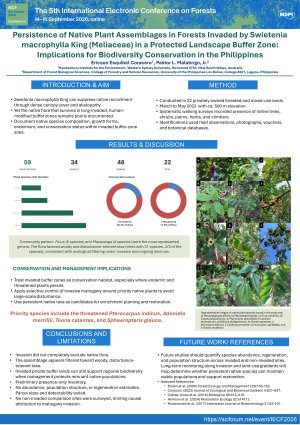
A total of 59 native plant species belonging to 34 families were documented across the invaded sites. Woody plants dominated the assemblage, accounting for approximately 71% of all recorded species. Moraceae (8 species) and Euphorbiaceae (6 species) were the most species-rich families. Twelve species (20.3%) were Philippine endemics, including several taxa classified as nationally or globally threatened. Despite the extensive dominance of Swietenia macrophylla, native species richness remained relatively high, indicating persistence of taxonomically diverse native flora within invaded stands. The observed community structure suggests strong environmental filtering associated with altered canopy conditions and historical land-use disturbance.
Conclusions:
These findings demonstrate that invasion by S. macrophylla does not result in complete exclusion of native flora but instead restructures community composition through selective filtering mechanisms. Invaded buffer zones may therefore retain significant conservation value and should be incorporated into adaptive management strategies that balance invasive species control with the protection of remnant native biodiversity.
Keywords
biological invasions
community assembly
environmental filtering
tropical forest ecology
endemic species
conservation management
Poster
Coracero IECF.pdf
Dynamics of North African Forests under Climate Change: A Species Distribution Modeling Approach in Morocco