Event submissions
Published
This submission belongs to the session S1. Forest Ecology and Sustainable Management of the event The 5th International Electronic Conference on Forests
Published date
09 Sep, 2026
Academic Editor
'%3e%3cpath%20d='M12.6657%2010.9104C12.4185%2010.325%2012.0599%209.79327%2011.6097%209.34482C11.1609%208.89508%2010.6293%208.5365%2010.0442%208.28888C10.0389%208.28626%2010.0337%208.28495%2010.0285%208.28233C10.8446%207.69279%2011.3752%206.73249%2011.3752%205.64904C11.3752%203.8542%209.92103%202.39999%208.1262%202.39999C6.33136%202.39999%204.87715%203.8542%204.87715%205.64904C4.87715%206.73249%205.40774%207.69279%206.22393%208.28364C6.21869%208.28626%206.21345%208.28757%206.20821%208.29019C5.62129%208.5378%205.09463%208.89284%204.64265%209.34613C4.1929%209.79493%203.83432%2010.3266%203.58671%2010.9117C3.34345%2011.4845%203.21226%2012.0987%203.20023%2012.7209C3.19988%2012.7349%203.20233%2012.7488%203.20744%2012.7619C3.21255%2012.7749%203.22022%2012.7867%203.22998%2012.7968C3.23975%2012.8068%203.25142%2012.8147%203.26431%2012.8202C3.2772%2012.8256%203.29105%2012.8284%203.30504%2012.8284H4.09109C4.14874%2012.8284%204.19459%2012.7825%204.1959%2012.7262C4.2221%2011.7148%204.62823%2010.7676%205.34617%2010.0497C6.08899%209.30683%207.0755%208.89808%208.1262%208.89808C9.17689%208.89808%2010.1634%209.30683%2010.9062%2010.0497C11.6242%2010.7676%2012.0303%2011.7148%2012.0565%2012.7262C12.0578%2012.7838%2012.1037%2012.8284%2012.1613%2012.8284H12.9474C12.9613%2012.8284%2012.9752%2012.8256%2012.9881%2012.8202C13.001%2012.8147%2013.0126%2012.8068%2013.0224%2012.7968C13.0322%2012.7867%2013.0398%2012.7749%2013.0449%2012.7619C13.0501%2012.7488%2013.0525%2012.7349%2013.0522%2012.7209C13.0391%2012.0947%2012.9094%2011.4855%2012.6657%2010.9104ZM8.1262%207.9024C7.52486%207.9024%206.9589%207.6679%206.53312%207.24211C6.10733%206.81633%205.87283%206.25037%205.87283%205.64904C5.87283%205.0477%206.10733%204.48174%206.53312%204.05596C6.9589%203.63018%207.52486%203.39567%208.1262%203.39567C8.72753%203.39567%209.29349%203.63018%209.71927%204.05596C10.1451%204.48174%2010.3796%205.0477%2010.3796%205.64904C10.3796%206.25037%2010.1451%206.81633%209.71927%207.24211C9.29349%207.6679%208.72753%207.9024%208.1262%207.9024Z'%20fill='%235D1EE1'/%3e%3c/g%3e%3c/svg%3e) Giovanna Battipaglia
Giovanna BattipagliaCitation
said moukrim, Said Lahssini, Kamal Menzou, Issam Ifaadassan, Abdessadeq Boudjaj, Laila Rhazi, Dynamics of North African Forests under Climate Change: A Species Distribution Modeling Approach in Morocco, in Proceedings of The 5th International Electronic Conference on Forests, 14 September–16 September 2026, MDPI: Basel, Switzerland
Share
Email
Facebook
Twitter
LinkedIn
Dynamics of North African Forests under Climate Change: A Species Distribution Modeling Approach in Morocco
'%3e%3cpath%20d='M12.6647%2010.9104C12.4176%2010.325%2012.0589%209.7933%2011.6088%209.34485C11.16%208.89511%2010.6283%208.53653%2010.0432%208.28891C10.038%208.28629%2010.0327%208.28498%2010.0275%208.28236C10.8437%207.69282%2011.3743%206.73252%2011.3743%205.64907C11.3743%203.85423%209.92005%202.40002%208.12522%202.40002C6.33038%202.40002%204.87618%203.85423%204.87618%205.64907C4.87618%206.73252%205.40677%207.69282%206.22296%208.28367C6.21772%208.28629%206.21248%208.2876%206.20724%208.29022C5.62031%208.53783%205.09365%208.89287%204.64167%209.34616C4.19192%209.79496%203.83334%2010.3266%203.58573%2010.9117C3.34247%2011.4846%203.21128%2012.0987%203.19925%2012.721C3.1989%2012.735%203.20135%2012.7489%203.20646%2012.7619C3.21157%2012.7749%203.21924%2012.7868%203.22901%2012.7968C3.23877%2012.8068%203.25045%2012.8148%203.26334%2012.8202C3.27623%2012.8256%203.29007%2012.8284%203.30406%2012.8284H4.09012C4.14776%2012.8284%204.19362%2012.7825%204.19493%2012.7262C4.22113%2011.7148%204.62726%2010.7676%205.34519%2010.0497C6.08802%209.30686%207.07452%208.89811%208.12522%208.89811C9.17592%208.89811%2010.1624%209.30686%2010.9052%2010.0497C11.6232%2010.7676%2012.0293%2011.7148%2012.0555%2012.7262C12.0568%2012.7839%2012.1027%2012.8284%2012.1603%2012.8284H12.9464C12.9604%2012.8284%2012.9742%2012.8256%2012.9871%2012.8202C13%2012.8148%2013.0117%2012.8068%2013.0214%2012.7968C13.0312%2012.7868%2013.0389%2012.7749%2013.044%2012.7619C13.0491%2012.7489%2013.0515%2012.735%2013.0512%2012.721C13.0381%2012.0947%2012.9084%2011.4856%2012.6647%2010.9104ZM8.12522%207.90243C7.52388%207.90243%206.95792%207.66793%206.53214%207.24215C6.10636%206.81636%205.87185%206.2504%205.87185%205.64907C5.87185%205.04773%206.10636%204.48177%206.53214%204.05599C6.95792%203.63021%207.52388%203.3957%208.12522%203.3957C8.72655%203.3957%209.29252%203.63021%209.7183%204.05599C10.1441%204.48177%2010.3786%205.04773%2010.3786%205.64907C10.3786%206.2504%2010.1441%206.81636%209.7183%207.24215C9.29252%207.66793%208.72655%207.90243%208.12522%207.90243Z'%20fill='%235D1EE1'/%3e%3c/g%3e%3c/svg%3e)
said moukrim 1
Said Lahssini 2
Kamal Menzou 2
Issam Ifaadassan 1
Abdessadeq Boudjaj 1
Laila Rhazi 1
1. Laboratory of Botany and Valorization of Plant and Fungal Resources (BOVAREF), Faculty of Sciences, Mohammed V University, Rabat, BP1014 RP, Morocco
2. Forest Management department, National School of Forestry Engineers, Salé, 11000 BP. 511, Morocco
Abstract
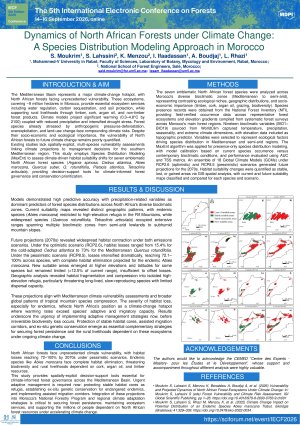
North African forests, located in a major Mediterranean climate change hotspot, provide essential ecological and socio-economic services but face increasing climatic and anthropogenic pressures. This study assesses the vulnerability of seven emblematic Moroccan forest tree species (Argania spinosa, Cedrus atlantica, Abies marocana, Quercus suber, Quercus rotundifolia, Pistacia atlantica, Tetraclinis articulata) to projected climate change, aiming to anticipate habitat shifts and support adaptive forest management. Species distribution models were built using the MaxEnt algorithm, combining occurrence data from the National Forest Inventory with 19 bioclimatic variables and elevation. Future projections were derived from an ensemble of 18 GCMs under two scenarios (optimistic/pessimistic). Model performance was evaluated using AUC/TSS, and habitat suitability changes (stable, lost, gain) were quantified through GIS-based spatial analysis. Models showed high predictive accuracy, with precipitation-related variables as dominant predictors. Current and future (2070) suitability maps were produced for each species, revealing widespread spatial contractions and limited emergence of new favorable zones. Under optimistic scenario, habitat losses ranged from 15.4% (C. atlantica) to 73% (Q. rotundifolia). Under pessimistic scenario, losses reached 72.1–100%, with complete habitat elimination projected for A. marocana. New suitable areas (<12.5%) were insufficient to offset losses, indicating widespread range contraction and fragmentation. Southern Mediterranean forests face severe climate-driven contraction, threatening biodiversity, endemic species survival, and rural livelihoods dependent on cork, argan oil, and grazing. These spatially explicit projections provide critical decision-support tools for forest governance in Morocco and the broader North Africa. Management priorities should include the protection of stable habitat cores as conservation refugia, ex-situ genetic conservation for critically endangered endemics such as A. marocana, and proactive assisted migration and restoration in emerging suitable areas for resilient species such as T. articulata and A. spinosa. Integrating these projections into reforestation programs, land-use planning, and regional cooperation across the Maghreb is essential to anticipate climate impacts and secure forest-dependent livelihoods.
Keywords
MaxEnt
Climate change vulnerability
Forest Ecologys
Habitat suitability
Forest management
Poster
IECF2026_MOUKRIM_Poster_vf.pdf
Persistence of Native Plant Assemblages in Forests Invaded by Swietenia macrophylla King (Meliaceae) in a Protected Landscape Buffer Zone: Implications for Biodiversity Conservation in the Philippines
Unveiling Amazon Forest Vertical Dynamics through Multifrequency Microwave Radiometry