Event submissions
Published
This submission belongs to the session S1. Forest Ecology and Sustainable Management of the event The 5th International Electronic Conference on Forests
Published date
09 Sep, 2026
Academic Editor
'%3e%3cpath%20d='M12.6657%2010.9104C12.4185%2010.325%2012.0599%209.79327%2011.6097%209.34482C11.1609%208.89508%2010.6293%208.5365%2010.0442%208.28888C10.0389%208.28626%2010.0337%208.28495%2010.0285%208.28233C10.8446%207.69279%2011.3752%206.73249%2011.3752%205.64904C11.3752%203.8542%209.92103%202.39999%208.1262%202.39999C6.33136%202.39999%204.87715%203.8542%204.87715%205.64904C4.87715%206.73249%205.40774%207.69279%206.22393%208.28364C6.21869%208.28626%206.21345%208.28757%206.20821%208.29019C5.62129%208.5378%205.09463%208.89284%204.64265%209.34613C4.1929%209.79493%203.83432%2010.3266%203.58671%2010.9117C3.34345%2011.4845%203.21226%2012.0987%203.20023%2012.7209C3.19988%2012.7349%203.20233%2012.7488%203.20744%2012.7619C3.21255%2012.7749%203.22022%2012.7867%203.22998%2012.7968C3.23975%2012.8068%203.25142%2012.8147%203.26431%2012.8202C3.2772%2012.8256%203.29105%2012.8284%203.30504%2012.8284H4.09109C4.14874%2012.8284%204.19459%2012.7825%204.1959%2012.7262C4.2221%2011.7148%204.62823%2010.7676%205.34617%2010.0497C6.08899%209.30683%207.0755%208.89808%208.1262%208.89808C9.17689%208.89808%2010.1634%209.30683%2010.9062%2010.0497C11.6242%2010.7676%2012.0303%2011.7148%2012.0565%2012.7262C12.0578%2012.7838%2012.1037%2012.8284%2012.1613%2012.8284H12.9474C12.9613%2012.8284%2012.9752%2012.8256%2012.9881%2012.8202C13.001%2012.8147%2013.0126%2012.8068%2013.0224%2012.7968C13.0322%2012.7867%2013.0398%2012.7749%2013.0449%2012.7619C13.0501%2012.7488%2013.0525%2012.7349%2013.0522%2012.7209C13.0391%2012.0947%2012.9094%2011.4855%2012.6657%2010.9104ZM8.1262%207.9024C7.52486%207.9024%206.9589%207.6679%206.53312%207.24211C6.10733%206.81633%205.87283%206.25037%205.87283%205.64904C5.87283%205.0477%206.10733%204.48174%206.53312%204.05596C6.9589%203.63018%207.52486%203.39567%208.1262%203.39567C8.72753%203.39567%209.29349%203.63018%209.71927%204.05596C10.1451%204.48174%2010.3796%205.0477%2010.3796%205.64904C10.3796%206.25037%2010.1451%206.81633%209.71927%207.24211C9.29349%207.6679%208.72753%207.9024%208.1262%207.9024Z'%20fill='%235D1EE1'/%3e%3c/g%3e%3c/svg%3e) Giovanna Battipaglia
Giovanna BattipagliaCitation
Maeve Lynskey, Juan A. Blanco, J. Bosco Imbert, Analysing twenty-six years of phosphorus return via litterfall in two contrasting Pinus sylvestris forests under different thinning intensities (western Pyrenees, Spain), in Proceedings of The 5th International Electronic Conference on Forests, 14 September–16 September 2026, MDPI: Basel, Switzerland
Share
Email
Facebook
Twitter
LinkedIn
Analysing twenty-six years of phosphorus return via litterfall in two contrasting Pinus sylvestris forests under different thinning intensities (western Pyrenees, Spain)
'%3e%3cpath%20d='M12.6647%2010.9104C12.4176%2010.325%2012.0589%209.7933%2011.6088%209.34485C11.16%208.89511%2010.6283%208.53653%2010.0432%208.28891C10.038%208.28629%2010.0327%208.28498%2010.0275%208.28236C10.8437%207.69282%2011.3743%206.73252%2011.3743%205.64907C11.3743%203.85423%209.92005%202.40002%208.12522%202.40002C6.33038%202.40002%204.87618%203.85423%204.87618%205.64907C4.87618%206.73252%205.40677%207.69282%206.22296%208.28367C6.21772%208.28629%206.21248%208.2876%206.20724%208.29022C5.62031%208.53783%205.09365%208.89287%204.64167%209.34616C4.19192%209.79496%203.83334%2010.3266%203.58573%2010.9117C3.34247%2011.4846%203.21128%2012.0987%203.19925%2012.721C3.1989%2012.735%203.20135%2012.7489%203.20646%2012.7619C3.21157%2012.7749%203.21924%2012.7868%203.22901%2012.7968C3.23877%2012.8068%203.25045%2012.8148%203.26334%2012.8202C3.27623%2012.8256%203.29007%2012.8284%203.30406%2012.8284H4.09012C4.14776%2012.8284%204.19362%2012.7825%204.19493%2012.7262C4.22113%2011.7148%204.62726%2010.7676%205.34519%2010.0497C6.08802%209.30686%207.07452%208.89811%208.12522%208.89811C9.17592%208.89811%2010.1624%209.30686%2010.9052%2010.0497C11.6232%2010.7676%2012.0293%2011.7148%2012.0555%2012.7262C12.0568%2012.7839%2012.1027%2012.8284%2012.1603%2012.8284H12.9464C12.9604%2012.8284%2012.9742%2012.8256%2012.9871%2012.8202C13%2012.8148%2013.0117%2012.8068%2013.0214%2012.7968C13.0312%2012.7868%2013.0389%2012.7749%2013.044%2012.7619C13.0491%2012.7489%2013.0515%2012.735%2013.0512%2012.721C13.0381%2012.0947%2012.9084%2011.4856%2012.6647%2010.9104ZM8.12522%207.90243C7.52388%207.90243%206.95792%207.66793%206.53214%207.24215C6.10636%206.81636%205.87185%206.2504%205.87185%205.64907C5.87185%205.04773%206.10636%204.48177%206.53214%204.05599C6.95792%203.63021%207.52388%203.3957%208.12522%203.3957C8.72655%203.3957%209.29252%203.63021%209.7183%204.05599C10.1441%204.48177%2010.3786%205.04773%2010.3786%205.64907C10.3786%206.2504%2010.1441%206.81636%209.7183%207.24215C9.29252%207.66793%208.72655%207.90243%208.12522%207.90243Z'%20fill='%235D1EE1'/%3e%3c/g%3e%3c/svg%3e)
Maeve Lynskey 1

Juan A. Blanco 2
J. Bosco Imbert 2
1. Independent Researcher, Pamplona, 31006, Spain
2. Dep. Sciences, Public Univerisity of Navarre, Pamplona, 31006, Spain
Abstract
Introduction
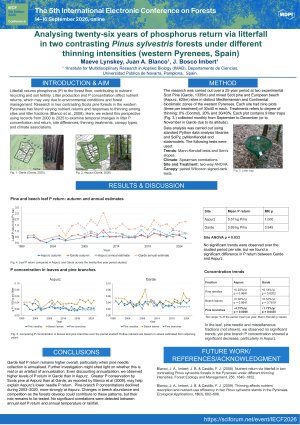
Phosphorus (P) is frequently a limiting nutrient in temperate forest ecosystems, yet accurate long-term estimates of P fluxes remain rare because they require uninterrupted field measurement across many years. Sustainable management of temperate forests should ideally account for these cycles, since harvesting decisions can either conserve or progressively deplete site P capital.
Methods
This study draws on a long-term litterfall monitoring programme in two even-aged *Pinus sylvestris* L. forests that represent the extremes of a site-quality gradient in the western Pyrenees (Navarre, Spain): Aspurz, a productive Mediterranean site (625m, mean annual temperature 12°C, 912 mm precipitation), and Garde, a lower-productivity continental site (1335m, 8.2 °C, 1268 mm). At each site, a randomized block design compares three treatments; an unthinned control, moderate thinning (20% of basal area removed) and heavy thinning (30%). Since 2000, litterfall has been collected over regular intervals using circular litter traps, separated into needles, other pine organs and miscellaneous fractions, oven-dried and analysed for P, allowing annual P return (kg P ha⁻¹ yr⁻¹) to be quantified for each year from 2000 to 2025.
Expected Results
To analyse long-term trends, we will use non-parametric trend analysis (Mann–Kendall test with Sen's slope estimator) together with time-series decomposition to analyse the dataset, with the aim of separating real trends from interannual climatic variability. We will further use machine-learning (e.g. random-forest models with variable-importance analysis) to disentangle the relative influence of climatic versus management drivers on the magnitude and direction of P-return trends.
Conclusions
We expect to identify site and treatment dependent trends in litterfall P return that reveal how thinning intensity shapes long-term phosphorus cycling and inform sustainable management of temperate Scots pine forests.
Keywords
sustainable forest management
long-term nutrient flows
phosporous
Poster
Maeve_Lynskey_poster.pdf
Spatial dynamics and innovative approaches for the governance of argan forest heritage and ecological risk reduction;
Case study of the Chiadma territory, Essaouira /Mogador , Morocco
Operational Planning in Chestnut Coppices: Testing GIS–AHP Across Stakeholder Perspectives