Event submissions
Published
This submission belongs to the session S1. Forest Ecology and Sustainable Management of the event The 5th International Electronic Conference on Forests
Published date
09 Sep, 2026
Academic Editor
'%3e%3cpath%20d='M12.6657%2010.9104C12.4185%2010.325%2012.0599%209.79327%2011.6097%209.34482C11.1609%208.89508%2010.6293%208.5365%2010.0442%208.28888C10.0389%208.28626%2010.0337%208.28495%2010.0285%208.28233C10.8446%207.69279%2011.3752%206.73249%2011.3752%205.64904C11.3752%203.8542%209.92103%202.39999%208.1262%202.39999C6.33136%202.39999%204.87715%203.8542%204.87715%205.64904C4.87715%206.73249%205.40774%207.69279%206.22393%208.28364C6.21869%208.28626%206.21345%208.28757%206.20821%208.29019C5.62129%208.5378%205.09463%208.89284%204.64265%209.34613C4.1929%209.79493%203.83432%2010.3266%203.58671%2010.9117C3.34345%2011.4845%203.21226%2012.0987%203.20023%2012.7209C3.19988%2012.7349%203.20233%2012.7488%203.20744%2012.7619C3.21255%2012.7749%203.22022%2012.7867%203.22998%2012.7968C3.23975%2012.8068%203.25142%2012.8147%203.26431%2012.8202C3.2772%2012.8256%203.29105%2012.8284%203.30504%2012.8284H4.09109C4.14874%2012.8284%204.19459%2012.7825%204.1959%2012.7262C4.2221%2011.7148%204.62823%2010.7676%205.34617%2010.0497C6.08899%209.30683%207.0755%208.89808%208.1262%208.89808C9.17689%208.89808%2010.1634%209.30683%2010.9062%2010.0497C11.6242%2010.7676%2012.0303%2011.7148%2012.0565%2012.7262C12.0578%2012.7838%2012.1037%2012.8284%2012.1613%2012.8284H12.9474C12.9613%2012.8284%2012.9752%2012.8256%2012.9881%2012.8202C13.001%2012.8147%2013.0126%2012.8068%2013.0224%2012.7968C13.0322%2012.7867%2013.0398%2012.7749%2013.0449%2012.7619C13.0501%2012.7488%2013.0525%2012.7349%2013.0522%2012.7209C13.0391%2012.0947%2012.9094%2011.4855%2012.6657%2010.9104ZM8.1262%207.9024C7.52486%207.9024%206.9589%207.6679%206.53312%207.24211C6.10733%206.81633%205.87283%206.25037%205.87283%205.64904C5.87283%205.0477%206.10733%204.48174%206.53312%204.05596C6.9589%203.63018%207.52486%203.39567%208.1262%203.39567C8.72753%203.39567%209.29349%203.63018%209.71927%204.05596C10.1451%204.48174%2010.3796%205.0477%2010.3796%205.64904C10.3796%206.25037%2010.1451%206.81633%209.71927%207.24211C9.29349%207.6679%208.72753%207.9024%208.1262%207.9024Z'%20fill='%235D1EE1'/%3e%3c/g%3e%3c/svg%3e) Giovanna Battipaglia
Giovanna BattipagliaCitation
Reshid Ibragimov, Ivan Bacherikov, Dmitry Danilov, Evaluation of the need for nature reserves located on forested lands in the Republic of Crimea, in Proceedings of The 5th International Electronic Conference on Forests, 14 September–16 September 2026, MDPI: Basel, Switzerland
Share
Email
Facebook
Twitter
LinkedIn
Evaluation of the need for nature reserves located on forested lands in the Republic of Crimea
'%3e%3cpath%20d='M12.6647%2010.9104C12.4176%2010.325%2012.0589%209.7933%2011.6088%209.34485C11.16%208.89511%2010.6283%208.53653%2010.0432%208.28891C10.038%208.28629%2010.0327%208.28498%2010.0275%208.28236C10.8437%207.69282%2011.3743%206.73252%2011.3743%205.64907C11.3743%203.85423%209.92005%202.40002%208.12522%202.40002C6.33038%202.40002%204.87618%203.85423%204.87618%205.64907C4.87618%206.73252%205.40677%207.69282%206.22296%208.28367C6.21772%208.28629%206.21248%208.2876%206.20724%208.29022C5.62031%208.53783%205.09365%208.89287%204.64167%209.34616C4.19192%209.79496%203.83334%2010.3266%203.58573%2010.9117C3.34247%2011.4846%203.21128%2012.0987%203.19925%2012.721C3.1989%2012.735%203.20135%2012.7489%203.20646%2012.7619C3.21157%2012.7749%203.21924%2012.7868%203.22901%2012.7968C3.23877%2012.8068%203.25045%2012.8148%203.26334%2012.8202C3.27623%2012.8256%203.29007%2012.8284%203.30406%2012.8284H4.09012C4.14776%2012.8284%204.19362%2012.7825%204.19493%2012.7262C4.22113%2011.7148%204.62726%2010.7676%205.34519%2010.0497C6.08802%209.30686%207.07452%208.89811%208.12522%208.89811C9.17592%208.89811%2010.1624%209.30686%2010.9052%2010.0497C11.6232%2010.7676%2012.0293%2011.7148%2012.0555%2012.7262C12.0568%2012.7839%2012.1027%2012.8284%2012.1603%2012.8284H12.9464C12.9604%2012.8284%2012.9742%2012.8256%2012.9871%2012.8202C13%2012.8148%2013.0117%2012.8068%2013.0214%2012.7968C13.0312%2012.7868%2013.0389%2012.7749%2013.044%2012.7619C13.0491%2012.7489%2013.0515%2012.735%2013.0512%2012.721C13.0381%2012.0947%2012.9084%2011.4856%2012.6647%2010.9104ZM8.12522%207.90243C7.52388%207.90243%206.95792%207.66793%206.53214%207.24215C6.10636%206.81636%205.87185%206.2504%205.87185%205.64907C5.87185%205.04773%206.10636%204.48177%206.53214%204.05599C6.95792%203.63021%207.52388%203.3957%208.12522%203.3957C8.72655%203.3957%209.29252%203.63021%209.7183%204.05599C10.1441%204.48177%2010.3786%205.04773%2010.3786%205.64907C10.3786%206.2504%2010.1441%206.81636%209.7183%207.24215C9.29252%207.66793%208.72655%207.90243%208.12522%207.90243Z'%20fill='%235D1EE1'/%3e%3c/g%3e%3c/svg%3e)
Reshid Ibragimov 1
Ivan Bacherikov 2
Dmitry Danilov 1
1. Soil Science Department, Institute of Forestry and Natural Resource Management, Federal State Educational Institution of Higher Professional Education «Saint-Petersburg State Forest Technical University named after S.M. Kirov», Saint-Petersburg, 194021, R, Russia
2. Department of Mathematical Modeling and Optimization Computing, LLC «Smart Digital Solutions», Novoivanovskoye working settlement, 143001, Russia
Abstract
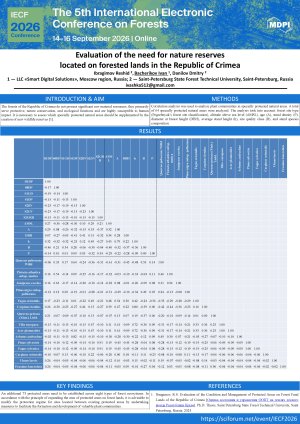
The forests of the Republic of Crimea serve protective, nature conservation, and ecological functions, but remain highly vulnerable to anthropogenic impact. This study assesses the necessity of establishing additional specially protected natural areas (PAs) on forest fund lands to enhance biodiversity conservation and ecological connectivity. Using correlation analysis based on Pogrebnyak’s forest site classification, a total of 64 PAs were evaluated according to key stand parameters: altitude, age, stand density, DBH, average height, site quality class, and species composition. The analysis identified specific forest ecosystem types requiring expansion. Results indicate that 75 additional PAs need to be established across eight types of forest ecosystems.
Pure stands include: five PAs of Juniperus sabina L.; eight of Fagus orientalis Lipsky; five of Carpinus betulus L.; and five of F. orientalis Lipsky.
Mixed stands include: two PAs of Pistacia atlantica Desf. with J. sabina L.; two of P. atlantica with Quercus petraea (Matt.) Liebl.; two of Quercus pubescens Willd. with F. orientalis Lipsky and C. betulus; six of Q. pubescens with C. betulus and Pinus nigra J.F.Arnold; five of P. nigra with Q. pubescens ; five of Q. pubescens with P. atlantica and P. nigra; ten of F. orientalis with C. betulus, P. nigra, and Q. pubescens; ten of F. orientalis with P. nigra; five of Q. pubescens with P. atlantica, J. sabina, and P. nigra; and five of Q. petraea with Betula pendula Roth.
No additions are required for the juniper-dominated group within D1DP (Dry oak forest site, downy oak type) or for S1DP (Dry mixed oak forest site, downy oak type) conditions. Following the principle of expanding PA areas on forest lands, modifying protection regimes between existing PAs by forming of valuable plant communities is recommended, creating ecological corridors that connect currently isolated clusters.
Keywords
forest fund lands
protected natural areas
nature reserves
Republic of Crimea
correlation analysis
Poster
2026-05-14 Poster.pdf
PLANT DIVERSITY AND ECOLOGICAL CHARACTERISTICS OF THE VEGETATION OF THE DOSSO PARTIAL WILDLIFE RESERVE
Effects of Surrounding Forest Cover and Stand Characteristics on Grapevine Trunk Disease Symptoms and Vine Mortality