Event submissions
Published
This submission belongs to the session S1. Forest Ecology and Sustainable Management of the event The 5th International Electronic Conference on Forests
Published date
09 Sep, 2026
Academic Editor
'%3e%3cpath%20d='M12.6657%2010.9104C12.4185%2010.325%2012.0599%209.79327%2011.6097%209.34482C11.1609%208.89508%2010.6293%208.5365%2010.0442%208.28888C10.0389%208.28626%2010.0337%208.28495%2010.0285%208.28233C10.8446%207.69279%2011.3752%206.73249%2011.3752%205.64904C11.3752%203.8542%209.92103%202.39999%208.1262%202.39999C6.33136%202.39999%204.87715%203.8542%204.87715%205.64904C4.87715%206.73249%205.40774%207.69279%206.22393%208.28364C6.21869%208.28626%206.21345%208.28757%206.20821%208.29019C5.62129%208.5378%205.09463%208.89284%204.64265%209.34613C4.1929%209.79493%203.83432%2010.3266%203.58671%2010.9117C3.34345%2011.4845%203.21226%2012.0987%203.20023%2012.7209C3.19988%2012.7349%203.20233%2012.7488%203.20744%2012.7619C3.21255%2012.7749%203.22022%2012.7867%203.22998%2012.7968C3.23975%2012.8068%203.25142%2012.8147%203.26431%2012.8202C3.2772%2012.8256%203.29105%2012.8284%203.30504%2012.8284H4.09109C4.14874%2012.8284%204.19459%2012.7825%204.1959%2012.7262C4.2221%2011.7148%204.62823%2010.7676%205.34617%2010.0497C6.08899%209.30683%207.0755%208.89808%208.1262%208.89808C9.17689%208.89808%2010.1634%209.30683%2010.9062%2010.0497C11.6242%2010.7676%2012.0303%2011.7148%2012.0565%2012.7262C12.0578%2012.7838%2012.1037%2012.8284%2012.1613%2012.8284H12.9474C12.9613%2012.8284%2012.9752%2012.8256%2012.9881%2012.8202C13.001%2012.8147%2013.0126%2012.8068%2013.0224%2012.7968C13.0322%2012.7867%2013.0398%2012.7749%2013.0449%2012.7619C13.0501%2012.7488%2013.0525%2012.7349%2013.0522%2012.7209C13.0391%2012.0947%2012.9094%2011.4855%2012.6657%2010.9104ZM8.1262%207.9024C7.52486%207.9024%206.9589%207.6679%206.53312%207.24211C6.10733%206.81633%205.87283%206.25037%205.87283%205.64904C5.87283%205.0477%206.10733%204.48174%206.53312%204.05596C6.9589%203.63018%207.52486%203.39567%208.1262%203.39567C8.72753%203.39567%209.29349%203.63018%209.71927%204.05596C10.1451%204.48174%2010.3796%205.0477%2010.3796%205.64904C10.3796%206.25037%2010.1451%206.81633%209.71927%207.24211C9.29349%207.6679%208.72753%207.9024%208.1262%207.9024Z'%20fill='%235D1EE1'/%3e%3c/g%3e%3c/svg%3e) Giovanna Battipaglia
Giovanna BattipagliaCitation
Milana Šilanskienė, Dorotėja Vaitiekūnaitė, Vaida Sirgedaitė-Polikaitienė, Bacterial Priming of Scots Pine Seedlings Under Drought: Biochemical Evidence from Three Genotypes, in Proceedings of The 5th International Electronic Conference on Forests, 14 September–16 September 2026, MDPI: Basel, Switzerland
Share
Email
Facebook
Twitter
LinkedIn
Bacterial Priming of Scots Pine Seedlings Under Drought: Biochemical Evidence from Three Genotypes

Milana Šilanskienė 1

Dorotėja Vaitiekūnaitė 1
'%3e%3cpath%20d='M12.6647%2010.9104C12.4176%2010.325%2012.0589%209.7933%2011.6088%209.34485C11.16%208.89511%2010.6283%208.53653%2010.0432%208.28891C10.038%208.28629%2010.0327%208.28498%2010.0275%208.28236C10.8437%207.69282%2011.3743%206.73252%2011.3743%205.64907C11.3743%203.85423%209.92005%202.40002%208.12522%202.40002C6.33038%202.40002%204.87618%203.85423%204.87618%205.64907C4.87618%206.73252%205.40677%207.69282%206.22296%208.28367C6.21772%208.28629%206.21248%208.2876%206.20724%208.29022C5.62031%208.53783%205.09365%208.89287%204.64167%209.34616C4.19192%209.79496%203.83334%2010.3266%203.58573%2010.9117C3.34247%2011.4846%203.21128%2012.0987%203.19925%2012.721C3.1989%2012.735%203.20135%2012.7489%203.20646%2012.7619C3.21157%2012.7749%203.21924%2012.7868%203.22901%2012.7968C3.23877%2012.8068%203.25045%2012.8148%203.26334%2012.8202C3.27623%2012.8256%203.29007%2012.8284%203.30406%2012.8284H4.09012C4.14776%2012.8284%204.19362%2012.7825%204.19493%2012.7262C4.22113%2011.7148%204.62726%2010.7676%205.34519%2010.0497C6.08802%209.30686%207.07452%208.89811%208.12522%208.89811C9.17592%208.89811%2010.1624%209.30686%2010.9052%2010.0497C11.6232%2010.7676%2012.0293%2011.7148%2012.0555%2012.7262C12.0568%2012.7839%2012.1027%2012.8284%2012.1603%2012.8284H12.9464C12.9604%2012.8284%2012.9742%2012.8256%2012.9871%2012.8202C13%2012.8148%2013.0117%2012.8068%2013.0214%2012.7968C13.0312%2012.7868%2013.0389%2012.7749%2013.044%2012.7619C13.0491%2012.7489%2013.0515%2012.735%2013.0512%2012.721C13.0381%2012.0947%2012.9084%2011.4856%2012.6647%2010.9104ZM8.12522%207.90243C7.52388%207.90243%206.95792%207.66793%206.53214%207.24215C6.10636%206.81636%205.87185%206.2504%205.87185%205.64907C5.87185%205.04773%206.10636%204.48177%206.53214%204.05599C6.95792%203.63021%207.52388%203.3957%208.12522%203.3957C8.72655%203.3957%209.29252%203.63021%209.7183%204.05599C10.1441%204.48177%2010.3786%205.04773%2010.3786%205.64907C10.3786%206.2504%2010.1441%206.81636%209.7183%207.24215C9.29252%207.66793%208.72655%207.90243%208.12522%207.90243Z'%20fill='%235D1EE1'/%3e%3c/g%3e%3c/svg%3e)
Vaida Sirgedaitė-Polikaitienė 1
1. Lithuanian Research Centre for Agriculture and Forestry, Institute of Forestry, Laboratory of Forest Plant Biotechnology, Girionys, LT-53101, Lithuania
Abstract
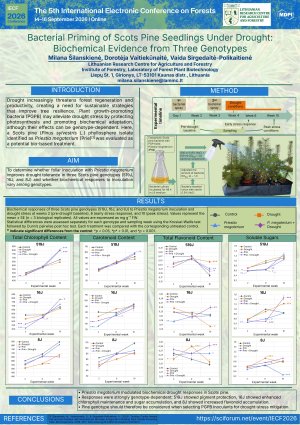
Drought stress increasingly threatens forest ecosystems, highlighting the need for sustainable and bio-based mitigation strategies for resilient forest management. This study examined the ability of a plant growth-promoting bacterium (PGPB) derived from Scots pine (Pinus sylvestris L.) phyllosphere, previously identified as Priestia megaterium (Prie), to improve drought tolerance in three pine genotypes (8J, 16J, and 519J) through biochemical profiling over a 10-week period.
Under greenhouse conditions, three-year-old pine seedlings were foliar-sprayed with bacterial inoculant at week 0 and week 3, with controlled drought conditions imposed from week 4 onward. Photosynthetic pigments (carotenoids, total chlorophyll a + b) and stress-related secondary metabolites (total phenolic content, total flavonoid content, soluble sugars) were assessed at weeks 2, 6, and 10, representing pre-drought baseline, early stress response, and peak stress conditions, respectively.
Prie inoculation most consistently enhanced total chlorophyll content, with Prie-treated and Prie × drought-treated plants in genotypes 519J and 16J maintaining or exceeding control pigment levels at week 10 despite ongoing drought. Carotenoid responses were genotype-specific, with the most pronounced Prie benefit observed in genotype 519J. Flavonoid accumulation was strongly increased in genotype 8J under combined Prie × drought treatment, reaching the highest values recorded across all conditions, while genotype 16J showed the greatest soluble sugar accumulation under Prie × drought, indicating amplified osmotic adjustment capacity. Genotype 519J exhibited a distinct response pattern, with drought alone driving stronger osmotic responses than bacterial inoculation, suggesting genotype-specific differences in PGPB sensitivity.
Overall, Priestia sp. inoculation showed clear biochemical benefits for pine drought tolerance, particularly for photosynthetic pigment protection and osmotic adjustment, although the magnitude and nature of responses were strongly genotype-dependent. These findings emphasize that effective PGPB-based strategies in forest nurseries must account for genotypic variation in bacterial responsiveness.
Keywords
Pinus sylvestris L.
Priestia megaterium
inoculation
drought
biochemical response
Poster
5th IECF_poster_silanskiene_09_09.pdf
Effects of Surrounding Forest Cover and Stand Characteristics on Grapevine Trunk Disease Symptoms and Vine Mortality
Mechanical Damage to Mixed Hardwood Regeneration Across Trail Systems and Harvest Intensities: A Seedling and Sapling Assessment