Event submissions
Published
This submission belongs to the session S1. Forest Ecology and Sustainable Management of the event The 5th International Electronic Conference on Forests
Published date
09 Sep, 2026
Academic Editor
'%3e%3cpath%20d='M12.6657%2010.9104C12.4185%2010.325%2012.0599%209.79327%2011.6097%209.34482C11.1609%208.89508%2010.6293%208.5365%2010.0442%208.28888C10.0389%208.28626%2010.0337%208.28495%2010.0285%208.28233C10.8446%207.69279%2011.3752%206.73249%2011.3752%205.64904C11.3752%203.8542%209.92103%202.39999%208.1262%202.39999C6.33136%202.39999%204.87715%203.8542%204.87715%205.64904C4.87715%206.73249%205.40774%207.69279%206.22393%208.28364C6.21869%208.28626%206.21345%208.28757%206.20821%208.29019C5.62129%208.5378%205.09463%208.89284%204.64265%209.34613C4.1929%209.79493%203.83432%2010.3266%203.58671%2010.9117C3.34345%2011.4845%203.21226%2012.0987%203.20023%2012.7209C3.19988%2012.7349%203.20233%2012.7488%203.20744%2012.7619C3.21255%2012.7749%203.22022%2012.7867%203.22998%2012.7968C3.23975%2012.8068%203.25142%2012.8147%203.26431%2012.8202C3.2772%2012.8256%203.29105%2012.8284%203.30504%2012.8284H4.09109C4.14874%2012.8284%204.19459%2012.7825%204.1959%2012.7262C4.2221%2011.7148%204.62823%2010.7676%205.34617%2010.0497C6.08899%209.30683%207.0755%208.89808%208.1262%208.89808C9.17689%208.89808%2010.1634%209.30683%2010.9062%2010.0497C11.6242%2010.7676%2012.0303%2011.7148%2012.0565%2012.7262C12.0578%2012.7838%2012.1037%2012.8284%2012.1613%2012.8284H12.9474C12.9613%2012.8284%2012.9752%2012.8256%2012.9881%2012.8202C13.001%2012.8147%2013.0126%2012.8068%2013.0224%2012.7968C13.0322%2012.7867%2013.0398%2012.7749%2013.0449%2012.7619C13.0501%2012.7488%2013.0525%2012.7349%2013.0522%2012.7209C13.0391%2012.0947%2012.9094%2011.4855%2012.6657%2010.9104ZM8.1262%207.9024C7.52486%207.9024%206.9589%207.6679%206.53312%207.24211C6.10733%206.81633%205.87283%206.25037%205.87283%205.64904C5.87283%205.0477%206.10733%204.48174%206.53312%204.05596C6.9589%203.63018%207.52486%203.39567%208.1262%203.39567C8.72753%203.39567%209.29349%203.63018%209.71927%204.05596C10.1451%204.48174%2010.3796%205.0477%2010.3796%205.64904C10.3796%206.25037%2010.1451%206.81633%209.71927%207.24211C9.29349%207.6679%208.72753%207.9024%208.1262%207.9024Z'%20fill='%235D1EE1'/%3e%3c/g%3e%3c/svg%3e) Giovanna Battipaglia
Giovanna BattipagliaCitation
Yuriy SKRYLNYK, Iryna Koval, Olga Zinchenko, Valentyna Meshkova, Radial growth of Fraxinus excelsior and Emerald ash borer invasion in Kharkiv region (Ukraine), in Proceedings of The 5th International Electronic Conference on Forests, 14 September–16 September 2026, MDPI: Basel, Switzerland
Share
Email
Facebook
Twitter
LinkedIn
Radial growth of Fraxinus excelsior and Emerald ash borer invasion in Kharkiv region (Ukraine)
'%3e%3cpath%20d='M12.6647%2010.9104C12.4176%2010.325%2012.0589%209.7933%2011.6088%209.34485C11.16%208.89511%2010.6283%208.53653%2010.0432%208.28891C10.038%208.28629%2010.0327%208.28498%2010.0275%208.28236C10.8437%207.69282%2011.3743%206.73252%2011.3743%205.64907C11.3743%203.85423%209.92005%202.40002%208.12522%202.40002C6.33038%202.40002%204.87618%203.85423%204.87618%205.64907C4.87618%206.73252%205.40677%207.69282%206.22296%208.28367C6.21772%208.28629%206.21248%208.2876%206.20724%208.29022C5.62031%208.53783%205.09365%208.89287%204.64167%209.34616C4.19192%209.79496%203.83334%2010.3266%203.58573%2010.9117C3.34247%2011.4846%203.21128%2012.0987%203.19925%2012.721C3.1989%2012.735%203.20135%2012.7489%203.20646%2012.7619C3.21157%2012.7749%203.21924%2012.7868%203.22901%2012.7968C3.23877%2012.8068%203.25045%2012.8148%203.26334%2012.8202C3.27623%2012.8256%203.29007%2012.8284%203.30406%2012.8284H4.09012C4.14776%2012.8284%204.19362%2012.7825%204.19493%2012.7262C4.22113%2011.7148%204.62726%2010.7676%205.34519%2010.0497C6.08802%209.30686%207.07452%208.89811%208.12522%208.89811C9.17592%208.89811%2010.1624%209.30686%2010.9052%2010.0497C11.6232%2010.7676%2012.0293%2011.7148%2012.0555%2012.7262C12.0568%2012.7839%2012.1027%2012.8284%2012.1603%2012.8284H12.9464C12.9604%2012.8284%2012.9742%2012.8256%2012.9871%2012.8202C13%2012.8148%2013.0117%2012.8068%2013.0214%2012.7968C13.0312%2012.7868%2013.0389%2012.7749%2013.044%2012.7619C13.0491%2012.7489%2013.0515%2012.735%2013.0512%2012.721C13.0381%2012.0947%2012.9084%2011.4856%2012.6647%2010.9104ZM8.12522%207.90243C7.52388%207.90243%206.95792%207.66793%206.53214%207.24215C6.10636%206.81636%205.87185%206.2504%205.87185%205.64907C5.87185%205.04773%206.10636%204.48177%206.53214%204.05599C6.95792%203.63021%207.52388%203.3957%208.12522%203.3957C8.72655%203.3957%209.29252%203.63021%209.7183%204.05599C10.1441%204.48177%2010.3786%205.04773%2010.3786%205.64907C10.3786%206.2504%2010.1441%206.81636%209.7183%207.24215C9.29252%207.66793%208.72655%207.90243%208.12522%207.90243Z'%20fill='%235D1EE1'/%3e%3c/g%3e%3c/svg%3e)
Yuriy SKRYLNYK 1
Iryna Koval 2
Olga Zinchenko 1

Valentyna Meshkova 1,3
1. Department of Entomology, Phytopathology, and Physiology, Ukrainian Research Institute of Forestry & Forest Melioration, Hryhoriia Skovorody 86, UA-61024 Kharkiv, Ukraine
2. Department of Ecology, Ukrainian Research Institute of Forestry & Forest Melioration, Hryhoriia Skovorody 86, UA-61024 Kharkiv, Ukraine
3. B.M. Litvinov Department of Zoology, Entomology, Phytopathology, Integrated Protection and Quarantine of Plants, State Biotechnological University, 62483 Dokuchaievsk, Ukraine
Abstract
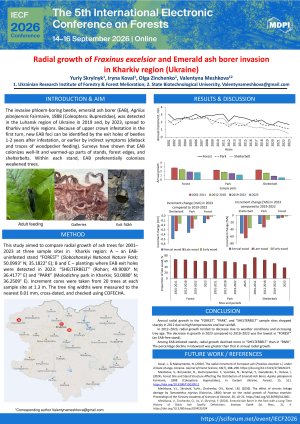
Invasive phloem-boring beetle, emerald ash borer (EAB), Agrilus planipennis Fairmaire, 1888 (Coleoptera: Buprestidae), was detected in the Luhansk region of Ukraine, and by 2023, spread to Kharkiv and Kyiv regions. Because of the infestation of upper crown parts in the first turn, new EAB foci can be identified by the exit holes of beetles 1-2 years after infestation, or earlier by indirect symptoms (dieback and traces of woodpecker feeding). Surveys have shown that EAB colonizes well-lit and warmed-up parts of stands, forest edges, and shelterbelts. Within each stand, EAB preferentially colonizes weakened trees. This study aimed to compare radial growth of ash trees for 2001–2023 at three sample sites: A – an EAB-uninfested stand “FOREST” (Slobozhanskyi National Nature Park; 50.0993° N; 35.1822° E); B and C – plantings where EAB exit holes were detected in 2023: “SHELTERBELT” (Rohan; 49.9000° N; 36.4177° E) and “PARK” (Molodizhny park in Kharkiv; 50.0080° N; 36.2509° E). Increment cores were taken from 20 trees at each sample site at 1.3 m. The tree ring widths were measured to the nearest 0.01 mm, crossdated, and checked using the COFECHA. Due to weather conditions and tree age increase, annual radial growth in the “FOREST”, “PARK”, and “SHELTERBELT” sample sites, in 2012–2023 decreased by 0.64, 1.05, and 0.63 mm, respectively, compared to 2001–2011. The “FOREST”, “PARK”, and “SHELTERBELT” sample sites, annual radial growth in 2023 was lower by 0.16, 0.36, and 0.49 mm (8.4, 24.4, and 51.4%), respectively, compared to the mean annual radial growth for 2019–2022. Latewood width in 2023 was also lower by 0.07, 0.27, and 0.33 mm (6.5, 33.9, and 64.7%, respectively) in the “FOREST”, “PARK”, and “SHELTERBELT” compared to 2019–2022. The results suggest a relationship between EAB infestation and reduced radial growth of European ash under different conditions.
Keywords
Agrilus planipennis
European ash
tree rings
Poster
Skrylnyk_Koval_Zinchenko_Meshkova.pdf
Voltage over herbicides: defining lethal electrocution thresholds for successful eradication of Ailanthus altissima (Mill.) Swingle seedlings
Transpiration and water balance in Quercus ilex forests under different management