Event submissions
Published
This submission belongs to the session S1. Forest Ecology and Sustainable Management of the event The 5th International Electronic Conference on Forests
Published date
09 Sep, 2026
Academic Editor
'%3e%3cpath%20d='M12.6657%2010.9104C12.4185%2010.325%2012.0599%209.79327%2011.6097%209.34482C11.1609%208.89508%2010.6293%208.5365%2010.0442%208.28888C10.0389%208.28626%2010.0337%208.28495%2010.0285%208.28233C10.8446%207.69279%2011.3752%206.73249%2011.3752%205.64904C11.3752%203.8542%209.92103%202.39999%208.1262%202.39999C6.33136%202.39999%204.87715%203.8542%204.87715%205.64904C4.87715%206.73249%205.40774%207.69279%206.22393%208.28364C6.21869%208.28626%206.21345%208.28757%206.20821%208.29019C5.62129%208.5378%205.09463%208.89284%204.64265%209.34613C4.1929%209.79493%203.83432%2010.3266%203.58671%2010.9117C3.34345%2011.4845%203.21226%2012.0987%203.20023%2012.7209C3.19988%2012.7349%203.20233%2012.7488%203.20744%2012.7619C3.21255%2012.7749%203.22022%2012.7867%203.22998%2012.7968C3.23975%2012.8068%203.25142%2012.8147%203.26431%2012.8202C3.2772%2012.8256%203.29105%2012.8284%203.30504%2012.8284H4.09109C4.14874%2012.8284%204.19459%2012.7825%204.1959%2012.7262C4.2221%2011.7148%204.62823%2010.7676%205.34617%2010.0497C6.08899%209.30683%207.0755%208.89808%208.1262%208.89808C9.17689%208.89808%2010.1634%209.30683%2010.9062%2010.0497C11.6242%2010.7676%2012.0303%2011.7148%2012.0565%2012.7262C12.0578%2012.7838%2012.1037%2012.8284%2012.1613%2012.8284H12.9474C12.9613%2012.8284%2012.9752%2012.8256%2012.9881%2012.8202C13.001%2012.8147%2013.0126%2012.8068%2013.0224%2012.7968C13.0322%2012.7867%2013.0398%2012.7749%2013.0449%2012.7619C13.0501%2012.7488%2013.0525%2012.7349%2013.0522%2012.7209C13.0391%2012.0947%2012.9094%2011.4855%2012.6657%2010.9104ZM8.1262%207.9024C7.52486%207.9024%206.9589%207.6679%206.53312%207.24211C6.10733%206.81633%205.87283%206.25037%205.87283%205.64904C5.87283%205.0477%206.10733%204.48174%206.53312%204.05596C6.9589%203.63018%207.52486%203.39567%208.1262%203.39567C8.72753%203.39567%209.29349%203.63018%209.71927%204.05596C10.1451%204.48174%2010.3796%205.0477%2010.3796%205.64904C10.3796%206.25037%2010.1451%206.81633%209.71927%207.24211C9.29349%207.6679%208.72753%207.9024%208.1262%207.9024Z'%20fill='%235D1EE1'/%3e%3c/g%3e%3c/svg%3e) Giovanna Battipaglia
Giovanna BattipagliaCitation
Diaz-Maroto I.J., Effects of wildlife on the natural regeneration of Atlantic oak forests in the Iberian Northwest, in Proceedings of The 5th International Electronic Conference on Forests, 14 September–16 September 2026, MDPI: Basel, Switzerland
Share
Email
Facebook
Twitter
LinkedIn
Effects of wildlife on the natural regeneration of Atlantic oak forests in the Iberian Northwest

Diaz-Maroto I.J. 1
1. Department of Agroforestry Engineering, University of Santiago de Compostela, Lugo, Spain
Abstract
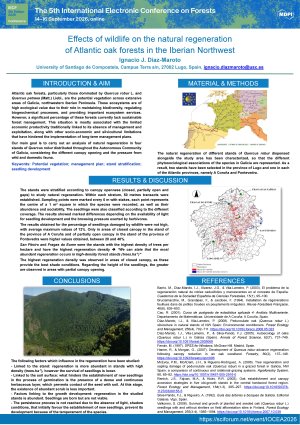
Atlantic oak forests, particularly those dominated by Quercus robur L. and Quercus petraea (Matt.) Liebl., correspond to the potential vegetation across extensive areas of Galicia, northwestern Iberian Peninsula. These ecosystems are of high ecological value due to their role in maintaining biodiversity, regulating biogeochemical processes, and providing important ecosystem services. Nevertheless, a significant proportion of these forests currently lack sustainable forest management. This state is largely associated with the limited economic profitability traditionally linked to their exploitation, together with other socio-economic and silvicultural constraints that have hindered the implementation of long-term management plans. The natural regeneration of different stands of Q. robur distributed throughout the study area has been characterized, so that the different phytosociological associations of the species in Galicia are represented. As a result, two stands have been selected in the province of Lugo and one in each of the Atlantic provinces, namely A Coruña and Pontevedra. To study natural regeneration, the stands were stratified according to canopy openness (closed, partially open, and gap conditions). Within each stratum, 50 m transects were established. Sampling points were marked every 5 m with stakes, each point representing the centre of a 1 m × 1 m square in which the species present, as well as their abundance and sociability, were recorded. Seedlings were also classified according to the different cover types. The results showed marked differences depending on light availability for seedling development and the browsing pressure exerted by herbivores. The results obtained for the percentage of seedlings eaten by wildlife have not been high, with maximum average values of 12%. Only in areas of closed canopy in the A Coruña stand and of partial canopy opening in the Pontevedra stand have higher values been obtained, with percentages between 20 and 40%.
Keywords
Sustainable rural development
management plan
stand stratification
seedling development
Poster
5th IECF_Diaz-Maroto_Poster_3.pdf
Modeling the determinants of CO₂ emissions from drained organic soils in Denmark: A robust PCA and HAC covariance analysis
Community Structure and Seasonal Dynamics of Moth Assemblages in Sal (Shorea robusta) Forests of the Shiwalik Ranges, Uttarakhand, India