Event submissions
Published
This submission belongs to the session S1. Forest Ecology and Sustainable Management of the event The 5th International Electronic Conference on Forests
Published date
09 Sep, 2026
Academic Editor
'%3e%3cpath%20d='M12.6657%2010.9104C12.4185%2010.325%2012.0599%209.79327%2011.6097%209.34482C11.1609%208.89508%2010.6293%208.5365%2010.0442%208.28888C10.0389%208.28626%2010.0337%208.28495%2010.0285%208.28233C10.8446%207.69279%2011.3752%206.73249%2011.3752%205.64904C11.3752%203.8542%209.92103%202.39999%208.1262%202.39999C6.33136%202.39999%204.87715%203.8542%204.87715%205.64904C4.87715%206.73249%205.40774%207.69279%206.22393%208.28364C6.21869%208.28626%206.21345%208.28757%206.20821%208.29019C5.62129%208.5378%205.09463%208.89284%204.64265%209.34613C4.1929%209.79493%203.83432%2010.3266%203.58671%2010.9117C3.34345%2011.4845%203.21226%2012.0987%203.20023%2012.7209C3.19988%2012.7349%203.20233%2012.7488%203.20744%2012.7619C3.21255%2012.7749%203.22022%2012.7867%203.22998%2012.7968C3.23975%2012.8068%203.25142%2012.8147%203.26431%2012.8202C3.2772%2012.8256%203.29105%2012.8284%203.30504%2012.8284H4.09109C4.14874%2012.8284%204.19459%2012.7825%204.1959%2012.7262C4.2221%2011.7148%204.62823%2010.7676%205.34617%2010.0497C6.08899%209.30683%207.0755%208.89808%208.1262%208.89808C9.17689%208.89808%2010.1634%209.30683%2010.9062%2010.0497C11.6242%2010.7676%2012.0303%2011.7148%2012.0565%2012.7262C12.0578%2012.7838%2012.1037%2012.8284%2012.1613%2012.8284H12.9474C12.9613%2012.8284%2012.9752%2012.8256%2012.9881%2012.8202C13.001%2012.8147%2013.0126%2012.8068%2013.0224%2012.7968C13.0322%2012.7867%2013.0398%2012.7749%2013.0449%2012.7619C13.0501%2012.7488%2013.0525%2012.7349%2013.0522%2012.7209C13.0391%2012.0947%2012.9094%2011.4855%2012.6657%2010.9104ZM8.1262%207.9024C7.52486%207.9024%206.9589%207.6679%206.53312%207.24211C6.10733%206.81633%205.87283%206.25037%205.87283%205.64904C5.87283%205.0477%206.10733%204.48174%206.53312%204.05596C6.9589%203.63018%207.52486%203.39567%208.1262%203.39567C8.72753%203.39567%209.29349%203.63018%209.71927%204.05596C10.1451%204.48174%2010.3796%205.0477%2010.3796%205.64904C10.3796%206.25037%2010.1451%206.81633%209.71927%207.24211C9.29349%207.6679%208.72753%207.9024%208.1262%207.9024Z'%20fill='%235D1EE1'/%3e%3c/g%3e%3c/svg%3e) Giovanna Battipaglia
Giovanna BattipagliaCitation
Lekhendra Sahu, Arun Pratap Singh, Community Structure and Seasonal Dynamics of Moth Assemblages in Sal (Shorea robusta) Forests of the Shiwalik Ranges, Uttarakhand, India, in Proceedings of The 5th International Electronic Conference on Forests, 14 September–16 September 2026, MDPI: Basel, Switzerland
Share
Email
Facebook
Twitter
LinkedIn
Community Structure and Seasonal Dynamics of Moth Assemblages in Sal (Shorea robusta) Forests of the Shiwalik Ranges, Uttarakhand, India
'%3e%3cpath%20d='M12.6647%2010.9104C12.4176%2010.325%2012.0589%209.7933%2011.6088%209.34485C11.16%208.89511%2010.6283%208.53653%2010.0432%208.28891C10.038%208.28629%2010.0327%208.28498%2010.0275%208.28236C10.8437%207.69282%2011.3743%206.73252%2011.3743%205.64907C11.3743%203.85423%209.92005%202.40002%208.12522%202.40002C6.33038%202.40002%204.87618%203.85423%204.87618%205.64907C4.87618%206.73252%205.40677%207.69282%206.22296%208.28367C6.21772%208.28629%206.21248%208.2876%206.20724%208.29022C5.62031%208.53783%205.09365%208.89287%204.64167%209.34616C4.19192%209.79496%203.83334%2010.3266%203.58573%2010.9117C3.34247%2011.4846%203.21128%2012.0987%203.19925%2012.721C3.1989%2012.735%203.20135%2012.7489%203.20646%2012.7619C3.21157%2012.7749%203.21924%2012.7868%203.22901%2012.7968C3.23877%2012.8068%203.25045%2012.8148%203.26334%2012.8202C3.27623%2012.8256%203.29007%2012.8284%203.30406%2012.8284H4.09012C4.14776%2012.8284%204.19362%2012.7825%204.19493%2012.7262C4.22113%2011.7148%204.62726%2010.7676%205.34519%2010.0497C6.08802%209.30686%207.07452%208.89811%208.12522%208.89811C9.17592%208.89811%2010.1624%209.30686%2010.9052%2010.0497C11.6232%2010.7676%2012.0293%2011.7148%2012.0555%2012.7262C12.0568%2012.7839%2012.1027%2012.8284%2012.1603%2012.8284H12.9464C12.9604%2012.8284%2012.9742%2012.8256%2012.9871%2012.8202C13%2012.8148%2013.0117%2012.8068%2013.0214%2012.7968C13.0312%2012.7868%2013.0389%2012.7749%2013.044%2012.7619C13.0491%2012.7489%2013.0515%2012.735%2013.0512%2012.721C13.0381%2012.0947%2012.9084%2011.4856%2012.6647%2010.9104ZM8.12522%207.90243C7.52388%207.90243%206.95792%207.66793%206.53214%207.24215C6.10636%206.81636%205.87185%206.2504%205.87185%205.64907C5.87185%205.04773%206.10636%204.48177%206.53214%204.05599C6.95792%203.63021%207.52388%203.3957%208.12522%203.3957C8.72655%203.3957%209.29252%203.63021%209.7183%204.05599C10.1441%204.48177%2010.3786%205.04773%2010.3786%205.64907C10.3786%206.2504%2010.1441%206.81636%209.7183%207.24215C9.29252%207.66793%208.72655%207.90243%208.12522%207.90243Z'%20fill='%235D1EE1'/%3e%3c/g%3e%3c/svg%3e)
Lekhendra Sahu 1
Arun Pratap Singh 1
1. Forest Entomology Discipline, Forest Protection Division, Forest Research Institute(FRI), P.O. New Forest, Dehradun, Uttarakhand 248006, India
Abstract
A study was carried out to know species composition, diversity and seasonality of macro-moths in the Sal (Shorea robusta) Roth (Dipterocarpaceae) forests (n=4; Timli, Naudi-Mundiapani, Chilla and Chorgaliya) in the Shiwalik ranges of Uttarakhand, northern India. Seasonal surveys were conducted using moth screen over 56 days, spanning 168 sampling hours from July 2020 to October 2023, across pre-monsoon, monsoon, and post-monsoon periods. A total of 2,377 individuals representing 231 species of macro-moths, belonging to 18 families and 48 sub-families, were recorded, indicating a high level of diversity. This included 04 new range extensions into Northern India from Southeast India, Central (Nepal), and Eastern Himalaya. Two annual peaks were observed in Sal forests; the first peak occurred earlier in August (monsoon), while the second occurred in October (post-monsoon). Family Erebidae (68) was the most dominant, followed by Crambidae (48), Geometridae (47) and Noctuidae (20), respectively; while a low number of species was recorded in the families Notodontidae (1), Pyralidae (1) and Zygaenidae (1). Naudi-Mundiapani forests site had the greatest Shannon & Simpson diversity (4.377 & 0.9805). Over 123 moth species were recorded in ‘Naudi-Mundiapani’ forest, making it a unique habitat for macro-moths. Naudi-Mundiapani forest site exhibited a distinct moth community structure. A number of habitat-restricted and rare moth species were recorded during the survey, including; Brahmaea hearseyi (White, 1862), Agrotera scissalis (Walker, 1866) Parapoynx bilinealis (Snellen, 1876), Ischyja marapok (Holloway, 2005), Achaea serva (Fabricius, 1775), Sarobela litterata (Pagenstecher, 1888), Diomea lignicolora (Walker,1858), Fascellina chromataria (Walker, 1860), Cania bilinea (Walker, 1855), Antheraea assamensis (Helfer, 1837), and Episteme adulatrix (Kollar,1884) and Ramadasa pavo (Walker, 1856). There is still potential for recording additional species, as species richness estimators indicated a much higher estimated richness than the observed number of species (Chao 2: 544; Jackknife 1: 349; Jackknife 2: 412). These findings highlight Shiwalik Sal forests as important ecological and biodiversity hotspots supporting seasonally dynamic moth communities, rare habitat-restricted species, and serving as ecological refuges within the Shiwalik range.
Keywords
Diversity
Community
Shannon Diversity
Notodontidae
Eastern Himalaya
Central Himalaya.
Poster
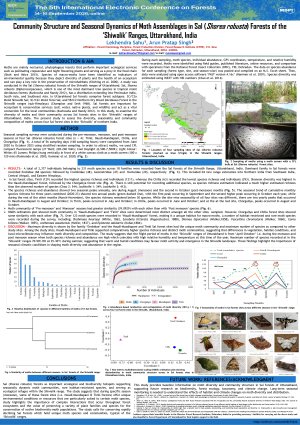
Sal Moths Poster- Lekhendra.pdf
Effects of wildlife on the natural regeneration of Atlantic oak forests in the Iberian Northwest
Coastal Forests at the Crossroads: Ecological Baseline Assessment of Mangroves in Belen, Calabanga for Sustainable Management and Community Governance