Event submissions
Published
This submission belongs to the session S2. Forest Biodiversity, Ecosystem Services, and Earth Observations of the event The 5th International Electronic Conference on Forests
Published date
09 Sep, 2026
Academic Editor
'%3e%3cpath%20d='M12.6657%2010.9104C12.4185%2010.325%2012.0599%209.79327%2011.6097%209.34482C11.1609%208.89508%2010.6293%208.5365%2010.0442%208.28888C10.0389%208.28626%2010.0337%208.28495%2010.0285%208.28233C10.8446%207.69279%2011.3752%206.73249%2011.3752%205.64904C11.3752%203.8542%209.92103%202.39999%208.1262%202.39999C6.33136%202.39999%204.87715%203.8542%204.87715%205.64904C4.87715%206.73249%205.40774%207.69279%206.22393%208.28364C6.21869%208.28626%206.21345%208.28757%206.20821%208.29019C5.62129%208.5378%205.09463%208.89284%204.64265%209.34613C4.1929%209.79493%203.83432%2010.3266%203.58671%2010.9117C3.34345%2011.4845%203.21226%2012.0987%203.20023%2012.7209C3.19988%2012.7349%203.20233%2012.7488%203.20744%2012.7619C3.21255%2012.7749%203.22022%2012.7867%203.22998%2012.7968C3.23975%2012.8068%203.25142%2012.8147%203.26431%2012.8202C3.2772%2012.8256%203.29105%2012.8284%203.30504%2012.8284H4.09109C4.14874%2012.8284%204.19459%2012.7825%204.1959%2012.7262C4.2221%2011.7148%204.62823%2010.7676%205.34617%2010.0497C6.08899%209.30683%207.0755%208.89808%208.1262%208.89808C9.17689%208.89808%2010.1634%209.30683%2010.9062%2010.0497C11.6242%2010.7676%2012.0303%2011.7148%2012.0565%2012.7262C12.0578%2012.7838%2012.1037%2012.8284%2012.1613%2012.8284H12.9474C12.9613%2012.8284%2012.9752%2012.8256%2012.9881%2012.8202C13.001%2012.8147%2013.0126%2012.8068%2013.0224%2012.7968C13.0322%2012.7867%2013.0398%2012.7749%2013.0449%2012.7619C13.0501%2012.7488%2013.0525%2012.7349%2013.0522%2012.7209C13.0391%2012.0947%2012.9094%2011.4855%2012.6657%2010.9104ZM8.1262%207.9024C7.52486%207.9024%206.9589%207.6679%206.53312%207.24211C6.10733%206.81633%205.87283%206.25037%205.87283%205.64904C5.87283%205.0477%206.10733%204.48174%206.53312%204.05596C6.9589%203.63018%207.52486%203.39567%208.1262%203.39567C8.72753%203.39567%209.29349%203.63018%209.71927%204.05596C10.1451%204.48174%2010.3796%205.0477%2010.3796%205.64904C10.3796%206.25037%2010.1451%206.81633%209.71927%207.24211C9.29349%207.6679%208.72753%207.9024%208.1262%207.9024Z'%20fill='%235D1EE1'/%3e%3c/g%3e%3c/svg%3e) Margarita Arianoutsou
Margarita ArianoutsouCitation
Mebirouk-Boudechiche Lamia, Chaker-Houd Kahina, Ismahane Bendekoum, Nutritional and Phytochemical Profiling of Bourdim Forest Shrubs Selected by Small Ruminant Foraging Preferences (Northeastern Algeria), in Proceedings of The 5th International Electronic Conference on Forests, 14 September–16 September 2026, MDPI: Basel, Switzerland
Share
Email
Facebook
Twitter
LinkedIn
Nutritional and Phytochemical Profiling of Bourdim Forest Shrubs Selected by Small Ruminant Foraging Preferences (Northeastern Algeria)
'%3e%3cpath%20d='M12.6647%2010.9104C12.4176%2010.325%2012.0589%209.7933%2011.6088%209.34485C11.16%208.89511%2010.6283%208.53653%2010.0432%208.28891C10.038%208.28629%2010.0327%208.28498%2010.0275%208.28236C10.8437%207.69282%2011.3743%206.73252%2011.3743%205.64907C11.3743%203.85423%209.92005%202.40002%208.12522%202.40002C6.33038%202.40002%204.87618%203.85423%204.87618%205.64907C4.87618%206.73252%205.40677%207.69282%206.22296%208.28367C6.21772%208.28629%206.21248%208.2876%206.20724%208.29022C5.62031%208.53783%205.09365%208.89287%204.64167%209.34616C4.19192%209.79496%203.83334%2010.3266%203.58573%2010.9117C3.34247%2011.4846%203.21128%2012.0987%203.19925%2012.721C3.1989%2012.735%203.20135%2012.7489%203.20646%2012.7619C3.21157%2012.7749%203.21924%2012.7868%203.22901%2012.7968C3.23877%2012.8068%203.25045%2012.8148%203.26334%2012.8202C3.27623%2012.8256%203.29007%2012.8284%203.30406%2012.8284H4.09012C4.14776%2012.8284%204.19362%2012.7825%204.19493%2012.7262C4.22113%2011.7148%204.62726%2010.7676%205.34519%2010.0497C6.08802%209.30686%207.07452%208.89811%208.12522%208.89811C9.17592%208.89811%2010.1624%209.30686%2010.9052%2010.0497C11.6232%2010.7676%2012.0293%2011.7148%2012.0555%2012.7262C12.0568%2012.7839%2012.1027%2012.8284%2012.1603%2012.8284H12.9464C12.9604%2012.8284%2012.9742%2012.8256%2012.9871%2012.8202C13%2012.8148%2013.0117%2012.8068%2013.0214%2012.7968C13.0312%2012.7868%2013.0389%2012.7749%2013.044%2012.7619C13.0491%2012.7489%2013.0515%2012.735%2013.0512%2012.721C13.0381%2012.0947%2012.9084%2011.4856%2012.6647%2010.9104ZM8.12522%207.90243C7.52388%207.90243%206.95792%207.66793%206.53214%207.24215C6.10636%206.81636%205.87185%206.2504%205.87185%205.64907C5.87185%205.04773%206.10636%204.48177%206.53214%204.05599C6.95792%203.63021%207.52388%203.3957%208.12522%203.3957C8.72655%203.3957%209.29252%203.63021%209.7183%204.05599C10.1441%204.48177%2010.3786%205.04773%2010.3786%205.64907C10.3786%206.2504%2010.1441%206.81636%209.7183%207.24215C9.29252%207.66793%208.72655%207.90243%208.12522%207.90243Z'%20fill='%235D1EE1'/%3e%3c/g%3e%3c/svg%3e)
Mebirouk-Boudechiche Lamia 1,2
Chaker-Houd Kahina 1,2
Ismahane Bendekoum 1
1. Laboratory of epidemiological surveillance, health, production and reproduction, experimentation and cell therapy of domestic and wild animals, Chadli Bendjedid University, 36000 El Tarf, Algeria
2. Laboratory of agriculture and ecosystem functioning, Chadli Bendjedid University, 36000 El Tarf, Algeria
Abstract
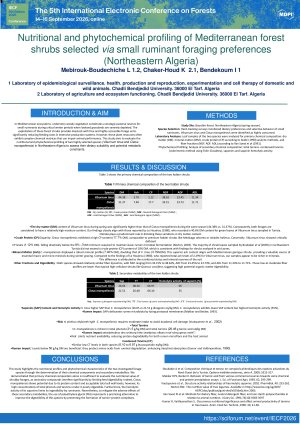
Managing Mediterranean forest ecosystems requires a deep understanding of the nutritional value of understory vegetation utilized by grazing livestock. This study aimed to evaluate the primary and secondary chemical compositions of two key Mediterranean shrub species in the Bourdim forest (Northeastern Algeria) to assess their suitability and safety as extensive forage resources. A preliminary herd-tracking survey was conducted within the forest to monitor the dietary preferences and selective behavior of grazing animals. Based on these field observations, two highly consumed species, Viburnum tinus and Cistus monspeliensis, were selected for detailed laboratory analysis during the spring season. Leaf samples were analyzed for dry matter (DM), mineral matter (MM), Crude protein (CP), fiber fractions (NDF, ADF, ADL), saponins, total phenols, total tannins, and condensed tannins. Saponin hemolytic activity was also quantified. The results revealed contrasting nutritional profiles between the two species. C. monspeliensis demonstrated a high crude protein content (17.7% DM) and superior mineral content (7.40% DM). Conversely, V. tinus exhibited critically low protein levels (1.12% DM), well below the minimum threshold required for optimal rumen microbial activity. Fiber fractions (NDF, ADF, ADL) were relatively similar between species, suggesting comparable potential digestibilities. Regarding secondary metabolites, C. monspeliensis displayed significantly higher total phenols and total tannins (31.5 and 26.48 g tannic acid eq./kg DM, respectively). While V. tinus contained slightly higher saponin levels, C. monspeliensis exhibited a severe hemolytic activity of 55%, compared to only 5% for V. tinus. Although selected by grazing herds, these forest shrubs present specific metabolic constraints. C. monspeliensis is an excellent source of protein but requires moderate ingestion due to high hemolytic activity and tannin levels that may restrict nutrient degradability. V. tinus provides moisture and fiber but requires protein supplementation in extensive production systems to prevent rumen dysfunction.
Keywords
Bourdim forest
extensive grazing
foraging preferences
Cistus monspeliensis
Viburnum tinus
chemical composition.
Poster
poster_fodder_shrub.pdf
Browsing Intensity and Woody Species Selectivity of Wild Ungulates in a Forest Habitat, Hungary
Spontaneous Forest Biodiversity as a Provisioning Ecosystem Service: Nutritional value and secondary metabolites of Four Spontaneous Fodder shrubs from Northeastern Algeria Under Climate Change