Event submissions
Published
This submission belongs to the session S2. Forest Biodiversity, Ecosystem Services, and Earth Observations of the event The 5th International Electronic Conference on Forests
Published date
09 Sep, 2026
Academic Editor
'%3e%3cpath%20d='M12.6657%2010.9104C12.4185%2010.325%2012.0599%209.79327%2011.6097%209.34482C11.1609%208.89508%2010.6293%208.5365%2010.0442%208.28888C10.0389%208.28626%2010.0337%208.28495%2010.0285%208.28233C10.8446%207.69279%2011.3752%206.73249%2011.3752%205.64904C11.3752%203.8542%209.92103%202.39999%208.1262%202.39999C6.33136%202.39999%204.87715%203.8542%204.87715%205.64904C4.87715%206.73249%205.40774%207.69279%206.22393%208.28364C6.21869%208.28626%206.21345%208.28757%206.20821%208.29019C5.62129%208.5378%205.09463%208.89284%204.64265%209.34613C4.1929%209.79493%203.83432%2010.3266%203.58671%2010.9117C3.34345%2011.4845%203.21226%2012.0987%203.20023%2012.7209C3.19988%2012.7349%203.20233%2012.7488%203.20744%2012.7619C3.21255%2012.7749%203.22022%2012.7867%203.22998%2012.7968C3.23975%2012.8068%203.25142%2012.8147%203.26431%2012.8202C3.2772%2012.8256%203.29105%2012.8284%203.30504%2012.8284H4.09109C4.14874%2012.8284%204.19459%2012.7825%204.1959%2012.7262C4.2221%2011.7148%204.62823%2010.7676%205.34617%2010.0497C6.08899%209.30683%207.0755%208.89808%208.1262%208.89808C9.17689%208.89808%2010.1634%209.30683%2010.9062%2010.0497C11.6242%2010.7676%2012.0303%2011.7148%2012.0565%2012.7262C12.0578%2012.7838%2012.1037%2012.8284%2012.1613%2012.8284H12.9474C12.9613%2012.8284%2012.9752%2012.8256%2012.9881%2012.8202C13.001%2012.8147%2013.0126%2012.8068%2013.0224%2012.7968C13.0322%2012.7867%2013.0398%2012.7749%2013.0449%2012.7619C13.0501%2012.7488%2013.0525%2012.7349%2013.0522%2012.7209C13.0391%2012.0947%2012.9094%2011.4855%2012.6657%2010.9104ZM8.1262%207.9024C7.52486%207.9024%206.9589%207.6679%206.53312%207.24211C6.10733%206.81633%205.87283%206.25037%205.87283%205.64904C5.87283%205.0477%206.10733%204.48174%206.53312%204.05596C6.9589%203.63018%207.52486%203.39567%208.1262%203.39567C8.72753%203.39567%209.29349%203.63018%209.71927%204.05596C10.1451%204.48174%2010.3796%205.0477%2010.3796%205.64904C10.3796%206.25037%2010.1451%206.81633%209.71927%207.24211C9.29349%207.6679%208.72753%207.9024%208.1262%207.9024Z'%20fill='%235D1EE1'/%3e%3c/g%3e%3c/svg%3e) Margarita Arianoutsou
Margarita ArianoutsouCitation
AISHAT AVOSUAHI ABUBAKIR, Oyinlola Abiodun FASORO, CONTRIBUTION OF URBAN GREEN SPACES IN THE PRESERVATION OF ETHNOMEDICINAL PRACTICES IN IBADAN METROPOLIS, OYO STATE, NIGERIA., in Proceedings of The 5th International Electronic Conference on Forests, 14 September–16 September 2026, MDPI: Basel, Switzerland
Share
Email
Facebook
Twitter
LinkedIn
CONTRIBUTION OF URBAN GREEN SPACES IN THE PRESERVATION OF ETHNOMEDICINAL PRACTICES IN IBADAN METROPOLIS, OYO STATE, NIGERIA.
'%3e%3cpath%20d='M12.6647%2010.9104C12.4176%2010.325%2012.0589%209.7933%2011.6088%209.34485C11.16%208.89511%2010.6283%208.53653%2010.0432%208.28891C10.038%208.28629%2010.0327%208.28498%2010.0275%208.28236C10.8437%207.69282%2011.3743%206.73252%2011.3743%205.64907C11.3743%203.85423%209.92005%202.40002%208.12522%202.40002C6.33038%202.40002%204.87618%203.85423%204.87618%205.64907C4.87618%206.73252%205.40677%207.69282%206.22296%208.28367C6.21772%208.28629%206.21248%208.2876%206.20724%208.29022C5.62031%208.53783%205.09365%208.89287%204.64167%209.34616C4.19192%209.79496%203.83334%2010.3266%203.58573%2010.9117C3.34247%2011.4846%203.21128%2012.0987%203.19925%2012.721C3.1989%2012.735%203.20135%2012.7489%203.20646%2012.7619C3.21157%2012.7749%203.21924%2012.7868%203.22901%2012.7968C3.23877%2012.8068%203.25045%2012.8148%203.26334%2012.8202C3.27623%2012.8256%203.29007%2012.8284%203.30406%2012.8284H4.09012C4.14776%2012.8284%204.19362%2012.7825%204.19493%2012.7262C4.22113%2011.7148%204.62726%2010.7676%205.34519%2010.0497C6.08802%209.30686%207.07452%208.89811%208.12522%208.89811C9.17592%208.89811%2010.1624%209.30686%2010.9052%2010.0497C11.6232%2010.7676%2012.0293%2011.7148%2012.0555%2012.7262C12.0568%2012.7839%2012.1027%2012.8284%2012.1603%2012.8284H12.9464C12.9604%2012.8284%2012.9742%2012.8256%2012.9871%2012.8202C13%2012.8148%2013.0117%2012.8068%2013.0214%2012.7968C13.0312%2012.7868%2013.0389%2012.7749%2013.044%2012.7619C13.0491%2012.7489%2013.0515%2012.735%2013.0512%2012.721C13.0381%2012.0947%2012.9084%2011.4856%2012.6647%2010.9104ZM8.12522%207.90243C7.52388%207.90243%206.95792%207.66793%206.53214%207.24215C6.10636%206.81636%205.87185%206.2504%205.87185%205.64907C5.87185%205.04773%206.10636%204.48177%206.53214%204.05599C6.95792%203.63021%207.52388%203.3957%208.12522%203.3957C8.72655%203.3957%209.29252%203.63021%209.7183%204.05599C10.1441%204.48177%2010.3786%205.04773%2010.3786%205.64907C10.3786%206.2504%2010.1441%206.81636%209.7183%207.24215C9.29252%207.66793%208.72655%207.90243%208.12522%207.90243Z'%20fill='%235D1EE1'/%3e%3c/g%3e%3c/svg%3e)
AISHAT AVOSUAHI ABUBAKIR 1
Oyinlola Abiodun FASORO 1
1. Department of Social and Environmental Forestry, Faculty of Renewable Natural Resources, University of Ibadan, Ibadan, Nigeria
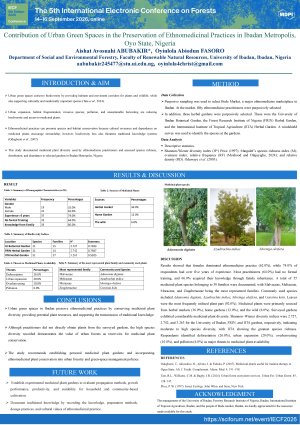
Abstract
Ethnomedicine relies on medicinal plants, animal-derived products, and traditional healing
practices for disease treatment. However, increasing biodiversity loss and urbanization threaten
the availability of medicinal plant resources. This study assessed the role of urban forests in
sustaining medicinal plant availability in Ibadan, Nigeria. Purposive sampling was used to select
Bode Market, a major ethnomedicine marketplace, and three herbal gardens: the University of
Ibadan Botanical Garden, the Forest Research Institute of Nigeria (FRIN) Herbal Garden, and
the International Institute of Tropical Agriculture (IITA) Herbal Garden. Fifty ethnomedicine
practitioners were purposively selected, while medicinal plant species in the gardens were
identified through a windshield survey. Data were analyzed using descriptive statistics and
Shannon–Wiener diversity index. Results showed that females dominated ethnomedicine
practice (62.0%), while 74.0% of respondents had over five years of experience. Most
practitioners (64.0%) had no formal training, and 66.0% acquired their knowledge through
family inheritance. A total of 55 medicinal plant species belonging to 30 families were
documented, with Malvaceae, Meliaceae, Moraceae, and Zingiberaceae being the most
represented families. Commonly used species included Adansonia digitata, Azadirachta indica,
Moringa oleifera, and Garcinia kola. Leaves were the most frequently utilized plant part
(92.0%). Medicinal plants were primarily sourced from herbal markets (36.0%), home gardens
(12.0%), and the wild (6.0%). Surveyed gardens exhibited considerable medicinal plant
diversity. Shannon–Wiener diversity indices were 2.727, 2.742, and 3.263 for the University of
Ibadan, FRIN, and IITA gardens, respectively, indicating moderate to high species diversity, with
IITA showing the greatest species richness. Respondents identified deforestation (26.0%), urban
expansion (20.0%), overharvesting (10.0%), and pollution (6.0%) as major threats to medicinal
plant availability. Although practitioners did not directly source plants from the surveyed
gardens, the high diversity recorded highlights the importance of urban forests in medicinal plant
conservation. The study recommends establishing personal medicinal plant gardens and
integrating ethnomedicinal plant conservation into urban forestry and green space management
policies.
Keywords
ethnomedicine
medicinal plants
biodiversity conservation
urban forests: species diversity
herbal gardens
Poster
Abubakir_Aishat_POSTER.pdf
Integrating Ethnobotanical Knowledge and Scientometric Mapping for the Conservation of Medicinal Shrubs in Arid Ecosystems of Algeria
Diversity and species patterns of macrofungi in a relict Pinus mugo Turra population in the Apennines