Event submissions
Published
This submission belongs to the session S2. Forest Biodiversity, Ecosystem Services, and Earth Observations of the event The 5th International Electronic Conference on Forests
Published date
09 Sep, 2026
Academic Editor
'%3e%3cpath%20d='M12.6657%2010.9104C12.4185%2010.325%2012.0599%209.79327%2011.6097%209.34482C11.1609%208.89508%2010.6293%208.5365%2010.0442%208.28888C10.0389%208.28626%2010.0337%208.28495%2010.0285%208.28233C10.8446%207.69279%2011.3752%206.73249%2011.3752%205.64904C11.3752%203.8542%209.92103%202.39999%208.1262%202.39999C6.33136%202.39999%204.87715%203.8542%204.87715%205.64904C4.87715%206.73249%205.40774%207.69279%206.22393%208.28364C6.21869%208.28626%206.21345%208.28757%206.20821%208.29019C5.62129%208.5378%205.09463%208.89284%204.64265%209.34613C4.1929%209.79493%203.83432%2010.3266%203.58671%2010.9117C3.34345%2011.4845%203.21226%2012.0987%203.20023%2012.7209C3.19988%2012.7349%203.20233%2012.7488%203.20744%2012.7619C3.21255%2012.7749%203.22022%2012.7867%203.22998%2012.7968C3.23975%2012.8068%203.25142%2012.8147%203.26431%2012.8202C3.2772%2012.8256%203.29105%2012.8284%203.30504%2012.8284H4.09109C4.14874%2012.8284%204.19459%2012.7825%204.1959%2012.7262C4.2221%2011.7148%204.62823%2010.7676%205.34617%2010.0497C6.08899%209.30683%207.0755%208.89808%208.1262%208.89808C9.17689%208.89808%2010.1634%209.30683%2010.9062%2010.0497C11.6242%2010.7676%2012.0303%2011.7148%2012.0565%2012.7262C12.0578%2012.7838%2012.1037%2012.8284%2012.1613%2012.8284H12.9474C12.9613%2012.8284%2012.9752%2012.8256%2012.9881%2012.8202C13.001%2012.8147%2013.0126%2012.8068%2013.0224%2012.7968C13.0322%2012.7867%2013.0398%2012.7749%2013.0449%2012.7619C13.0501%2012.7488%2013.0525%2012.7349%2013.0522%2012.7209C13.0391%2012.0947%2012.9094%2011.4855%2012.6657%2010.9104ZM8.1262%207.9024C7.52486%207.9024%206.9589%207.6679%206.53312%207.24211C6.10733%206.81633%205.87283%206.25037%205.87283%205.64904C5.87283%205.0477%206.10733%204.48174%206.53312%204.05596C6.9589%203.63018%207.52486%203.39567%208.1262%203.39567C8.72753%203.39567%209.29349%203.63018%209.71927%204.05596C10.1451%204.48174%2010.3796%205.0477%2010.3796%205.64904C10.3796%206.25037%2010.1451%206.81633%209.71927%207.24211C9.29349%207.6679%208.72753%207.9024%208.1262%207.9024Z'%20fill='%235D1EE1'/%3e%3c/g%3e%3c/svg%3e) Mark Vanderwel
Mark VanderwelCitation
Diaz-Maroto I.J., Broadleaf deciduous forests of temperate regions: livelihoods, ecosystem services and biodiversity conservation, in Proceedings of The 5th International Electronic Conference on Forests, 14 September–16 September 2026, MDPI: Basel, Switzerland
Share
Email
Facebook
Twitter
LinkedIn
Broadleaf deciduous forests of temperate regions: livelihoods, ecosystem services and biodiversity conservation

Diaz-Maroto I.J. 1
1. Department of Agroforestry Engineering, University of Santiago de Compostela, Lugo, Spain
Abstract
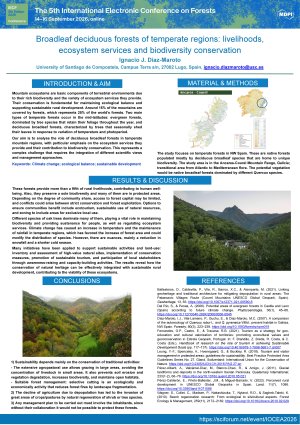
Mountain ecosystems are basic components of terrestrial environments due to their rich biodiversity and the wide range of ecosystem services they provide. Their conservation is crucial for maintaining ecological balance and supporting sustainable rural development. Around 15% of the mountains are covered by forests, which represents 28% of the world’s forests. Two main types of temperate forests occur in the mid-latitudes: evergreen forests, dominated by tree species that retain their foliage throughout the year, and deciduous broadleaf forests, characterized by trees that seasonally shed their leaves in response to variation of temperature and photoperiod. Likewise, these forests provide more than a fifth of the rural livelihoods, offering solutions to poverty and contributing to human well-being. Also, they conserve a unique biodiversity and many of them are protected. Depending on the degree of involvement of communities, access to forest capital may be limited and trade-offs could be created between conservation and poverty alleviation. Options to ensure that communities benefit from protected forest ecosystems include ecotourism, sustainable use of natural resources, and zoning to include sole local use areas.
Different species of oak trees dominate many of these forests, playing an essential role in maintaining biodiversity and people’s livelihoods, as well as in regulating ecosystem services. Climate change has caused an increase in temperature and the maintenance of rainfall in temperate regions, which has favoured the increase of forest area and could modify the distribution of species. Although, there are nuances, mainly a reduction in snowfall and a shorter cold season. Our aim is to analyse the role of deciduous broadleaf forests in temperate mountain regions, with particular emphasis on the ecosystem services they provide and their contribution to biodiversity conservation. This represents a complex challenge that requires the integration of diverse scientific perspectives and management approaches.
Keywords
Global chance
ecological balance
sustainable rural development
livelihoods
Poster
5th IECF_Diaz-Maroto_Poster_2.pdf
Climate change threatens endemic medicinal and aromatic plants with habitat loss and elevational shifts: evidence from the High Atlas Mountains of Morocco
Monitoring and Predicting Land Use/Land Cover Dynamics in the Sahyadri Tiger Reserve, Maharashtra, India, Using a Hybrid CA–Markov Model