Event submissions
Published
This submission belongs to the session S2. Forest Biodiversity, Ecosystem Services, and Earth Observations of the event The 5th International Electronic Conference on Forests
Published date
09 Sep, 2026
Academic Editor
'%3e%3cpath%20d='M12.6657%2010.9104C12.4185%2010.325%2012.0599%209.79327%2011.6097%209.34482C11.1609%208.89508%2010.6293%208.5365%2010.0442%208.28888C10.0389%208.28626%2010.0337%208.28495%2010.0285%208.28233C10.8446%207.69279%2011.3752%206.73249%2011.3752%205.64904C11.3752%203.8542%209.92103%202.39999%208.1262%202.39999C6.33136%202.39999%204.87715%203.8542%204.87715%205.64904C4.87715%206.73249%205.40774%207.69279%206.22393%208.28364C6.21869%208.28626%206.21345%208.28757%206.20821%208.29019C5.62129%208.5378%205.09463%208.89284%204.64265%209.34613C4.1929%209.79493%203.83432%2010.3266%203.58671%2010.9117C3.34345%2011.4845%203.21226%2012.0987%203.20023%2012.7209C3.19988%2012.7349%203.20233%2012.7488%203.20744%2012.7619C3.21255%2012.7749%203.22022%2012.7867%203.22998%2012.7968C3.23975%2012.8068%203.25142%2012.8147%203.26431%2012.8202C3.2772%2012.8256%203.29105%2012.8284%203.30504%2012.8284H4.09109C4.14874%2012.8284%204.19459%2012.7825%204.1959%2012.7262C4.2221%2011.7148%204.62823%2010.7676%205.34617%2010.0497C6.08899%209.30683%207.0755%208.89808%208.1262%208.89808C9.17689%208.89808%2010.1634%209.30683%2010.9062%2010.0497C11.6242%2010.7676%2012.0303%2011.7148%2012.0565%2012.7262C12.0578%2012.7838%2012.1037%2012.8284%2012.1613%2012.8284H12.9474C12.9613%2012.8284%2012.9752%2012.8256%2012.9881%2012.8202C13.001%2012.8147%2013.0126%2012.8068%2013.0224%2012.7968C13.0322%2012.7867%2013.0398%2012.7749%2013.0449%2012.7619C13.0501%2012.7488%2013.0525%2012.7349%2013.0522%2012.7209C13.0391%2012.0947%2012.9094%2011.4855%2012.6657%2010.9104ZM8.1262%207.9024C7.52486%207.9024%206.9589%207.6679%206.53312%207.24211C6.10733%206.81633%205.87283%206.25037%205.87283%205.64904C5.87283%205.0477%206.10733%204.48174%206.53312%204.05596C6.9589%203.63018%207.52486%203.39567%208.1262%203.39567C8.72753%203.39567%209.29349%203.63018%209.71927%204.05596C10.1451%204.48174%2010.3796%205.0477%2010.3796%205.64904C10.3796%206.25037%2010.1451%206.81633%209.71927%207.24211C9.29349%207.6679%208.72753%207.9024%208.1262%207.9024Z'%20fill='%235D1EE1'/%3e%3c/g%3e%3c/svg%3e) Mark Vanderwel
Mark VanderwelCitation
Ivan Bacherikov, Anastasia Durova, Daria Prokopyeva, Dmitry Danilov, The influence of seed weight and region of origin on seedling growth in the first rotation, in Proceedings of The 5th International Electronic Conference on Forests, 14 September–16 September 2026, MDPI: Basel, Switzerland
Share
Email
Facebook
Twitter
LinkedIn
The influence of seed weight and region of origin on seedling growth in the first rotation
'%3e%3cpath%20d='M12.6647%2010.9104C12.4176%2010.325%2012.0589%209.7933%2011.6088%209.34485C11.16%208.89511%2010.6283%208.53653%2010.0432%208.28891C10.038%208.28629%2010.0327%208.28498%2010.0275%208.28236C10.8437%207.69282%2011.3743%206.73252%2011.3743%205.64907C11.3743%203.85423%209.92005%202.40002%208.12522%202.40002C6.33038%202.40002%204.87618%203.85423%204.87618%205.64907C4.87618%206.73252%205.40677%207.69282%206.22296%208.28367C6.21772%208.28629%206.21248%208.2876%206.20724%208.29022C5.62031%208.53783%205.09365%208.89287%204.64167%209.34616C4.19192%209.79496%203.83334%2010.3266%203.58573%2010.9117C3.34247%2011.4846%203.21128%2012.0987%203.19925%2012.721C3.1989%2012.735%203.20135%2012.7489%203.20646%2012.7619C3.21157%2012.7749%203.21924%2012.7868%203.22901%2012.7968C3.23877%2012.8068%203.25045%2012.8148%203.26334%2012.8202C3.27623%2012.8256%203.29007%2012.8284%203.30406%2012.8284H4.09012C4.14776%2012.8284%204.19362%2012.7825%204.19493%2012.7262C4.22113%2011.7148%204.62726%2010.7676%205.34519%2010.0497C6.08802%209.30686%207.07452%208.89811%208.12522%208.89811C9.17592%208.89811%2010.1624%209.30686%2010.9052%2010.0497C11.6232%2010.7676%2012.0293%2011.7148%2012.0555%2012.7262C12.0568%2012.7839%2012.1027%2012.8284%2012.1603%2012.8284H12.9464C12.9604%2012.8284%2012.9742%2012.8256%2012.9871%2012.8202C13%2012.8148%2013.0117%2012.8068%2013.0214%2012.7968C13.0312%2012.7868%2013.0389%2012.7749%2013.044%2012.7619C13.0491%2012.7489%2013.0515%2012.735%2013.0512%2012.721C13.0381%2012.0947%2012.9084%2011.4856%2012.6647%2010.9104ZM8.12522%207.90243C7.52388%207.90243%206.95792%207.66793%206.53214%207.24215C6.10636%206.81636%205.87185%206.2504%205.87185%205.64907C5.87185%205.04773%206.10636%204.48177%206.53214%204.05599C6.95792%203.63021%207.52388%203.3957%208.12522%203.3957C8.72655%203.3957%209.29252%203.63021%209.7183%204.05599C10.1441%204.48177%2010.3786%205.04773%2010.3786%205.64907C10.3786%206.2504%2010.1441%206.81636%209.7183%207.24215C9.29252%207.66793%208.72655%207.90243%208.12522%207.90243Z'%20fill='%235D1EE1'/%3e%3c/g%3e%3c/svg%3e)
Ivan Bacherikov 1
Anastasia Durova 2
Daria Prokopyeva 2
Dmitry Danilov 3
1. Department of Mathematical Modeling and Optimization Computing, LLC «Smart Digital Solutions», Novoivanovskoye working settlement, 143001, Russia
2. Department of Forest Crops, Federal State Budgetary Educational Institution of Higher Education "Saint-Petersburg State Forest Technical University"/ Institute of Forest and Environmental Management, Saint-Petersburg, 194021, Russia
3. Soil Science Department, Institute of Forestry and Natural Resource Management, Federal State Educational Institution of Higher Professional Education «Saint-Petersburg State Forest Technical University named after S.M. Kirov», Saint-Petersburg, 194021, Russia
Abstract
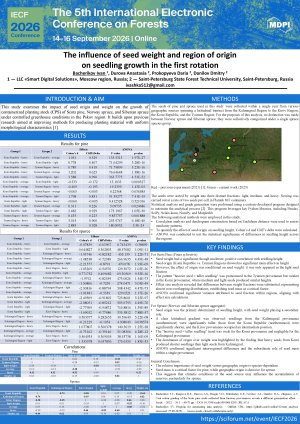
This work is devoted to analyzing the influence of the region of origin and weight of Scots pine, European spruce, and Siberian spruce seeds on the growth ball-rooted planting material in greenhouse conditions in the Pskov region. Pine and spruce seeds were collected in one year from different regions in the latitudinal range of the Kaliningrad region, Kirov region, Komi Republic, and Tyumen region, and then separated by weight into heavy, medium, and light. Further cultivation of ball-rooted planting material of pine and spruce was carried out at the greenhouse complex of Ecopolis LLC. The analysis of the data obtained included: correlation analysis, effect analysis (Cohen's D and Cliff's delta) and ANOVA. Distinctive relationships were identified between the weight of pine and spruce seeds and the biometric indicators of seedlings. For pine seeds, a strong positive correlation was found between seed weight (for the heavy fraction) and seedling height. At the same time, the region of origin of the seeds was statistically less significant than the seed mass. The influence of the region of origin on seedling height was recorded only when comparing seeds of the same mass. For European spruce, on the contrary, the key factor is the region of origin of the seeds, and the weight of the seed fractions had no significant effect on seedling height. Therefore, it is likely that spruce seeds should only be separated to remove foreign inclusions and hollow specimens.
Keywords
seeds
seedlings
Scots pine
Pinus sylvestris L.
Norway spruce
Picea abies (L.) Karst.
Siberian spruce
Picea obovata L.
seed weight
regions of origin
analysis
statistics
Poster
2026-03-09 Poster.pdf
Monitoring and Predicting Land Use/Land Cover Dynamics in the Sahyadri Tiger Reserve, Maharashtra, India, Using a Hybrid CA–Markov Model
Standardized Video-Based Assay of Insect Colour Choice to Support Forest Biodiversity and Pollination Services