Event submissions
Published
This submission belongs to the session S2. Forest Biodiversity, Ecosystem Services, and Earth Observations of the event The 5th International Electronic Conference on Forests
Published date
09 Sep, 2026
Academic Editor
'%3e%3cpath%20d='M12.6657%2010.9104C12.4185%2010.325%2012.0599%209.79327%2011.6097%209.34482C11.1609%208.89508%2010.6293%208.5365%2010.0442%208.28888C10.0389%208.28626%2010.0337%208.28495%2010.0285%208.28233C10.8446%207.69279%2011.3752%206.73249%2011.3752%205.64904C11.3752%203.8542%209.92103%202.39999%208.1262%202.39999C6.33136%202.39999%204.87715%203.8542%204.87715%205.64904C4.87715%206.73249%205.40774%207.69279%206.22393%208.28364C6.21869%208.28626%206.21345%208.28757%206.20821%208.29019C5.62129%208.5378%205.09463%208.89284%204.64265%209.34613C4.1929%209.79493%203.83432%2010.3266%203.58671%2010.9117C3.34345%2011.4845%203.21226%2012.0987%203.20023%2012.7209C3.19988%2012.7349%203.20233%2012.7488%203.20744%2012.7619C3.21255%2012.7749%203.22022%2012.7867%203.22998%2012.7968C3.23975%2012.8068%203.25142%2012.8147%203.26431%2012.8202C3.2772%2012.8256%203.29105%2012.8284%203.30504%2012.8284H4.09109C4.14874%2012.8284%204.19459%2012.7825%204.1959%2012.7262C4.2221%2011.7148%204.62823%2010.7676%205.34617%2010.0497C6.08899%209.30683%207.0755%208.89808%208.1262%208.89808C9.17689%208.89808%2010.1634%209.30683%2010.9062%2010.0497C11.6242%2010.7676%2012.0303%2011.7148%2012.0565%2012.7262C12.0578%2012.7838%2012.1037%2012.8284%2012.1613%2012.8284H12.9474C12.9613%2012.8284%2012.9752%2012.8256%2012.9881%2012.8202C13.001%2012.8147%2013.0126%2012.8068%2013.0224%2012.7968C13.0322%2012.7867%2013.0398%2012.7749%2013.0449%2012.7619C13.0501%2012.7488%2013.0525%2012.7349%2013.0522%2012.7209C13.0391%2012.0947%2012.9094%2011.4855%2012.6657%2010.9104ZM8.1262%207.9024C7.52486%207.9024%206.9589%207.6679%206.53312%207.24211C6.10733%206.81633%205.87283%206.25037%205.87283%205.64904C5.87283%205.0477%206.10733%204.48174%206.53312%204.05596C6.9589%203.63018%207.52486%203.39567%208.1262%203.39567C8.72753%203.39567%209.29349%203.63018%209.71927%204.05596C10.1451%204.48174%2010.3796%205.0477%2010.3796%205.64904C10.3796%206.25037%2010.1451%206.81633%209.71927%207.24211C9.29349%207.6679%208.72753%207.9024%208.1262%207.9024Z'%20fill='%235D1EE1'/%3e%3c/g%3e%3c/svg%3e) Mark Vanderwel
Mark VanderwelCitation
Lekhendra Sahu, Arun Pratap Singh, Ecological Insights into Moth Diversity and Seasonal Dynamics in Ban Oak Forests of the Western Himalaya, India, in Proceedings of The 5th International Electronic Conference on Forests, 14 September–16 September 2026, MDPI: Basel, Switzerland
Share
Email
Facebook
Twitter
LinkedIn
Ecological Insights into Moth Diversity and Seasonal Dynamics in Ban Oak Forests of the Western Himalaya, India
'%3e%3cpath%20d='M12.6647%2010.9104C12.4176%2010.325%2012.0589%209.7933%2011.6088%209.34485C11.16%208.89511%2010.6283%208.53653%2010.0432%208.28891C10.038%208.28629%2010.0327%208.28498%2010.0275%208.28236C10.8437%207.69282%2011.3743%206.73252%2011.3743%205.64907C11.3743%203.85423%209.92005%202.40002%208.12522%202.40002C6.33038%202.40002%204.87618%203.85423%204.87618%205.64907C4.87618%206.73252%205.40677%207.69282%206.22296%208.28367C6.21772%208.28629%206.21248%208.2876%206.20724%208.29022C5.62031%208.53783%205.09365%208.89287%204.64167%209.34616C4.19192%209.79496%203.83334%2010.3266%203.58573%2010.9117C3.34247%2011.4846%203.21128%2012.0987%203.19925%2012.721C3.1989%2012.735%203.20135%2012.7489%203.20646%2012.7619C3.21157%2012.7749%203.21924%2012.7868%203.22901%2012.7968C3.23877%2012.8068%203.25045%2012.8148%203.26334%2012.8202C3.27623%2012.8256%203.29007%2012.8284%203.30406%2012.8284H4.09012C4.14776%2012.8284%204.19362%2012.7825%204.19493%2012.7262C4.22113%2011.7148%204.62726%2010.7676%205.34519%2010.0497C6.08802%209.30686%207.07452%208.89811%208.12522%208.89811C9.17592%208.89811%2010.1624%209.30686%2010.9052%2010.0497C11.6232%2010.7676%2012.0293%2011.7148%2012.0555%2012.7262C12.0568%2012.7839%2012.1027%2012.8284%2012.1603%2012.8284H12.9464C12.9604%2012.8284%2012.9742%2012.8256%2012.9871%2012.8202C13%2012.8148%2013.0117%2012.8068%2013.0214%2012.7968C13.0312%2012.7868%2013.0389%2012.7749%2013.044%2012.7619C13.0491%2012.7489%2013.0515%2012.735%2013.0512%2012.721C13.0381%2012.0947%2012.9084%2011.4856%2012.6647%2010.9104ZM8.12522%207.90243C7.52388%207.90243%206.95792%207.66793%206.53214%207.24215C6.10636%206.81636%205.87185%206.2504%205.87185%205.64907C5.87185%205.04773%206.10636%204.48177%206.53214%204.05599C6.95792%203.63021%207.52388%203.3957%208.12522%203.3957C8.72655%203.3957%209.29252%203.63021%209.7183%204.05599C10.1441%204.48177%2010.3786%205.04773%2010.3786%205.64907C10.3786%206.2504%2010.1441%206.81636%209.7183%207.24215C9.29252%207.66793%208.72655%207.90243%208.12522%207.90243Z'%20fill='%235D1EE1'/%3e%3c/g%3e%3c/svg%3e)
Lekhendra Sahu 1
Arun Pratap Singh 1
1. Forest Entomology Discipline, Forest Protection Division, Forest Research Institute(FRI), P.O. New Forest, Dehradun, Uttarakhand 248006, India
Abstract
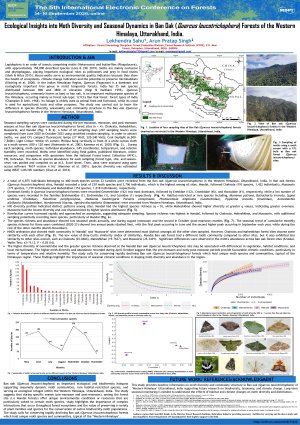
Ecological studies are vital for understanding biodiversity patterns and their seasonal dynamics. A study was carried out to know species composition, diversity and seasonality of macro-moths in the Quercus leucotrichophora A. Camus (Fagaceae) forests (n=4) in the Western Himalayan (WH) regions of Uttarakhand state in northern India. Seasonal surveys were conducted using moth screen over 69 days, spanning 207 sampling hours from June 2020 to October 2023, across pre-monsoon, monsoon, and post-monsoon periods. 6875 individuals of 480 species of macro-moths belonging to 09 super families, 22 families, 51 subfamilies, reflecting rich diversity. Which included 01 new range extensions (Epiplema adamantina Inoue, 1998) into the Western Himalaya from Central (Nepal) and Eastern Himalaya. Family Geometridae (162) was most dominant, followed by Erebidae (132), Crambidae (45), and Noctuidae (41), respectively; while a low number of species was recorded in the families Brahmaeidae (1), Endromidae (1), and Cossidae (1). Of the sites, Mandal and Maheshkhan had the greatest Shannon diversity (4.283 & 4.557). Mandal forest site indicated the unique moth community structure. Over 123 moth species were recorded in ‘Mandal’ forest, which makes it a unique habitat. Two annual peaks shows in ban oak forest first peak oocured earlier in May (pre-monsoon) and second also occurred earlier in September (early post-monsoon). Habitat-restricted or rare species including, Numenes patrana, Batracharta irrorata, Sypna umbrosa (Erebidae), Fascellina porphyreofusa, Medasina basistrigaria Paralcis conspicauta, Photoscotosia amplicata (Geometridae), Epiplema arcuata (Uraniidae), Acmeshachia albifascia (Notodontidae), Nordstromia lilacina, Agnidra discispilaria (Drepanidae) were recorded, emphasizing the conservation significance of these forest ecosystems. This study highlights the ecological importance of Ban Oak forests as biodiversity hotspots supporting diverse and seasonal moth communities. Habitat heterogeneity and the presence of rare species highlight their role as crucial ecological refuges in the Western Himalaya.
Keywords
Diversity
Community
Shannon Diversity
Geometridae
Eastern Himalaya
Seasonality
Poster
Ban oak - Lekhendra.pdf
Standardized Video-Based Assay of Insect Colour Choice to Support Forest Biodiversity and Pollination Services
Underutilised Sudanese Hardwood Species as Sustainable Construction Materials: A Critical Review of Properties, Engineering Potential, and Strategic Development Pathways