Event submissions
Published
This submission belongs to the session S3. Wood Science, Production Chains, Fuelwood and Trade of the event The 5th International Electronic Conference on Forests
Published date
09 Sep, 2026
Academic Editor
'%3e%3cpath%20d='M12.6657%2010.9104C12.4185%2010.325%2012.0599%209.79327%2011.6097%209.34482C11.1609%208.89508%2010.6293%208.5365%2010.0442%208.28888C10.0389%208.28626%2010.0337%208.28495%2010.0285%208.28233C10.8446%207.69279%2011.3752%206.73249%2011.3752%205.64904C11.3752%203.8542%209.92103%202.39999%208.1262%202.39999C6.33136%202.39999%204.87715%203.8542%204.87715%205.64904C4.87715%206.73249%205.40774%207.69279%206.22393%208.28364C6.21869%208.28626%206.21345%208.28757%206.20821%208.29019C5.62129%208.5378%205.09463%208.89284%204.64265%209.34613C4.1929%209.79493%203.83432%2010.3266%203.58671%2010.9117C3.34345%2011.4845%203.21226%2012.0987%203.20023%2012.7209C3.19988%2012.7349%203.20233%2012.7488%203.20744%2012.7619C3.21255%2012.7749%203.22022%2012.7867%203.22998%2012.7968C3.23975%2012.8068%203.25142%2012.8147%203.26431%2012.8202C3.2772%2012.8256%203.29105%2012.8284%203.30504%2012.8284H4.09109C4.14874%2012.8284%204.19459%2012.7825%204.1959%2012.7262C4.2221%2011.7148%204.62823%2010.7676%205.34617%2010.0497C6.08899%209.30683%207.0755%208.89808%208.1262%208.89808C9.17689%208.89808%2010.1634%209.30683%2010.9062%2010.0497C11.6242%2010.7676%2012.0303%2011.7148%2012.0565%2012.7262C12.0578%2012.7838%2012.1037%2012.8284%2012.1613%2012.8284H12.9474C12.9613%2012.8284%2012.9752%2012.8256%2012.9881%2012.8202C13.001%2012.8147%2013.0126%2012.8068%2013.0224%2012.7968C13.0322%2012.7867%2013.0398%2012.7749%2013.0449%2012.7619C13.0501%2012.7488%2013.0525%2012.7349%2013.0522%2012.7209C13.0391%2012.0947%2012.9094%2011.4855%2012.6657%2010.9104ZM8.1262%207.9024C7.52486%207.9024%206.9589%207.6679%206.53312%207.24211C6.10733%206.81633%205.87283%206.25037%205.87283%205.64904C5.87283%205.0477%206.10733%204.48174%206.53312%204.05596C6.9589%203.63018%207.52486%203.39567%208.1262%203.39567C8.72753%203.39567%209.29349%203.63018%209.71927%204.05596C10.1451%204.48174%2010.3796%205.0477%2010.3796%205.64904C10.3796%206.25037%2010.1451%206.81633%209.71927%207.24211C9.29349%207.6679%208.72753%207.9024%208.1262%207.9024Z'%20fill='%235D1EE1'/%3e%3c/g%3e%3c/svg%3e) Magdalena Broda
Magdalena BrodaCitation
Ahmed ALtaher Omer, Underutilised Sudanese Hardwood Species as Sustainable Construction Materials: A Critical Review of Properties, Engineering Potential, and Strategic Development Pathways, in Proceedings of The 5th International Electronic Conference on Forests, 14 September–16 September 2026, MDPI: Basel, Switzerland
Share
Email
Facebook
Twitter
LinkedIn
Underutilised Sudanese Hardwood Species as Sustainable Construction Materials: A Critical Review of Properties, Engineering Potential, and Strategic Development Pathways

Ahmed ALtaher Omer 1
1. Károly Simonyi Faculty of Engineering, Wood Science, and Art, University of Sopron, Sopron
Abstract
Sudan holds an estimated 69.5 million hectares of forest and woodland, harbouring a diverse assemblage of indigenous hardwood species whose physical and mechanical properties remain largely uncharacterised in the peer-reviewed literature. Building materials manufacturing contributes approximately 11% of global greenhouse gas emissions annually, creating strong incentives to substitute imported, carbon-intensive concrete and steel with locally produced, low-embodied-carbon engineered wood products (EWPs). This systematic review compiles and critically evaluates published property data for eight key Sudanese hardwood species — Anogeissus leiocarpus, Balanites aegyptiaca, Acacia nilotica, Khaya senegalensis, Eucalyptus camaldulensis, Azadirachta indica, Sclerocarya birrea, and Commiphora africana — assessing their compliance with BS EN 338:2016 structural timber strength classes, ANSI/APA PRG 320 CLT eligibility requirements, and EN 350:2016 natural durability classifications. A systematic search of Web of Science, Scopus, and Google Scholar identified 68 qualifying sources. Results demonstrate that A. leiocarpus (820–940 kg/m³; D27), B. aegyptiaca (780–920 kg/m³; D45), and A. nilotica (850–1,050 kg/m³; estimated D35–D50) represent premium structural resources substantially exceeding minimum CLT density requirements. E. camaldulensis plantation stocks offer the most immediately viable EWP feedstock. In contrast, C. africana (261 kg/m³) does not qualify for any structural strength class. Principal development barriers include deforestation (≥9.3 million tCO2/year from forest loss and degradation per REDD+ assessments), active armed conflict, absence of processing infrastructure, and critical characterisation data gaps. Seven specific recommendations are advanced to translate the identified resource potential into commercial construction supply chains, encompassing species characterisation, pilot EWP production, national grading standards, and integration of sustainable timber processing into Sudan's REDD+ and Nationally Determined Contribution frameworks.
Keywords
Sudan
tropical hardwood
engineered wood products
cross-laminated timber
wood characterisation
BS EN 338
Anogeissus leiocarpus
Balanites aegyptiaca
sustainable construction
wood modification
deforestation
REDD+
Poster
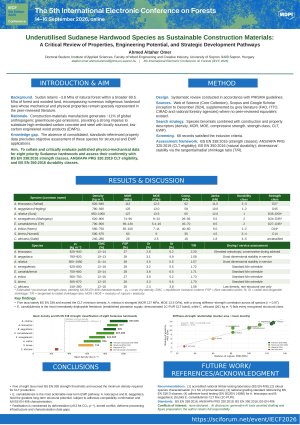
IECF2026_Poster.pdf
Ecological Insights into Moth Diversity and Seasonal Dynamics in Ban Oak Forests of the Western Himalaya, India
Fungicidal Activity of Bio-oils as Wood Preservatives