Event submissions
Published
This submission belongs to the session S3. Wood Science, Production Chains, Fuelwood and Trade of the event The 5th International Electronic Conference on Forests
Published date
09 Sep, 2026
Academic Editor
'%3e%3cpath%20d='M12.6657%2010.9104C12.4185%2010.325%2012.0599%209.79327%2011.6097%209.34482C11.1609%208.89508%2010.6293%208.5365%2010.0442%208.28888C10.0389%208.28626%2010.0337%208.28495%2010.0285%208.28233C10.8446%207.69279%2011.3752%206.73249%2011.3752%205.64904C11.3752%203.8542%209.92103%202.39999%208.1262%202.39999C6.33136%202.39999%204.87715%203.8542%204.87715%205.64904C4.87715%206.73249%205.40774%207.69279%206.22393%208.28364C6.21869%208.28626%206.21345%208.28757%206.20821%208.29019C5.62129%208.5378%205.09463%208.89284%204.64265%209.34613C4.1929%209.79493%203.83432%2010.3266%203.58671%2010.9117C3.34345%2011.4845%203.21226%2012.0987%203.20023%2012.7209C3.19988%2012.7349%203.20233%2012.7488%203.20744%2012.7619C3.21255%2012.7749%203.22022%2012.7867%203.22998%2012.7968C3.23975%2012.8068%203.25142%2012.8147%203.26431%2012.8202C3.2772%2012.8256%203.29105%2012.8284%203.30504%2012.8284H4.09109C4.14874%2012.8284%204.19459%2012.7825%204.1959%2012.7262C4.2221%2011.7148%204.62823%2010.7676%205.34617%2010.0497C6.08899%209.30683%207.0755%208.89808%208.1262%208.89808C9.17689%208.89808%2010.1634%209.30683%2010.9062%2010.0497C11.6242%2010.7676%2012.0303%2011.7148%2012.0565%2012.7262C12.0578%2012.7838%2012.1037%2012.8284%2012.1613%2012.8284H12.9474C12.9613%2012.8284%2012.9752%2012.8256%2012.9881%2012.8202C13.001%2012.8147%2013.0126%2012.8068%2013.0224%2012.7968C13.0322%2012.7867%2013.0398%2012.7749%2013.0449%2012.7619C13.0501%2012.7488%2013.0525%2012.7349%2013.0522%2012.7209C13.0391%2012.0947%2012.9094%2011.4855%2012.6657%2010.9104ZM8.1262%207.9024C7.52486%207.9024%206.9589%207.6679%206.53312%207.24211C6.10733%206.81633%205.87283%206.25037%205.87283%205.64904C5.87283%205.0477%206.10733%204.48174%206.53312%204.05596C6.9589%203.63018%207.52486%203.39567%208.1262%203.39567C8.72753%203.39567%209.29349%203.63018%209.71927%204.05596C10.1451%204.48174%2010.3796%205.0477%2010.3796%205.64904C10.3796%206.25037%2010.1451%206.81633%209.71927%207.24211C9.29349%207.6679%208.72753%207.9024%208.1262%207.9024Z'%20fill='%235D1EE1'/%3e%3c/g%3e%3c/svg%3e) Xiping Wang
Xiping WangCitation
Rodolfo Picchio, Angela Lo Monaco, Rachele Venanzi, Eugenia Pauselli, Giovanni Alessandri, Pierluca Gaglioppa, Slow pyrolysis with a kiln prototype for biochar production, in Proceedings of The 5th International Electronic Conference on Forests, 14 September–16 September 2026, MDPI: Basel, Switzerland
Share
Email
Facebook
Twitter
LinkedIn
Slow pyrolysis with a kiln prototype for biochar production

Rodolfo Picchio 1

Angela Lo Monaco 1

Rachele Venanzi 1
'%3e%3cpath%20d='M12.6647%2010.9104C12.4176%2010.325%2012.0589%209.7933%2011.6088%209.34485C11.16%208.89511%2010.6283%208.53653%2010.0432%208.28891C10.038%208.28629%2010.0327%208.28498%2010.0275%208.28236C10.8437%207.69282%2011.3743%206.73252%2011.3743%205.64907C11.3743%203.85423%209.92005%202.40002%208.12522%202.40002C6.33038%202.40002%204.87618%203.85423%204.87618%205.64907C4.87618%206.73252%205.40677%207.69282%206.22296%208.28367C6.21772%208.28629%206.21248%208.2876%206.20724%208.29022C5.62031%208.53783%205.09365%208.89287%204.64167%209.34616C4.19192%209.79496%203.83334%2010.3266%203.58573%2010.9117C3.34247%2011.4846%203.21128%2012.0987%203.19925%2012.721C3.1989%2012.735%203.20135%2012.7489%203.20646%2012.7619C3.21157%2012.7749%203.21924%2012.7868%203.22901%2012.7968C3.23877%2012.8068%203.25045%2012.8148%203.26334%2012.8202C3.27623%2012.8256%203.29007%2012.8284%203.30406%2012.8284H4.09012C4.14776%2012.8284%204.19362%2012.7825%204.19493%2012.7262C4.22113%2011.7148%204.62726%2010.7676%205.34519%2010.0497C6.08802%209.30686%207.07452%208.89811%208.12522%208.89811C9.17592%208.89811%2010.1624%209.30686%2010.9052%2010.0497C11.6232%2010.7676%2012.0293%2011.7148%2012.0555%2012.7262C12.0568%2012.7839%2012.1027%2012.8284%2012.1603%2012.8284H12.9464C12.9604%2012.8284%2012.9742%2012.8256%2012.9871%2012.8202C13%2012.8148%2013.0117%2012.8068%2013.0214%2012.7968C13.0312%2012.7868%2013.0389%2012.7749%2013.044%2012.7619C13.0491%2012.7489%2013.0515%2012.735%2013.0512%2012.721C13.0381%2012.0947%2012.9084%2011.4856%2012.6647%2010.9104ZM8.12522%207.90243C7.52388%207.90243%206.95792%207.66793%206.53214%207.24215C6.10636%206.81636%205.87185%206.2504%205.87185%205.64907C5.87185%205.04773%206.10636%204.48177%206.53214%204.05599C6.95792%203.63021%207.52388%203.3957%208.12522%203.3957C8.72655%203.3957%209.29252%203.63021%209.7183%204.05599C10.1441%204.48177%2010.3786%205.04773%2010.3786%205.64907C10.3786%206.2504%2010.1441%206.81636%209.7183%207.24215C9.29252%207.66793%208.72655%207.90243%208.12522%207.90243Z'%20fill='%235D1EE1'/%3e%3c/g%3e%3c/svg%3e)
Eugenia Pauselli 1
Giovanni Alessandri 2
Pierluca Gaglioppa 3
1. Department of Agricultural and Forest Sciences (DAFNE), University of Tuscia, Via San Camillo del Lellis, 01100 Viterbo – ITALY
2. Studio Tecnico Associato AGRICIS, Via Cana, 4, Sasso d'Ombrone, 58044 Cinigiano (GR) - ITALY
3. Regional Natural Reserve Selva del Lamone, Regione Lazio, loc. Bottino, 01010 Farnese (VT) - ITALY
Abstract
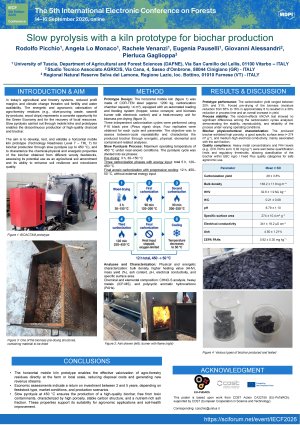
One of the most popular thermochemical transformations for wood products is pyrolysis. In this study, a slow pyrolysis process was conducted at an operating temperature of 450°C. The technology employed consisted of a horizontal mobile kiln, prototyped by this research group and with a technology readiness level 7.
The carbonization cycle consisted of six steps: (i) wood drying, duration 3 h, temperature range 30-150 °C; (ii-iv) carbonization phases (with energy input and temperature increase), duration 5 h, temperature range 120-450 °C; and (v) final carbonization (without energy input and with a simultaneous decrease in temperature), duration 12 h, temperature range 450-50 °C. The last step takes place almost entirely in an anoxic environment and represents one of the most important phases for creating high quality charcoal or biochar.
The tests conducted according to experimental criteria and following standardized protocols have given as a product carbonized wood that underwent visual, physical, and chemical evaluations according to technical standards.
A total of three complete carbonization cycles were analyzed, and the random-effects ANOVA test showed no differences between the cycles. The resulting charcoal exhibited positive characteristics, such as good porosity. The surface area in quantitative terms showed interesting values, and the electrical conductivity values were medium-high, most likely due to an increase in the number of ions resulting from the increased ash fraction.
Heavy metal contaminants analysis revealed that the recorded values were below the limit of quantification (<LQ) (2 mg kg−1) in all samples.
Raw material, timing, and operating temperature were found to be the most important parameters influencing the salient characteristics of biochar obtained from woody biomass.
The activities carried out were supported by the EU-Potarch (COST Action CA22155 European Unionion2019s Framework Programme for Research & Innovation).
Keywords
Wood Biochar
Charcoal kiln
Process sustainablity
Poster
Poster_Picchio_IECF.pdf
A study of demineralization methods and the thermal degradation of wood to assess the impact of mineral compounds on biomass torrefaction
Possible uses and applications of biochar and charcoal produced by slow pyrolysis kiln prototype