Event submissions
Published
This submission belongs to the session S3. Wood Science, Production Chains, Fuelwood and Trade of the event The 5th International Electronic Conference on Forests
Published date
09 Sep, 2026
Academic Editor
'%3e%3cpath%20d='M12.6657%2010.9104C12.4185%2010.325%2012.0599%209.79327%2011.6097%209.34482C11.1609%208.89508%2010.6293%208.5365%2010.0442%208.28888C10.0389%208.28626%2010.0337%208.28495%2010.0285%208.28233C10.8446%207.69279%2011.3752%206.73249%2011.3752%205.64904C11.3752%203.8542%209.92103%202.39999%208.1262%202.39999C6.33136%202.39999%204.87715%203.8542%204.87715%205.64904C4.87715%206.73249%205.40774%207.69279%206.22393%208.28364C6.21869%208.28626%206.21345%208.28757%206.20821%208.29019C5.62129%208.5378%205.09463%208.89284%204.64265%209.34613C4.1929%209.79493%203.83432%2010.3266%203.58671%2010.9117C3.34345%2011.4845%203.21226%2012.0987%203.20023%2012.7209C3.19988%2012.7349%203.20233%2012.7488%203.20744%2012.7619C3.21255%2012.7749%203.22022%2012.7867%203.22998%2012.7968C3.23975%2012.8068%203.25142%2012.8147%203.26431%2012.8202C3.2772%2012.8256%203.29105%2012.8284%203.30504%2012.8284H4.09109C4.14874%2012.8284%204.19459%2012.7825%204.1959%2012.7262C4.2221%2011.7148%204.62823%2010.7676%205.34617%2010.0497C6.08899%209.30683%207.0755%208.89808%208.1262%208.89808C9.17689%208.89808%2010.1634%209.30683%2010.9062%2010.0497C11.6242%2010.7676%2012.0303%2011.7148%2012.0565%2012.7262C12.0578%2012.7838%2012.1037%2012.8284%2012.1613%2012.8284H12.9474C12.9613%2012.8284%2012.9752%2012.8256%2012.9881%2012.8202C13.001%2012.8147%2013.0126%2012.8068%2013.0224%2012.7968C13.0322%2012.7867%2013.0398%2012.7749%2013.0449%2012.7619C13.0501%2012.7488%2013.0525%2012.7349%2013.0522%2012.7209C13.0391%2012.0947%2012.9094%2011.4855%2012.6657%2010.9104ZM8.1262%207.9024C7.52486%207.9024%206.9589%207.6679%206.53312%207.24211C6.10733%206.81633%205.87283%206.25037%205.87283%205.64904C5.87283%205.0477%206.10733%204.48174%206.53312%204.05596C6.9589%203.63018%207.52486%203.39567%208.1262%203.39567C8.72753%203.39567%209.29349%203.63018%209.71927%204.05596C10.1451%204.48174%2010.3796%205.0477%2010.3796%205.64904C10.3796%206.25037%2010.1451%206.81633%209.71927%207.24211C9.29349%207.6679%208.72753%207.9024%208.1262%207.9024Z'%20fill='%235D1EE1'/%3e%3c/g%3e%3c/svg%3e) Xiping Wang
Xiping WangCitation
Rachele Venanzi, RODOLFO PICCHIO, Angela Lo Monaco, Eugenia Pauselli, Giovanni Alessandri, Pierluca Gaglioppa, Possible uses and applications of biochar and charcoal produced by slow pyrolysis kiln prototype, in Proceedings of The 5th International Electronic Conference on Forests, 14 September–16 September 2026, MDPI: Basel, Switzerland
Share
Email
Facebook
Twitter
LinkedIn
Possible uses and applications of biochar and charcoal produced by slow pyrolysis kiln prototype

Rachele Venanzi 1

RODOLFO PICCHIO 1

Angela Lo Monaco 1
'%3e%3cpath%20d='M12.6647%2010.9104C12.4176%2010.325%2012.0589%209.7933%2011.6088%209.34485C11.16%208.89511%2010.6283%208.53653%2010.0432%208.28891C10.038%208.28629%2010.0327%208.28498%2010.0275%208.28236C10.8437%207.69282%2011.3743%206.73252%2011.3743%205.64907C11.3743%203.85423%209.92005%202.40002%208.12522%202.40002C6.33038%202.40002%204.87618%203.85423%204.87618%205.64907C4.87618%206.73252%205.40677%207.69282%206.22296%208.28367C6.21772%208.28629%206.21248%208.2876%206.20724%208.29022C5.62031%208.53783%205.09365%208.89287%204.64167%209.34616C4.19192%209.79496%203.83334%2010.3266%203.58573%2010.9117C3.34247%2011.4846%203.21128%2012.0987%203.19925%2012.721C3.1989%2012.735%203.20135%2012.7489%203.20646%2012.7619C3.21157%2012.7749%203.21924%2012.7868%203.22901%2012.7968C3.23877%2012.8068%203.25045%2012.8148%203.26334%2012.8202C3.27623%2012.8256%203.29007%2012.8284%203.30406%2012.8284H4.09012C4.14776%2012.8284%204.19362%2012.7825%204.19493%2012.7262C4.22113%2011.7148%204.62726%2010.7676%205.34519%2010.0497C6.08802%209.30686%207.07452%208.89811%208.12522%208.89811C9.17592%208.89811%2010.1624%209.30686%2010.9052%2010.0497C11.6232%2010.7676%2012.0293%2011.7148%2012.0555%2012.7262C12.0568%2012.7839%2012.1027%2012.8284%2012.1603%2012.8284H12.9464C12.9604%2012.8284%2012.9742%2012.8256%2012.9871%2012.8202C13%2012.8148%2013.0117%2012.8068%2013.0214%2012.7968C13.0312%2012.7868%2013.0389%2012.7749%2013.044%2012.7619C13.0491%2012.7489%2013.0515%2012.735%2013.0512%2012.721C13.0381%2012.0947%2012.9084%2011.4856%2012.6647%2010.9104ZM8.12522%207.90243C7.52388%207.90243%206.95792%207.66793%206.53214%207.24215C6.10636%206.81636%205.87185%206.2504%205.87185%205.64907C5.87185%205.04773%206.10636%204.48177%206.53214%204.05599C6.95792%203.63021%207.52388%203.3957%208.12522%203.3957C8.72655%203.3957%209.29252%203.63021%209.7183%204.05599C10.1441%204.48177%2010.3786%205.04773%2010.3786%205.64907C10.3786%206.2504%2010.1441%206.81636%209.7183%207.24215C9.29252%207.66793%208.72655%207.90243%208.12522%207.90243Z'%20fill='%235D1EE1'/%3e%3c/g%3e%3c/svg%3e)
Eugenia Pauselli 1
Giovanni Alessandri 2
Pierluca Gaglioppa 3
1. Department of Agricultural and Forest Sciences (DAFNE), University of Tuscia, Via San Camillo del Lellis, 01100 Viterbo – ITALY
2. Studio Tecnico Associato AGRICIS, Via Cana, 4, Sasso d'Ombrone, 58044 Cinigiano (GR) - ITALY
3. Regional Natural Reserve Selva del Lamone, Regione Lazio, loc. Bottino, 01010 Farnese (VT) - ITALY
Abstract
Wood residues from forestry represent an interesting source for economic valorization within a circular economy framework offering forest owners a significant opportunity for product diversification. From this perspective, wood charcoal offers an exciting prospect. To develop this prospect, new mobile kilns were tested on site, evaluating both the process and the final products.
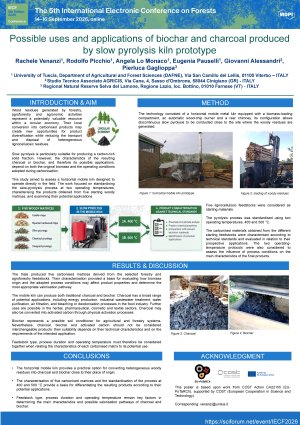
This new type of kiln features a mobile metal structure and can operate on the field. It has a loading compartment for the biomass to be carbonized, an automatic wood chip burner, and a rear chimney. As part of this research, the pyrolysis process was standardized and operated at two different operating temperature (400 and 500 °C).
These innovative kilns can produce traditional charcoal or biochar, which can in turn generate activated carbon through physical processes. Charcoal has undeniable positive qualities and is highly versatile: energy use, treatment of industrial wastewater, water purification, and air filtration; in the food industry for the bleaching and deodorization of wine, vinegar, fruit juices, and other food products; in the herbal, pharmaceutical, and cosmetic industries; and in the textile and agricultural sectors as a soil conditioner, known as "biochar." Forestry or agroforestry biochar of woody origins is a new product with very interesting application prospects. Charcoal produced in forestry supply chains could also benefit from PEFC Chain of Custody certification, reaching a more qualified market while adhering to the core principles of the Circular Economy and the Green Economy.
This research led to the characterization of 5 different charcoal matrices, evaluated against technical standards based on their application prospects. In addition, two process standards were proposed to evaluate their influence on the main characteristics.
The activities carried out were supported by the EU-Potarch (COST Action CA22155 European Unionion2019s Framework Programme for Research & Innovation).
Keywords
Wood charcoal
Biochar
Mobile charcoal kiln
Circular economy
Bioeconomy
Process sustainablity
Poster
Poster_Venanzi_IECF.pdf
Slow pyrolysis with a kiln prototype for biochar production
Innovation and multifunctionality in hilly and mountain forest and agroforestry systems: design of a mobile vertical pyrolysis kiln