Event submissions
Published
This submission belongs to the session S3. Wood Science, Production Chains, Fuelwood and Trade of the event The 5th International Electronic Conference on Forests
Published date
09 Sep, 2026
Academic Editor
'%3e%3cpath%20d='M12.6657%2010.9104C12.4185%2010.325%2012.0599%209.79327%2011.6097%209.34482C11.1609%208.89508%2010.6293%208.5365%2010.0442%208.28888C10.0389%208.28626%2010.0337%208.28495%2010.0285%208.28233C10.8446%207.69279%2011.3752%206.73249%2011.3752%205.64904C11.3752%203.8542%209.92103%202.39999%208.1262%202.39999C6.33136%202.39999%204.87715%203.8542%204.87715%205.64904C4.87715%206.73249%205.40774%207.69279%206.22393%208.28364C6.21869%208.28626%206.21345%208.28757%206.20821%208.29019C5.62129%208.5378%205.09463%208.89284%204.64265%209.34613C4.1929%209.79493%203.83432%2010.3266%203.58671%2010.9117C3.34345%2011.4845%203.21226%2012.0987%203.20023%2012.7209C3.19988%2012.7349%203.20233%2012.7488%203.20744%2012.7619C3.21255%2012.7749%203.22022%2012.7867%203.22998%2012.7968C3.23975%2012.8068%203.25142%2012.8147%203.26431%2012.8202C3.2772%2012.8256%203.29105%2012.8284%203.30504%2012.8284H4.09109C4.14874%2012.8284%204.19459%2012.7825%204.1959%2012.7262C4.2221%2011.7148%204.62823%2010.7676%205.34617%2010.0497C6.08899%209.30683%207.0755%208.89808%208.1262%208.89808C9.17689%208.89808%2010.1634%209.30683%2010.9062%2010.0497C11.6242%2010.7676%2012.0303%2011.7148%2012.0565%2012.7262C12.0578%2012.7838%2012.1037%2012.8284%2012.1613%2012.8284H12.9474C12.9613%2012.8284%2012.9752%2012.8256%2012.9881%2012.8202C13.001%2012.8147%2013.0126%2012.8068%2013.0224%2012.7968C13.0322%2012.7867%2013.0398%2012.7749%2013.0449%2012.7619C13.0501%2012.7488%2013.0525%2012.7349%2013.0522%2012.7209C13.0391%2012.0947%2012.9094%2011.4855%2012.6657%2010.9104ZM8.1262%207.9024C7.52486%207.9024%206.9589%207.6679%206.53312%207.24211C6.10733%206.81633%205.87283%206.25037%205.87283%205.64904C5.87283%205.0477%206.10733%204.48174%206.53312%204.05596C6.9589%203.63018%207.52486%203.39567%208.1262%203.39567C8.72753%203.39567%209.29349%203.63018%209.71927%204.05596C10.1451%204.48174%2010.3796%205.0477%2010.3796%205.64904C10.3796%206.25037%2010.1451%206.81633%209.71927%207.24211C9.29349%207.6679%208.72753%207.9024%208.1262%207.9024Z'%20fill='%235D1EE1'/%3e%3c/g%3e%3c/svg%3e) Mark Vanderwel
Mark VanderwelCitation
Angela Lo Monaco, Rodolfo Picchio, Rachele Venanzi, Pierluca Gaglioppa, Innovation and multifunctionality in hilly and mountain forest and agroforestry systems: design of a mobile vertical pyrolysis kiln, in Proceedings of The 5th International Electronic Conference on Forests, 14 September–16 September 2026, MDPI: Basel, Switzerland
Share
Email
Facebook
Twitter
LinkedIn
Innovation and multifunctionality in hilly and mountain forest and agroforestry systems: design of a mobile vertical pyrolysis kiln

Angela Lo Monaco 1

Rodolfo Picchio 1

Rachele Venanzi 1
'%3e%3cpath%20d='M12.6647%2010.9104C12.4176%2010.325%2012.0589%209.7933%2011.6088%209.34485C11.16%208.89511%2010.6283%208.53653%2010.0432%208.28891C10.038%208.28629%2010.0327%208.28498%2010.0275%208.28236C10.8437%207.69282%2011.3743%206.73252%2011.3743%205.64907C11.3743%203.85423%209.92005%202.40002%208.12522%202.40002C6.33038%202.40002%204.87618%203.85423%204.87618%205.64907C4.87618%206.73252%205.40677%207.69282%206.22296%208.28367C6.21772%208.28629%206.21248%208.2876%206.20724%208.29022C5.62031%208.53783%205.09365%208.89287%204.64167%209.34616C4.19192%209.79496%203.83334%2010.3266%203.58573%2010.9117C3.34247%2011.4846%203.21128%2012.0987%203.19925%2012.721C3.1989%2012.735%203.20135%2012.7489%203.20646%2012.7619C3.21157%2012.7749%203.21924%2012.7868%203.22901%2012.7968C3.23877%2012.8068%203.25045%2012.8148%203.26334%2012.8202C3.27623%2012.8256%203.29007%2012.8284%203.30406%2012.8284H4.09012C4.14776%2012.8284%204.19362%2012.7825%204.19493%2012.7262C4.22113%2011.7148%204.62726%2010.7676%205.34519%2010.0497C6.08802%209.30686%207.07452%208.89811%208.12522%208.89811C9.17592%208.89811%2010.1624%209.30686%2010.9052%2010.0497C11.6232%2010.7676%2012.0293%2011.7148%2012.0555%2012.7262C12.0568%2012.7839%2012.1027%2012.8284%2012.1603%2012.8284H12.9464C12.9604%2012.8284%2012.9742%2012.8256%2012.9871%2012.8202C13%2012.8148%2013.0117%2012.8068%2013.0214%2012.7968C13.0312%2012.7868%2013.0389%2012.7749%2013.044%2012.7619C13.0491%2012.7489%2013.0515%2012.735%2013.0512%2012.721C13.0381%2012.0947%2012.9084%2011.4856%2012.6647%2010.9104ZM8.12522%207.90243C7.52388%207.90243%206.95792%207.66793%206.53214%207.24215C6.10636%206.81636%205.87185%206.2504%205.87185%205.64907C5.87185%205.04773%206.10636%204.48177%206.53214%204.05599C6.95792%203.63021%207.52388%203.3957%208.12522%203.3957C8.72655%203.3957%209.29252%203.63021%209.7183%204.05599C10.1441%204.48177%2010.3786%205.04773%2010.3786%205.64907C10.3786%206.2504%2010.1441%206.81636%209.7183%207.24215C9.29252%207.66793%208.72655%207.90243%208.12522%207.90243Z'%20fill='%235D1EE1'/%3e%3c/g%3e%3c/svg%3e)
Pierluca Gaglioppa 2
1. Department of Agriculture and Forest Sciences (DAFNE), University of Tuscia, Viterbo, Italy
2. Regional Natural Reserve Selva del Lamone, Regione Lazio, loc. Bottino, 01010 Farnese (VT), Italy
Abstract
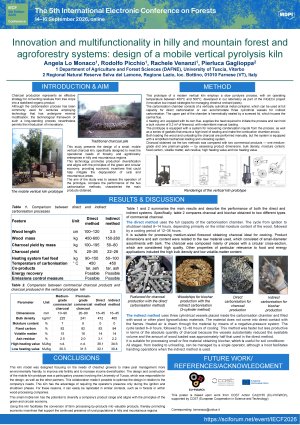
This study presents the design of a small, mobile vertical charcoal kiln, specifically designed to meet the operational needs of forestry and agroforestry enterprises in hilly and mountainous regions. By converting low-value wood byproducts into high-value raw materials, this technology promotes production diversification and aligns with the principles of the green and circular economy, providing economic incentives that could help mitigate the depopulation of rural and mountainous areas. The developed prototype consists of a vertical cylindrical metal structure, divided into separate carbonization and combustion chambers. A key feature of the system is its operational flexibility, as it supports both direct and indirect carbonization. In direct mode, biomass is loaded into the main chamber, where the flow of thermal energy passes directly through the material via a dedicated ventilation duct. In indirect mode, the wood is processed inside special cylindrical metal containers, which protect it from direct exposure to heat. The furnace incorporates several optimizations: a simplified mechanical loading and unloading system, high-efficiency sealing gaskets to ensure a completely anoxic environment in the charring zone, and an integrated system for recovering process condensation liquids. Operationally, the furnace requires manual operation only during start-up and shutdown, reducing labor requirements. Operating via slow pyrolysis at medium-low temperatures (approximately 500°C) and using untreated virgin wood, this prototype maximizes the qualitative and quantitative yield of solid biochar and carbon compared to high-temperature systems. Furthermore, the recovery of liquid pyroligneous condensates provides an additional high-potential byproduct, which could generate a diversified revenue stream from materials that would otherwise be discarded as waste. The activities carried out were supported by the projects INGECA (PS-GO, PSR Regione Toscana), DIVERSO (Italian Ministry for Education, University, and Research - Law 232/2016, Departments of Excellence 2023\\u20132027) and EU-Potarch (COST Action CA22155 European Unionion2019s Framework Programme for Research & Innovation).
Keywords
Slow pyrolysis
Direct and indirect carbonization
Charcoal
Biochar
Virgin forest biomass
Waste valorization
Poster
Lo Monaco et al iecf2026 POSTER.pdf
Possible uses and applications of biochar and charcoal produced by slow pyrolysis kiln prototype
Thermal Degradation and Fuel Characteristics of Douglas Fir Sapwood and Heartwood for Bioenergy Applications