Event submissions
Published
This submission belongs to the session S3. Wood Science, Production Chains, Fuelwood and Trade of the event The 5th International Electronic Conference on Forests
Published date
09 Sep, 2026
Academic Editor
'%3e%3cpath%20d='M12.6657%2010.9104C12.4185%2010.325%2012.0599%209.79327%2011.6097%209.34482C11.1609%208.89508%2010.6293%208.5365%2010.0442%208.28888C10.0389%208.28626%2010.0337%208.28495%2010.0285%208.28233C10.8446%207.69279%2011.3752%206.73249%2011.3752%205.64904C11.3752%203.8542%209.92103%202.39999%208.1262%202.39999C6.33136%202.39999%204.87715%203.8542%204.87715%205.64904C4.87715%206.73249%205.40774%207.69279%206.22393%208.28364C6.21869%208.28626%206.21345%208.28757%206.20821%208.29019C5.62129%208.5378%205.09463%208.89284%204.64265%209.34613C4.1929%209.79493%203.83432%2010.3266%203.58671%2010.9117C3.34345%2011.4845%203.21226%2012.0987%203.20023%2012.7209C3.19988%2012.7349%203.20233%2012.7488%203.20744%2012.7619C3.21255%2012.7749%203.22022%2012.7867%203.22998%2012.7968C3.23975%2012.8068%203.25142%2012.8147%203.26431%2012.8202C3.2772%2012.8256%203.29105%2012.8284%203.30504%2012.8284H4.09109C4.14874%2012.8284%204.19459%2012.7825%204.1959%2012.7262C4.2221%2011.7148%204.62823%2010.7676%205.34617%2010.0497C6.08899%209.30683%207.0755%208.89808%208.1262%208.89808C9.17689%208.89808%2010.1634%209.30683%2010.9062%2010.0497C11.6242%2010.7676%2012.0303%2011.7148%2012.0565%2012.7262C12.0578%2012.7838%2012.1037%2012.8284%2012.1613%2012.8284H12.9474C12.9613%2012.8284%2012.9752%2012.8256%2012.9881%2012.8202C13.001%2012.8147%2013.0126%2012.8068%2013.0224%2012.7968C13.0322%2012.7867%2013.0398%2012.7749%2013.0449%2012.7619C13.0501%2012.7488%2013.0525%2012.7349%2013.0522%2012.7209C13.0391%2012.0947%2012.9094%2011.4855%2012.6657%2010.9104ZM8.1262%207.9024C7.52486%207.9024%206.9589%207.6679%206.53312%207.24211C6.10733%206.81633%205.87283%206.25037%205.87283%205.64904C5.87283%205.0477%206.10733%204.48174%206.53312%204.05596C6.9589%203.63018%207.52486%203.39567%208.1262%203.39567C8.72753%203.39567%209.29349%203.63018%209.71927%204.05596C10.1451%204.48174%2010.3796%205.0477%2010.3796%205.64904C10.3796%206.25037%2010.1451%206.81633%209.71927%207.24211C9.29349%207.6679%208.72753%207.9024%208.1262%207.9024Z'%20fill='%235D1EE1'/%3e%3c/g%3e%3c/svg%3e) Magdalena Broda
Magdalena BrodaCitation
Evangelia Siafali, Grigorios Papageorgiou, Georgios Koulinas, AHP-Based Assessment of Strengthening Interventions for Asphalt-Paved Forest Roads Supporting Timber Transport Efficiency, in Proceedings of The 5th International Electronic Conference on Forests, 14 September–16 September 2026, MDPI: Basel, Switzerland
Share
Email
Facebook
Twitter
LinkedIn
AHP-Based Assessment of Strengthening Interventions for Asphalt-Paved Forest Roads Supporting Timber Transport Efficiency

Evangelia Siafali 1
'%3e%3cpath%20d='M12.6647%2010.9104C12.4176%2010.325%2012.0589%209.7933%2011.6088%209.34485C11.16%208.89511%2010.6283%208.53653%2010.0432%208.28891C10.038%208.28629%2010.0327%208.28498%2010.0275%208.28236C10.8437%207.69282%2011.3743%206.73252%2011.3743%205.64907C11.3743%203.85423%209.92005%202.40002%208.12522%202.40002C6.33038%202.40002%204.87618%203.85423%204.87618%205.64907C4.87618%206.73252%205.40677%207.69282%206.22296%208.28367C6.21772%208.28629%206.21248%208.2876%206.20724%208.29022C5.62031%208.53783%205.09365%208.89287%204.64167%209.34616C4.19192%209.79496%203.83334%2010.3266%203.58573%2010.9117C3.34247%2011.4846%203.21128%2012.0987%203.19925%2012.721C3.1989%2012.735%203.20135%2012.7489%203.20646%2012.7619C3.21157%2012.7749%203.21924%2012.7868%203.22901%2012.7968C3.23877%2012.8068%203.25045%2012.8148%203.26334%2012.8202C3.27623%2012.8256%203.29007%2012.8284%203.30406%2012.8284H4.09012C4.14776%2012.8284%204.19362%2012.7825%204.19493%2012.7262C4.22113%2011.7148%204.62726%2010.7676%205.34519%2010.0497C6.08802%209.30686%207.07452%208.89811%208.12522%208.89811C9.17592%208.89811%2010.1624%209.30686%2010.9052%2010.0497C11.6232%2010.7676%2012.0293%2011.7148%2012.0555%2012.7262C12.0568%2012.7839%2012.1027%2012.8284%2012.1603%2012.8284H12.9464C12.9604%2012.8284%2012.9742%2012.8256%2012.9871%2012.8202C13%2012.8148%2013.0117%2012.8068%2013.0214%2012.7968C13.0312%2012.7868%2013.0389%2012.7749%2013.044%2012.7619C13.0491%2012.7489%2013.0515%2012.735%2013.0512%2012.721C13.0381%2012.0947%2012.9084%2011.4856%2012.6647%2010.9104ZM8.12522%207.90243C7.52388%207.90243%206.95792%207.66793%206.53214%207.24215C6.10636%206.81636%205.87185%206.2504%205.87185%205.64907C5.87185%205.04773%206.10636%204.48177%206.53214%204.05599C6.95792%203.63021%207.52388%203.3957%208.12522%203.3957C8.72655%203.3957%209.29252%203.63021%209.7183%204.05599C10.1441%204.48177%2010.3786%205.04773%2010.3786%205.64907C10.3786%206.2504%2010.1441%206.81636%209.7183%207.24215C9.29252%207.66793%208.72655%207.90243%208.12522%207.90243Z'%20fill='%235D1EE1'/%3e%3c/g%3e%3c/svg%3e)
Grigorios Papageorgiou 1

Georgios Koulinas 2
1. Department of Forestry, Wood Sciences and Design, University of Thessaly Laboratory of Forest Road Engineering and Forest Works 11 Griva Street, Karditsa, Greece
2. Department of Production Engineering and Management, Democritus University of Thrace (DUTH), Management Systems Sector, Vas. Sophias 12, GR-671 32 Xanthi, Greece
Abstract
Asphalt-paved “Category A” forest roads serve as important infrastructure for forest management and timber logistics. Their pavement condition draws a direct correlation to transportation efficiency, vehicle operating costs, travel time, safety, and the unimpeded continuation of forest operations. These roads also support firefighting access to fire-prone areas and facilitate mountain tourism. However, pavement maintenance methods have mainly been evaluated in conventional road networks, while limited attention has been given to asphalt-paved forest roads. The aim of this study is to establish a multi-criteria framework for the selection and prioritization of optimal strengthening interventions on forest roads. The proposed methodology is based on a twofold application of the Analytical Hierarchy Process (AHP), combining engineering and economic appraisal. The examined alternatives include HMA overlay, hot rolled asphalt, stone matrix asphalt, recycling without overlay, overlay with fiber reinforcement, and Glasgrid with overlay. Engineering criteria include ease and rate of application, versatility, effectiveness, durability, and environmental impact. Economic criteria include construction cost, maintenance management cost, operational-stage cost, timber transport benefits, and broader forest-management benefits. Pairwise comparisons are used to calculate priorities for criteria and alternatives. The framework produces separate engineering and economic rankings, followed by a combined ranking of strengthening alternatives. The combined AHP score for forest roads supports interventions that improve pavement performance, increase durability under timber-truck traffic, reduce future maintenance costs, and ensure reliable wood transportation to concentration and processing facilities. Maintenance planning for asphalt-paved Category A forest roads should be addressed as a multi-criteria decision-making problem. The proposed AHP-based framework provides a transparent decision-support tool for forest services, engineers, and road operators. Future research should apply the framework to real forest road sections using field pavement-condition data, local costs, timber traffic intensity, and accessibility indicators.
Keywords
Multi-criteria decision-making
Wood supply chain
Analytical Hierarchy Process
Firefighting accessibility
Infrastructure management
Poster
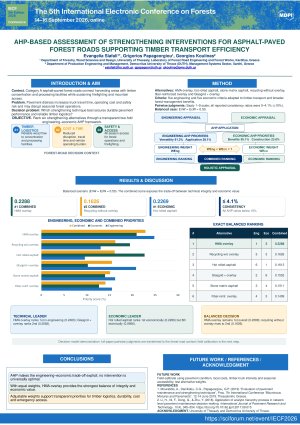
IECF2026_AHP_Forest_Road_Poster v1.pdf
Thermal Degradation and Fuel Characteristics of Douglas Fir Sapwood and Heartwood for Bioenergy Applications
Pellets produced from mechanical processing residues of Pinus taeda: quality assessment against the EN PLUS standard