Event submissions
Published
This submission belongs to the session S4. Forest Inventory, Modeling and Remote Sensing of the event The 5th International Electronic Conference on Forests
Published date
09 Sep, 2026
Academic Editor
'%3e%3cpath%20d='M12.6657%2010.9104C12.4185%2010.325%2012.0599%209.79327%2011.6097%209.34482C11.1609%208.89508%2010.6293%208.5365%2010.0442%208.28888C10.0389%208.28626%2010.0337%208.28495%2010.0285%208.28233C10.8446%207.69279%2011.3752%206.73249%2011.3752%205.64904C11.3752%203.8542%209.92103%202.39999%208.1262%202.39999C6.33136%202.39999%204.87715%203.8542%204.87715%205.64904C4.87715%206.73249%205.40774%207.69279%206.22393%208.28364C6.21869%208.28626%206.21345%208.28757%206.20821%208.29019C5.62129%208.5378%205.09463%208.89284%204.64265%209.34613C4.1929%209.79493%203.83432%2010.3266%203.58671%2010.9117C3.34345%2011.4845%203.21226%2012.0987%203.20023%2012.7209C3.19988%2012.7349%203.20233%2012.7488%203.20744%2012.7619C3.21255%2012.7749%203.22022%2012.7867%203.22998%2012.7968C3.23975%2012.8068%203.25142%2012.8147%203.26431%2012.8202C3.2772%2012.8256%203.29105%2012.8284%203.30504%2012.8284H4.09109C4.14874%2012.8284%204.19459%2012.7825%204.1959%2012.7262C4.2221%2011.7148%204.62823%2010.7676%205.34617%2010.0497C6.08899%209.30683%207.0755%208.89808%208.1262%208.89808C9.17689%208.89808%2010.1634%209.30683%2010.9062%2010.0497C11.6242%2010.7676%2012.0303%2011.7148%2012.0565%2012.7262C12.0578%2012.7838%2012.1037%2012.8284%2012.1613%2012.8284H12.9474C12.9613%2012.8284%2012.9752%2012.8256%2012.9881%2012.8202C13.001%2012.8147%2013.0126%2012.8068%2013.0224%2012.7968C13.0322%2012.7867%2013.0398%2012.7749%2013.0449%2012.7619C13.0501%2012.7488%2013.0525%2012.7349%2013.0522%2012.7209C13.0391%2012.0947%2012.9094%2011.4855%2012.6657%2010.9104ZM8.1262%207.9024C7.52486%207.9024%206.9589%207.6679%206.53312%207.24211C6.10733%206.81633%205.87283%206.25037%205.87283%205.64904C5.87283%205.0477%206.10733%204.48174%206.53312%204.05596C6.9589%203.63018%207.52486%203.39567%208.1262%203.39567C8.72753%203.39567%209.29349%203.63018%209.71927%204.05596C10.1451%204.48174%2010.3796%205.0477%2010.3796%205.64904C10.3796%206.25037%2010.1451%206.81633%209.71927%207.24211C9.29349%207.6679%208.72753%207.9024%208.1262%207.9024Z'%20fill='%235D1EE1'/%3e%3c/g%3e%3c/svg%3e) Krzysztof Stereńczak
Krzysztof StereńczakCitation
Johnny MUHINDO BAHAVIRA, Comparative Multi-Approach Mapping of GEDI-Derived Forest Biomass Classes Using Unsupervised Learning, Supervised Modelling and AHP-Based Multicriteria Analysis in the Luki Biosphere Reserve, DRC, in Proceedings of The 5th International Electronic Conference on Forests, 14 September–16 September 2026, MDPI: Basel, Switzerland
Share
Email
Facebook
Twitter
LinkedIn
Comparative Multi-Approach Mapping of GEDI-Derived Forest Biomass Classes Using Unsupervised Learning, Supervised Modelling and AHP-Based Multicriteria Analysis in the Luki Biosphere Reserve, DRC

Johnny MUHINDO BAHAVIRA 1
1. Department of Building and Public works, National Institute of Building and Public Works, Kinshasa, P.O. box.4731, Democratic Republic of Congo
Abstract
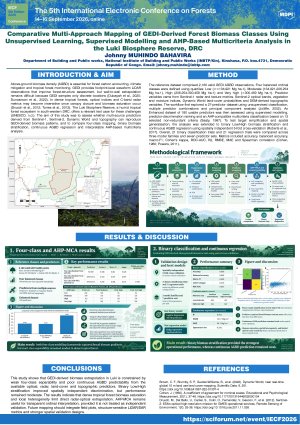
Introduction: Wall-to-wall estimation of tropical forest biomass remains challenging because GEDI provides accurate LiDAR-derived above-ground biomass density (AGBD) observations only at discrete footprints, while optical and radar predictors may show limited sensitivity in dense forests. This study evaluates the capacity of multi-source Earth observation predictors to reproduce GEDI-derived biomass patterns in the Luki Biosphere Reserve, Democratic Republic of the Congo.
Methods: A total of 2,160 valid GEDI AGBD observations were analysed using predictors derived from Sentinel-1 radar, Sentinel-2 optical bands, vegetation and moisture indices, texture metrics, Dynamic World land-cover probabilities and DEM-based topographic variables. The workflow combined an initial 27-predictor exploratory phase with principal component analysis and unsupervised classification, an Enhanced dataset containing 180 usable predictors, supervised modelling, predictor-discrimination analysis and AHP-based multicriteria classification using 12 selected criteria. To assess whether target simplification improved separability, both four-class mapping and binary Low/High biomass stratification were tested. Continuous AGBD regression was also evaluated. The revised modelling framework included 21 binary classification trials and 21 regression trials, covering 3 model families, 7 predictor sets and spatially independent 5-fold cross-validation.
Results: Four-class classification with all 180 predictors achieved 0.346 overall accuracy, 0.341 macro-F1 and 0.128 Cohen’s kappa. The AHP multicriteria classification reached 0.335 overall accuracy, 0.338 macro-F1, 0.114 kappa and 0.738 within-one-class agreement. Binary biomass stratification improved discrimination, reaching 0.609 accuracy, 0.609 balanced accuracy, 0.609 macro-F1, 0.219 kappa and 0.643 ROC-AUC. Continuous regression remained weak, with best performance of R² = 0.052, RMSE = 121.7 Mg ha⁻¹, MAE = 96.1 Mg ha⁻¹ and Spearman’s ρ = 0.242.
Conclusions: The study demonstrates that exact four-class GEDI biomass discrimination is limited in this dense tropical forest context, even with extensive predictor combinations and modelling strategies. Binary biomass stratification provides a more separable target, whereas continuous AGBD prediction remains strongly constrained, highlighting the effects of biomass saturation, spatial heterogeneity and limited radar-optical sensitivity.
Keywords
GEDI
forest biomass
Sentinel-1
Sentinel-2
synthetic aperture radar
supervised classification
unsupervised learning
AHP multicriteria analysis
Poster
FINAL_POSTER_JohnnyMuhindoBahavira.pdf
Classifying individual dead trees using high-resolution multispectral imagery from an unmanned aerial vehicle.
Integrating UAV-LiDAR and Wood Density Measurements to Characterize Phenotypic Variation in Peruvian Ceiba Populations