Event submissions
Published
This submission belongs to the session S4. Forest Inventory, Modeling and Remote Sensing of the event The 5th International Electronic Conference on Forests
Published date
09 Sep, 2026
Academic Editor
'%3e%3cpath%20d='M12.6657%2010.9104C12.4185%2010.325%2012.0599%209.79327%2011.6097%209.34482C11.1609%208.89508%2010.6293%208.5365%2010.0442%208.28888C10.0389%208.28626%2010.0337%208.28495%2010.0285%208.28233C10.8446%207.69279%2011.3752%206.73249%2011.3752%205.64904C11.3752%203.8542%209.92103%202.39999%208.1262%202.39999C6.33136%202.39999%204.87715%203.8542%204.87715%205.64904C4.87715%206.73249%205.40774%207.69279%206.22393%208.28364C6.21869%208.28626%206.21345%208.28757%206.20821%208.29019C5.62129%208.5378%205.09463%208.89284%204.64265%209.34613C4.1929%209.79493%203.83432%2010.3266%203.58671%2010.9117C3.34345%2011.4845%203.21226%2012.0987%203.20023%2012.7209C3.19988%2012.7349%203.20233%2012.7488%203.20744%2012.7619C3.21255%2012.7749%203.22022%2012.7867%203.22998%2012.7968C3.23975%2012.8068%203.25142%2012.8147%203.26431%2012.8202C3.2772%2012.8256%203.29105%2012.8284%203.30504%2012.8284H4.09109C4.14874%2012.8284%204.19459%2012.7825%204.1959%2012.7262C4.2221%2011.7148%204.62823%2010.7676%205.34617%2010.0497C6.08899%209.30683%207.0755%208.89808%208.1262%208.89808C9.17689%208.89808%2010.1634%209.30683%2010.9062%2010.0497C11.6242%2010.7676%2012.0303%2011.7148%2012.0565%2012.7262C12.0578%2012.7838%2012.1037%2012.8284%2012.1613%2012.8284H12.9474C12.9613%2012.8284%2012.9752%2012.8256%2012.9881%2012.8202C13.001%2012.8147%2013.0126%2012.8068%2013.0224%2012.7968C13.0322%2012.7867%2013.0398%2012.7749%2013.0449%2012.7619C13.0501%2012.7488%2013.0525%2012.7349%2013.0522%2012.7209C13.0391%2012.0947%2012.9094%2011.4855%2012.6657%2010.9104ZM8.1262%207.9024C7.52486%207.9024%206.9589%207.6679%206.53312%207.24211C6.10733%206.81633%205.87283%206.25037%205.87283%205.64904C5.87283%205.0477%206.10733%204.48174%206.53312%204.05596C6.9589%203.63018%207.52486%203.39567%208.1262%203.39567C8.72753%203.39567%209.29349%203.63018%209.71927%204.05596C10.1451%204.48174%2010.3796%205.0477%2010.3796%205.64904C10.3796%206.25037%2010.1451%206.81633%209.71927%207.24211C9.29349%207.6679%208.72753%207.9024%208.1262%207.9024Z'%20fill='%235D1EE1'/%3e%3c/g%3e%3c/svg%3e) Krzysztof Stereńczak
Krzysztof StereńczakCitation
Dănilă Constantin Iulian, Comparative stem form and height growth of hybrid poplar clones AF8 and Pannonia in short-rotation woody crops (SRWCs): a case study from the Rădăuți Depression (NE Romania), in Proceedings of The 5th International Electronic Conference on Forests, 14 September–16 September 2026, MDPI: Basel, Switzerland
Share
Email
Facebook
Twitter
LinkedIn
Comparative stem form and height growth of hybrid poplar clones AF8 and Pannonia in short-rotation woody crops (SRWCs): a case study from the Rădăuți Depression (NE Romania)

Dănilă Constantin Iulian 1
1. Faculty of Forestry, University of Suceava, Suceava, Romania
Abstract
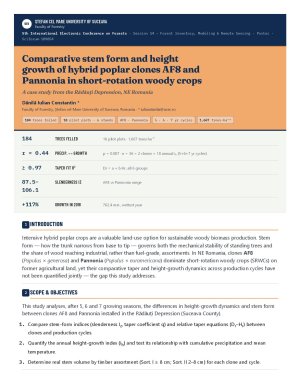
Intensive hybrid poplar crops represent a valuable land-use option for sustainable woody biomass production, and a sound understanding of stem form and height growth dynamics is essential for optimising production cycles. This study comparatively analyses the stem form and the height growth of two hybrid poplar clones, AF8 (Populus × generosa) and Pannonia (Populus × euramericana), established in intensive short-rotation woody crops (SRWCs) on agricultural land in the Rădăuți Depression (NE Romania). A total of 184 individuals from six plantation plots with a density of 1,667 trees·ha⁻¹ were felled and biometrically measured after 5, 6, and 7 growing seasons. Stem form indices (slenderness index Iz and taper coefficient q), relative taper equations (Dr/Hr), and real volumes by timber assortments were determined. The analysis of the height growth index (ih) showed that both clones reached their maximum annual growth in 2018, an exceptional year in terms of precipitation (762.4 mm), with mean ih values of 2.51–3.31 against a multi-annual mean of 1.36 m·m⁻¹. The correlation between the annual cumulative precipitation and ih (r = 0.44; p < 0.05) confirms the determining role of moisture availability under the local conditions. Clone AF8 developed a more slender stem (Iz = 91–106), whereas Pannonia recorded higher volumes after 6 growing seasons. Linear taper equations (Dr = a + b·Hr, R² ≥ 0.97) accurately described the stem profile, without significant differences between clones or production cycles. The results support the efficiency of intensive hybrid poplar cultivation in the study area and provide biometric parameters applicable to harvest planning.
Keywords
hybrid poplar clones
short-rotation woody crops (SRWCs)
slenderness index
relative taper
height growth rate
climatic factors
N.E. of Romania
Poster
Poplar Stem Form Poster.pdf
Evaluating Greedy and Shapley Approaches for Sequential Climate Envelope Modeling of Trees in the Conterminous United States
High Spatiotemporal Resolution RGB UAV Imagery: A Robust Approach for Assessing Juvenile Eucalyptus Crown Dynamics