Event submissions
Published
This submission belongs to the session S4. Forest Inventory, Modeling and Remote Sensing of the event The 5th International Electronic Conference on Forests
Published date
09 Sep, 2026
Academic Editor
'%3e%3cpath%20d='M12.6657%2010.9104C12.4185%2010.325%2012.0599%209.79327%2011.6097%209.34482C11.1609%208.89508%2010.6293%208.5365%2010.0442%208.28888C10.0389%208.28626%2010.0337%208.28495%2010.0285%208.28233C10.8446%207.69279%2011.3752%206.73249%2011.3752%205.64904C11.3752%203.8542%209.92103%202.39999%208.1262%202.39999C6.33136%202.39999%204.87715%203.8542%204.87715%205.64904C4.87715%206.73249%205.40774%207.69279%206.22393%208.28364C6.21869%208.28626%206.21345%208.28757%206.20821%208.29019C5.62129%208.5378%205.09463%208.89284%204.64265%209.34613C4.1929%209.79493%203.83432%2010.3266%203.58671%2010.9117C3.34345%2011.4845%203.21226%2012.0987%203.20023%2012.7209C3.19988%2012.7349%203.20233%2012.7488%203.20744%2012.7619C3.21255%2012.7749%203.22022%2012.7867%203.22998%2012.7968C3.23975%2012.8068%203.25142%2012.8147%203.26431%2012.8202C3.2772%2012.8256%203.29105%2012.8284%203.30504%2012.8284H4.09109C4.14874%2012.8284%204.19459%2012.7825%204.1959%2012.7262C4.2221%2011.7148%204.62823%2010.7676%205.34617%2010.0497C6.08899%209.30683%207.0755%208.89808%208.1262%208.89808C9.17689%208.89808%2010.1634%209.30683%2010.9062%2010.0497C11.6242%2010.7676%2012.0303%2011.7148%2012.0565%2012.7262C12.0578%2012.7838%2012.1037%2012.8284%2012.1613%2012.8284H12.9474C12.9613%2012.8284%2012.9752%2012.8256%2012.9881%2012.8202C13.001%2012.8147%2013.0126%2012.8068%2013.0224%2012.7968C13.0322%2012.7867%2013.0398%2012.7749%2013.0449%2012.7619C13.0501%2012.7488%2013.0525%2012.7349%2013.0522%2012.7209C13.0391%2012.0947%2012.9094%2011.4855%2012.6657%2010.9104ZM8.1262%207.9024C7.52486%207.9024%206.9589%207.6679%206.53312%207.24211C6.10733%206.81633%205.87283%206.25037%205.87283%205.64904C5.87283%205.0477%206.10733%204.48174%206.53312%204.05596C6.9589%203.63018%207.52486%203.39567%208.1262%203.39567C8.72753%203.39567%209.29349%203.63018%209.71927%204.05596C10.1451%204.48174%2010.3796%205.0477%2010.3796%205.64904C10.3796%206.25037%2010.1451%206.81633%209.71927%207.24211C9.29349%207.6679%208.72753%207.9024%208.1262%207.9024Z'%20fill='%235D1EE1'/%3e%3c/g%3e%3c/svg%3e) Krzysztof Stereńczak
Krzysztof StereńczakCitation
Bikash Das, Janki Prasad, Assessment of long-term urban vegetation quantity versus quality by decoding green vigor, atmospheric resilience, chlorophyll, and senescence analysis applying multi-spectral remote sensing data fusion, in Proceedings of The 5th International Electronic Conference on Forests, 14 September–16 September 2026, MDPI: Basel, Switzerland
Share
Email
Facebook
Twitter
LinkedIn
Assessment of long-term urban vegetation quantity versus quality by decoding green vigor, atmospheric resilience, chlorophyll, and senescence analysis applying multi-spectral remote sensing data fusion

Bikash Das 1
'%3e%3cpath%20d='M12.6647%2010.9104C12.4176%2010.325%2012.0589%209.7933%2011.6088%209.34485C11.16%208.89511%2010.6283%208.53653%2010.0432%208.28891C10.038%208.28629%2010.0327%208.28498%2010.0275%208.28236C10.8437%207.69282%2011.3743%206.73252%2011.3743%205.64907C11.3743%203.85423%209.92005%202.40002%208.12522%202.40002C6.33038%202.40002%204.87618%203.85423%204.87618%205.64907C4.87618%206.73252%205.40677%207.69282%206.22296%208.28367C6.21772%208.28629%206.21248%208.2876%206.20724%208.29022C5.62031%208.53783%205.09365%208.89287%204.64167%209.34616C4.19192%209.79496%203.83334%2010.3266%203.58573%2010.9117C3.34247%2011.4846%203.21128%2012.0987%203.19925%2012.721C3.1989%2012.735%203.20135%2012.7489%203.20646%2012.7619C3.21157%2012.7749%203.21924%2012.7868%203.22901%2012.7968C3.23877%2012.8068%203.25045%2012.8148%203.26334%2012.8202C3.27623%2012.8256%203.29007%2012.8284%203.30406%2012.8284H4.09012C4.14776%2012.8284%204.19362%2012.7825%204.19493%2012.7262C4.22113%2011.7148%204.62726%2010.7676%205.34519%2010.0497C6.08802%209.30686%207.07452%208.89811%208.12522%208.89811C9.17592%208.89811%2010.1624%209.30686%2010.9052%2010.0497C11.6232%2010.7676%2012.0293%2011.7148%2012.0555%2012.7262C12.0568%2012.7839%2012.1027%2012.8284%2012.1603%2012.8284H12.9464C12.9604%2012.8284%2012.9742%2012.8256%2012.9871%2012.8202C13%2012.8148%2013.0117%2012.8068%2013.0214%2012.7968C13.0312%2012.7868%2013.0389%2012.7749%2013.044%2012.7619C13.0491%2012.7489%2013.0515%2012.735%2013.0512%2012.721C13.0381%2012.0947%2012.9084%2011.4856%2012.6647%2010.9104ZM8.12522%207.90243C7.52388%207.90243%206.95792%207.66793%206.53214%207.24215C6.10636%206.81636%205.87185%206.2504%205.87185%205.64907C5.87185%205.04773%206.10636%204.48177%206.53214%204.05599C6.95792%203.63021%207.52388%203.3957%208.12522%203.3957C8.72655%203.3957%209.29252%203.63021%209.7183%204.05599C10.1441%204.48177%2010.3786%205.04773%2010.3786%205.64907C10.3786%206.2504%2010.1441%206.81636%209.7183%207.24215C9.29252%207.66793%208.72655%207.90243%208.12522%207.90243Z'%20fill='%235D1EE1'/%3e%3c/g%3e%3c/svg%3e)
Janki Prasad 1
1. Department of Geography, Faculty of Earth Science, Indira Gandhi National Tribal University, Amarkantak, Madhya Pradesh, 48487, India
Abstract
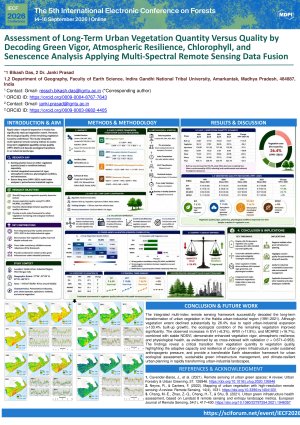
Rapid urbanization and industrialization have substantially transformed vegetation ecosystems worldwide, raising concerns regarding the long-term sustainability of urban green infrastructure and ecosystem services. The existing literature primarily relies on conventional indices and vegetation extent, often overlooking vegetation vigor, physiological condition, atmospheric-resilient greenness, and senescence dynamics. This study develops an integrated multi-index remote sensing framework to investigate long-term vegetation trajectories in the Haldia urban-industrial region (103.84 km²), India (1991-2021). Multi-sensor Landsat-5 TM, 7 ETM+, and 8 OLI/TIRS were processed to derive advanced vegetation indicators comprising the Enhanced Vegetation Index (EVI), Atmospherically Resistant Vegetation Index (ARVI), Modified Chlorophyll Absorption Ratio Index 2 (MCARI2), and Normalized Difference Senescent Vegetation Index (NDSVI). The framework quantifies vegetation vigor, atmospheric-resilient vegetation condition, chlorophyll-physiological health, and vegetation senescence of urban-industrial transformation.
The results reveal decline in vegetation extent (30.12-22.16 km²) (-26.4%), accompanied by rapid built-up expansion (22.87-53.37 km²) (+133.4%). Despite this reduction in vegetation area, mean EVI, ARVI, and MCARI2 values increased by 6.3%, 11.8%, and 16.7%, respectively, indicating enhanced vegetation vigor, atmospheric-resilient greenness, and physiological condition within the remaining vegetation cover. Concurrently, increasing standard deviation values for EVI (0.06-0.08), ARVI (0.12-0.15), and MCARI2 (0.03-0.04) revealed growing spatial heterogeneity of vegetation condition under continued urban-industrial development. In contrast, NDSVI remained relatively stable (mean = 0.11; SD = 0.06), suggesting limited long-term increases in vegetation senescence and degradation. Cross-index consistency analysis demonstrated strong positive correlations among EVI, ARVI, and MCARI2 (r = 0.671-0.953), confirming the robustness of vegetation vigor and physiological-condition assessments. Furthermore, inverse relationships between vegetation extent and vegetation condition indicators (r = -0.647 to -0.918) provided quantitative evidence of a transition from vegetation quantity to quality. The spectral findings highlight the ecological resilience of surviving urban green spaces despite continued urban-industrial expansion, providing a transferable Earth observation approach for urban ecological assessment and green space sustainability.
Keywords
Urban vegetation
Remote sensing
EVI
ARVI
MCARI2
NDSVI
Green infrastructure sustainability
Ecological resilience
Poster
Bikash_Das_Urban Vegetation Quantity Versus Quality _ Poster_ IECF 2026.pdf.pdf
High Spatiotemporal Resolution RGB UAV Imagery: A Robust Approach for Assessing Juvenile Eucalyptus Crown Dynamics
Optimizing aboveground biomass estimation in novel restoration systems through remote sensing and field data fusion