Event submissions
Published
This submission belongs to the session S4. Forest Inventory, Modeling and Remote Sensing of the event The 5th International Electronic Conference on Forests
Published date
09 Sep, 2026
Academic Editor
'%3e%3cpath%20d='M12.6657%2010.9104C12.4185%2010.325%2012.0599%209.79327%2011.6097%209.34482C11.1609%208.89508%2010.6293%208.5365%2010.0442%208.28888C10.0389%208.28626%2010.0337%208.28495%2010.0285%208.28233C10.8446%207.69279%2011.3752%206.73249%2011.3752%205.64904C11.3752%203.8542%209.92103%202.39999%208.1262%202.39999C6.33136%202.39999%204.87715%203.8542%204.87715%205.64904C4.87715%206.73249%205.40774%207.69279%206.22393%208.28364C6.21869%208.28626%206.21345%208.28757%206.20821%208.29019C5.62129%208.5378%205.09463%208.89284%204.64265%209.34613C4.1929%209.79493%203.83432%2010.3266%203.58671%2010.9117C3.34345%2011.4845%203.21226%2012.0987%203.20023%2012.7209C3.19988%2012.7349%203.20233%2012.7488%203.20744%2012.7619C3.21255%2012.7749%203.22022%2012.7867%203.22998%2012.7968C3.23975%2012.8068%203.25142%2012.8147%203.26431%2012.8202C3.2772%2012.8256%203.29105%2012.8284%203.30504%2012.8284H4.09109C4.14874%2012.8284%204.19459%2012.7825%204.1959%2012.7262C4.2221%2011.7148%204.62823%2010.7676%205.34617%2010.0497C6.08899%209.30683%207.0755%208.89808%208.1262%208.89808C9.17689%208.89808%2010.1634%209.30683%2010.9062%2010.0497C11.6242%2010.7676%2012.0303%2011.7148%2012.0565%2012.7262C12.0578%2012.7838%2012.1037%2012.8284%2012.1613%2012.8284H12.9474C12.9613%2012.8284%2012.9752%2012.8256%2012.9881%2012.8202C13.001%2012.8147%2013.0126%2012.8068%2013.0224%2012.7968C13.0322%2012.7867%2013.0398%2012.7749%2013.0449%2012.7619C13.0501%2012.7488%2013.0525%2012.7349%2013.0522%2012.7209C13.0391%2012.0947%2012.9094%2011.4855%2012.6657%2010.9104ZM8.1262%207.9024C7.52486%207.9024%206.9589%207.6679%206.53312%207.24211C6.10733%206.81633%205.87283%206.25037%205.87283%205.64904C5.87283%205.0477%206.10733%204.48174%206.53312%204.05596C6.9589%203.63018%207.52486%203.39567%208.1262%203.39567C8.72753%203.39567%209.29349%203.63018%209.71927%204.05596C10.1451%204.48174%2010.3796%205.0477%2010.3796%205.64904C10.3796%206.25037%2010.1451%206.81633%209.71927%207.24211C9.29349%207.6679%208.72753%207.9024%208.1262%207.9024Z'%20fill='%235D1EE1'/%3e%3c/g%3e%3c/svg%3e) Krzysztof Stereńczak
Krzysztof StereńczakCitation
Katerina Ainali, Theodore Tsiligiridis, A Comparison of Some Machine Learning Classifiers Applied in Three Silvopastoral Systems of Greece., in Proceedings of The 5th International Electronic Conference on Forests, 14 September–16 September 2026, MDPI: Basel, Switzerland
Share
Email
Facebook
Twitter
LinkedIn
A Comparison of Some Machine Learning Classifiers Applied in Three Silvopastoral Systems of Greece.
'%3e%3cpath%20d='M12.6647%2010.9104C12.4176%2010.325%2012.0589%209.7933%2011.6088%209.34485C11.16%208.89511%2010.6283%208.53653%2010.0432%208.28891C10.038%208.28629%2010.0327%208.28498%2010.0275%208.28236C10.8437%207.69282%2011.3743%206.73252%2011.3743%205.64907C11.3743%203.85423%209.92005%202.40002%208.12522%202.40002C6.33038%202.40002%204.87618%203.85423%204.87618%205.64907C4.87618%206.73252%205.40677%207.69282%206.22296%208.28367C6.21772%208.28629%206.21248%208.2876%206.20724%208.29022C5.62031%208.53783%205.09365%208.89287%204.64167%209.34616C4.19192%209.79496%203.83334%2010.3266%203.58573%2010.9117C3.34247%2011.4846%203.21128%2012.0987%203.19925%2012.721C3.1989%2012.735%203.20135%2012.7489%203.20646%2012.7619C3.21157%2012.7749%203.21924%2012.7868%203.22901%2012.7968C3.23877%2012.8068%203.25045%2012.8148%203.26334%2012.8202C3.27623%2012.8256%203.29007%2012.8284%203.30406%2012.8284H4.09012C4.14776%2012.8284%204.19362%2012.7825%204.19493%2012.7262C4.22113%2011.7148%204.62726%2010.7676%205.34519%2010.0497C6.08802%209.30686%207.07452%208.89811%208.12522%208.89811C9.17592%208.89811%2010.1624%209.30686%2010.9052%2010.0497C11.6232%2010.7676%2012.0293%2011.7148%2012.0555%2012.7262C12.0568%2012.7839%2012.1027%2012.8284%2012.1603%2012.8284H12.9464C12.9604%2012.8284%2012.9742%2012.8256%2012.9871%2012.8202C13%2012.8148%2013.0117%2012.8068%2013.0214%2012.7968C13.0312%2012.7868%2013.0389%2012.7749%2013.044%2012.7619C13.0491%2012.7489%2013.0515%2012.735%2013.0512%2012.721C13.0381%2012.0947%2012.9084%2011.4856%2012.6647%2010.9104ZM8.12522%207.90243C7.52388%207.90243%206.95792%207.66793%206.53214%207.24215C6.10636%206.81636%205.87185%206.2504%205.87185%205.64907C5.87185%205.04773%206.10636%204.48177%206.53214%204.05599C6.95792%203.63021%207.52388%203.3957%208.12522%203.3957C8.72655%203.3957%209.29252%203.63021%209.7183%204.05599C10.1441%204.48177%2010.3786%205.04773%2010.3786%205.64907C10.3786%206.2504%2010.1441%206.81636%209.7183%207.24215C9.29252%207.66793%208.72655%207.90243%208.12522%207.90243Z'%20fill='%235D1EE1'/%3e%3c/g%3e%3c/svg%3e)
Katerina Ainali 1

Theodore Tsiligiridis 1
1. Department of Agricultural Economics and Rural Development, InfoLab (ICT), Agricultural University of Athens, Athens, Greece
Abstract
Silvopastoral systems (SPS) provide critical ecosystem services across the Mediterranean basin; however, reliable classification models integrating machine learning and satellite imagery remain largely unexplored. Addressing this gap is critical for supporting agri-environmental policy within the EU Biodiversity Strategy 2030 and Common Agricultural Policy frameworks.
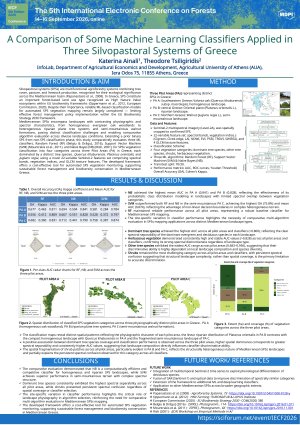
Extending a prior silvopastoral/non-silvopastoral classification phase, this study classifies silvopastoral extents into four vegetation categories: dominant tree species, other tree species, shrubs, and herbaceous vegetation. Sentinel-2 multispectral imagery was applied across three pilot areas in Greece, each representing a distinct SPS type -valonia oak (Quercus ithaburensis), oriental plane (Platanus orientalis), and walnut (Juglans regia)- with contrasting topographic and landscape characteristics. Three ML algorithms were comparatively evaluated: Random Forest (RF) and Support Vector Machine (SVM), recognized for their strong performance in remote sensing classification, and Naïve Bayes (NB), a computationally efficient classifier rarely applied in SPS contexts, yet showing effectiveness in landscapes with relatively distinct spectral class distributions. A 22-variable feature set was employed, comprising Sentinel-2 spectral bands, vegetation indices, and GLCM texture features. Model performance was assessed through AUC, overall accuracy, and Cohen's Kappa.
NB, outperformed RF and SVM in two study sites, suggesting its probabilistic approach is particularly suited to homogeneous and riparian SPS landscapes. SVM performed best in the semi-mountainous walnut system, where complex terrain favors non-linear decision boundaries. Among vegetation categories, dominant tree species achieved the highest separability, especially the evergreen valonia oak than deciduous walnut and plane tree. In cconstrast, shrubs exhibited the lowest accuracy due to persistent spectral confusion with adjacent categories. Our findings favor the application of NB as a classifier for homogeneous Mediterranean SPS landscapes, while RF /SVM performed better in structurally complex terrain. Further research is currently underway integrating the present framework with advanced classification methodologies to enhance vegetation mapping accuracy.
Keywords
remote sensing
random forest
support vector machine
naïve bayes
Sentinel-2
vegetation classification
valonia oak trees
walnut trees
oriental plane trees
Poster
Flash Poster Presentation_Ainali_Katerina.pdf
Predicting tree diameter from height with regard to the tree age for Scots pine in Poland
Dataset of winter roads of Krasnoyarsk Krai, Russia for the forestry infrastructural research