Event submissions
Published
This submission belongs to the session S6. Forest Ecophysiology, Genetics and Molecular Biology of the event The 5th International Electronic Conference on Forests
Published date
09 Sep, 2026
Academic Editor
'%3e%3cpath%20d='M12.6657%2010.9104C12.4185%2010.325%2012.0599%209.79327%2011.6097%209.34482C11.1609%208.89508%2010.6293%208.5365%2010.0442%208.28888C10.0389%208.28626%2010.0337%208.28495%2010.0285%208.28233C10.8446%207.69279%2011.3752%206.73249%2011.3752%205.64904C11.3752%203.8542%209.92103%202.39999%208.1262%202.39999C6.33136%202.39999%204.87715%203.8542%204.87715%205.64904C4.87715%206.73249%205.40774%207.69279%206.22393%208.28364C6.21869%208.28626%206.21345%208.28757%206.20821%208.29019C5.62129%208.5378%205.09463%208.89284%204.64265%209.34613C4.1929%209.79493%203.83432%2010.3266%203.58671%2010.9117C3.34345%2011.4845%203.21226%2012.0987%203.20023%2012.7209C3.19988%2012.7349%203.20233%2012.7488%203.20744%2012.7619C3.21255%2012.7749%203.22022%2012.7867%203.22998%2012.7968C3.23975%2012.8068%203.25142%2012.8147%203.26431%2012.8202C3.2772%2012.8256%203.29105%2012.8284%203.30504%2012.8284H4.09109C4.14874%2012.8284%204.19459%2012.7825%204.1959%2012.7262C4.2221%2011.7148%204.62823%2010.7676%205.34617%2010.0497C6.08899%209.30683%207.0755%208.89808%208.1262%208.89808C9.17689%208.89808%2010.1634%209.30683%2010.9062%2010.0497C11.6242%2010.7676%2012.0303%2011.7148%2012.0565%2012.7262C12.0578%2012.7838%2012.1037%2012.8284%2012.1613%2012.8284H12.9474C12.9613%2012.8284%2012.9752%2012.8256%2012.9881%2012.8202C13.001%2012.8147%2013.0126%2012.8068%2013.0224%2012.7968C13.0322%2012.7867%2013.0398%2012.7749%2013.0449%2012.7619C13.0501%2012.7488%2013.0525%2012.7349%2013.0522%2012.7209C13.0391%2012.0947%2012.9094%2011.4855%2012.6657%2010.9104ZM8.1262%207.9024C7.52486%207.9024%206.9589%207.6679%206.53312%207.24211C6.10733%206.81633%205.87283%206.25037%205.87283%205.64904C5.87283%205.0477%206.10733%204.48174%206.53312%204.05596C6.9589%203.63018%207.52486%203.39567%208.1262%203.39567C8.72753%203.39567%209.29349%203.63018%209.71927%204.05596C10.1451%204.48174%2010.3796%205.0477%2010.3796%205.64904C10.3796%206.25037%2010.1451%206.81633%209.71927%207.24211C9.29349%207.6679%208.72753%207.9024%208.1262%207.9024Z'%20fill='%235D1EE1'/%3e%3c/g%3e%3c/svg%3e) Juan Pedro Ferrio
Juan Pedro FerrioCitation
Beatriz García Valenciano, Juan Carlos Valverde Otárola, Dagoberto Arias Águilar, Integration of molecular and technological tools for the identification and conservation of threatened tree species in Costa Rica., in Proceedings of The 5th International Electronic Conference on Forests, 14 September–16 September 2026, MDPI: Basel, Switzerland
Share
Email
Facebook
Twitter
LinkedIn
Integration of molecular and technological tools for the identification and conservation of threatened tree species in Costa Rica.

Beatriz García Valenciano 1
'%3e%3cpath%20d='M12.6647%2010.9104C12.4176%2010.325%2012.0589%209.7933%2011.6088%209.34485C11.16%208.89511%2010.6283%208.53653%2010.0432%208.28891C10.038%208.28629%2010.0327%208.28498%2010.0275%208.28236C10.8437%207.69282%2011.3743%206.73252%2011.3743%205.64907C11.3743%203.85423%209.92005%202.40002%208.12522%202.40002C6.33038%202.40002%204.87618%203.85423%204.87618%205.64907C4.87618%206.73252%205.40677%207.69282%206.22296%208.28367C6.21772%208.28629%206.21248%208.2876%206.20724%208.29022C5.62031%208.53783%205.09365%208.89287%204.64167%209.34616C4.19192%209.79496%203.83334%2010.3266%203.58573%2010.9117C3.34247%2011.4846%203.21128%2012.0987%203.19925%2012.721C3.1989%2012.735%203.20135%2012.7489%203.20646%2012.7619C3.21157%2012.7749%203.21924%2012.7868%203.22901%2012.7968C3.23877%2012.8068%203.25045%2012.8148%203.26334%2012.8202C3.27623%2012.8256%203.29007%2012.8284%203.30406%2012.8284H4.09012C4.14776%2012.8284%204.19362%2012.7825%204.19493%2012.7262C4.22113%2011.7148%204.62726%2010.7676%205.34519%2010.0497C6.08802%209.30686%207.07452%208.89811%208.12522%208.89811C9.17592%208.89811%2010.1624%209.30686%2010.9052%2010.0497C11.6232%2010.7676%2012.0293%2011.7148%2012.0555%2012.7262C12.0568%2012.7839%2012.1027%2012.8284%2012.1603%2012.8284H12.9464C12.9604%2012.8284%2012.9742%2012.8256%2012.9871%2012.8202C13%2012.8148%2013.0117%2012.8068%2013.0214%2012.7968C13.0312%2012.7868%2013.0389%2012.7749%2013.044%2012.7619C13.0491%2012.7489%2013.0515%2012.735%2013.0512%2012.721C13.0381%2012.0947%2012.9084%2011.4856%2012.6647%2010.9104ZM8.12522%207.90243C7.52388%207.90243%206.95792%207.66793%206.53214%207.24215C6.10636%206.81636%205.87185%206.2504%205.87185%205.64907C5.87185%205.04773%206.10636%204.48177%206.53214%204.05599C6.95792%203.63021%207.52388%203.3957%208.12522%203.3957C8.72655%203.3957%209.29252%203.63021%209.7183%204.05599C10.1441%204.48177%2010.3786%205.04773%2010.3786%205.64907C10.3786%206.2504%2010.1441%206.81636%209.7183%207.24215C9.29252%207.66793%208.72655%207.90243%208.12522%207.90243Z'%20fill='%235D1EE1'/%3e%3c/g%3e%3c/svg%3e)
Juan Carlos Valverde Otárola 2
Dagoberto Arias Águilar 2
1. Agroforestry Academic Area, Master’s Program in Natural Resources Management and Production Technologies, Technological Institute of Costa Rica, Central Cartago Campus, Cartago 30101, Costa Rica
2. Forest Engineering School, Tecnológico de Costa Rica, Cartago 302101, Costa Rica
Abstract
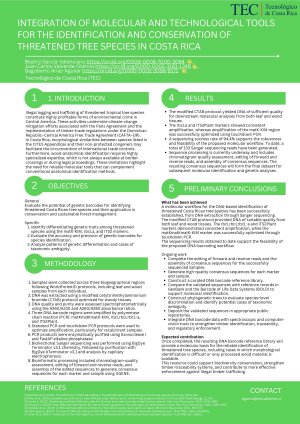
Illegal logging of threatened tropical tree species remains a major environmental challenge in Central America, undermining conservation efforts and international trade regulations. In Costa Rica, the morphological similarity between CITES-listed species and related taxa complicates timber identification and weakens enforcement, as wood anatomical identification often requires highly specialized expertise. This study presents preliminary results from the development of a genetic reference repository for ten threatened tree species of the genera Dalbergia, Platymiscium and Myroxylon, selected due to their conservation status, commercial value and identification challenges.
Samples were collected across three bioregions following World Forest ID protocols. Leaf and wood tissues were sampled from each individual. DNA was extracted using a modified CTAB protocol optimized for woody and leaf tissues, and quality was assessed spectrophotometrically. Three DNA barcode markers (matK, rbcL and ITS2) were amplified using standard and touchdown PCR when required. Bidirectional Sanger sequencing generated 133 high-quality sequences across the three markers, corresponding to six reads per sample, with an overall success rate of 94.4%. All markers were successfully recovered from both leaf and wood tissues, although matK required additional optimization for lignified material.
The resulting repository will support reliable species identification from wood, including processed samples lacking diagnostic anatomical features, and strengthen molecular forensic tools for CITES enforcement. Validated sequences will be deposited in GenBank and BOLD Systems to ensure accessibility for conservation, research and regulatory applications.
Keywords
DNA barcoding
illegal logging
CITES enforcement
forensic botany
tropical timber
Dalbergia
Platymiscium
Myroxylon
Costa Rica
molecular forensics
Poster
IECF.pdf
Post-Tsunami Forest Resilience in a Coastal Forest Ecosystem After the Mega-Tsunami of 2011, Japan
EuCarbHydro Project: Carbon and Water Balance Trade-offs in Eucalyptus Plantations as a Climate Change Adaptation Strategy