Event submissions
Published
This submission belongs to the session S5. Wildfires and Other Forest Disturbances of the event The 5th International Electronic Conference on Forests
Published date
09 Sep, 2026
Academic Editor
'%3e%3cpath%20d='M12.6657%2010.9104C12.4185%2010.325%2012.0599%209.79327%2011.6097%209.34482C11.1609%208.89508%2010.6293%208.5365%2010.0442%208.28888C10.0389%208.28626%2010.0337%208.28495%2010.0285%208.28233C10.8446%207.69279%2011.3752%206.73249%2011.3752%205.64904C11.3752%203.8542%209.92103%202.39999%208.1262%202.39999C6.33136%202.39999%204.87715%203.8542%204.87715%205.64904C4.87715%206.73249%205.40774%207.69279%206.22393%208.28364C6.21869%208.28626%206.21345%208.28757%206.20821%208.29019C5.62129%208.5378%205.09463%208.89284%204.64265%209.34613C4.1929%209.79493%203.83432%2010.3266%203.58671%2010.9117C3.34345%2011.4845%203.21226%2012.0987%203.20023%2012.7209C3.19988%2012.7349%203.20233%2012.7488%203.20744%2012.7619C3.21255%2012.7749%203.22022%2012.7867%203.22998%2012.7968C3.23975%2012.8068%203.25142%2012.8147%203.26431%2012.8202C3.2772%2012.8256%203.29105%2012.8284%203.30504%2012.8284H4.09109C4.14874%2012.8284%204.19459%2012.7825%204.1959%2012.7262C4.2221%2011.7148%204.62823%2010.7676%205.34617%2010.0497C6.08899%209.30683%207.0755%208.89808%208.1262%208.89808C9.17689%208.89808%2010.1634%209.30683%2010.9062%2010.0497C11.6242%2010.7676%2012.0303%2011.7148%2012.0565%2012.7262C12.0578%2012.7838%2012.1037%2012.8284%2012.1613%2012.8284H12.9474C12.9613%2012.8284%2012.9752%2012.8256%2012.9881%2012.8202C13.001%2012.8147%2013.0126%2012.8068%2013.0224%2012.7968C13.0322%2012.7867%2013.0398%2012.7749%2013.0449%2012.7619C13.0501%2012.7488%2013.0525%2012.7349%2013.0522%2012.7209C13.0391%2012.0947%2012.9094%2011.4855%2012.6657%2010.9104ZM8.1262%207.9024C7.52486%207.9024%206.9589%207.6679%206.53312%207.24211C6.10733%206.81633%205.87283%206.25037%205.87283%205.64904C5.87283%205.0477%206.10733%204.48174%206.53312%204.05596C6.9589%203.63018%207.52486%203.39567%208.1262%203.39567C8.72753%203.39567%209.29349%203.63018%209.71927%204.05596C10.1451%204.48174%2010.3796%205.0477%2010.3796%205.64904C10.3796%206.25037%2010.1451%206.81633%209.71927%207.24211C9.29349%207.6679%208.72753%207.9024%208.1262%207.9024Z'%20fill='%235D1EE1'/%3e%3c/g%3e%3c/svg%3e) Luis A. Ruiz
Luis A. RuizCitation
Elena I. Parfenova, Nadezhda M. Tchebakova, Searching for the X factor driving the decline/dieback of the Siberian fir forests across the National Park "Krasnoyarsk Stolby" in the East Sayan Mts, south-central Siberia, in Proceedings of The 5th International Electronic Conference on Forests, 14 September–16 September 2026, MDPI: Basel, Switzerland
Share
Email
Facebook
Twitter
LinkedIn
Searching for the X factor driving the decline/dieback of the Siberian fir forests across the National Park "Krasnoyarsk Stolby" in the East Sayan Mts, south-central Siberia
'%3e%3cpath%20d='M12.6647%2010.9104C12.4176%2010.325%2012.0589%209.7933%2011.6088%209.34485C11.16%208.89511%2010.6283%208.53653%2010.0432%208.28891C10.038%208.28629%2010.0327%208.28498%2010.0275%208.28236C10.8437%207.69282%2011.3743%206.73252%2011.3743%205.64907C11.3743%203.85423%209.92005%202.40002%208.12522%202.40002C6.33038%202.40002%204.87618%203.85423%204.87618%205.64907C4.87618%206.73252%205.40677%207.69282%206.22296%208.28367C6.21772%208.28629%206.21248%208.2876%206.20724%208.29022C5.62031%208.53783%205.09365%208.89287%204.64167%209.34616C4.19192%209.79496%203.83334%2010.3266%203.58573%2010.9117C3.34247%2011.4846%203.21128%2012.0987%203.19925%2012.721C3.1989%2012.735%203.20135%2012.7489%203.20646%2012.7619C3.21157%2012.7749%203.21924%2012.7868%203.22901%2012.7968C3.23877%2012.8068%203.25045%2012.8148%203.26334%2012.8202C3.27623%2012.8256%203.29007%2012.8284%203.30406%2012.8284H4.09012C4.14776%2012.8284%204.19362%2012.7825%204.19493%2012.7262C4.22113%2011.7148%204.62726%2010.7676%205.34519%2010.0497C6.08802%209.30686%207.07452%208.89811%208.12522%208.89811C9.17592%208.89811%2010.1624%209.30686%2010.9052%2010.0497C11.6232%2010.7676%2012.0293%2011.7148%2012.0555%2012.7262C12.0568%2012.7839%2012.1027%2012.8284%2012.1603%2012.8284H12.9464C12.9604%2012.8284%2012.9742%2012.8256%2012.9871%2012.8202C13%2012.8148%2013.0117%2012.8068%2013.0214%2012.7968C13.0312%2012.7868%2013.0389%2012.7749%2013.044%2012.7619C13.0491%2012.7489%2013.0515%2012.735%2013.0512%2012.721C13.0381%2012.0947%2012.9084%2011.4856%2012.6647%2010.9104ZM8.12522%207.90243C7.52388%207.90243%206.95792%207.66793%206.53214%207.24215C6.10636%206.81636%205.87185%206.2504%205.87185%205.64907C5.87185%205.04773%206.10636%204.48177%206.53214%204.05599C6.95792%203.63021%207.52388%203.3957%208.12522%203.3957C8.72655%203.3957%209.29252%203.63021%209.7183%204.05599C10.1441%204.48177%2010.3786%205.04773%2010.3786%205.64907C10.3786%206.2504%2010.1441%206.81636%209.7183%207.24215C9.29252%207.66793%208.72655%207.90243%208.12522%207.90243Z'%20fill='%235D1EE1'/%3e%3c/g%3e%3c/svg%3e)
Elena I. Parfenova 1
Nadezhda M. Tchebakova 1
1. forest monitoriing departament, V.N. Sukachev Forest Institute of FRC KSC SB RAS, Krasnoyarsk 660036, Russia
Abstract
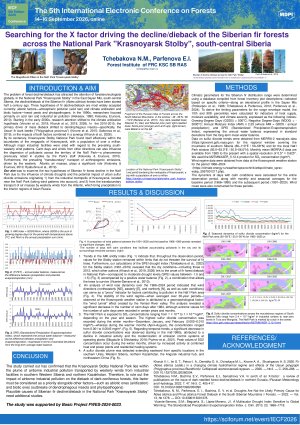
The problem of forest decline/dieback has attracted the attention of foresters/ecologists globally. The decline/dieback of the Siberian fir (Abies sibirica) forests in the National Park "Krasnoyarsk Stolby" have been started half a century ago. Three major reasons are considered: anthropogenic pollution, including acid rain; insect pests and phytopathogens; climate aridization. Our goal was to examine the two hypotheses of fir forest decline – due to climate droughts and the potential impact of urban sulfur dioxide emissions from the industrial metropolis of Krasnoyarsk bordering the Nat'l Park. In our analyses, we used meteodata of two weather stations close to the Nat'l Park for calculating SPEI droughts and wind dynamics; data from MERRA2, OMI, and TROPOMI instruments for determining concentrations of sulfur dioxide, SO2. Values of SPEI < –1.5 that characterized severe droughts happened here once in 8-10 years. Moreover, trees are capable of surviving 1-2 year severe droughts. We found no convincing evidence of climate droughts as a driver of the National Park's fir forests decline. The highest SO2 concentrations were recorded in the winter months (2–10 mg/m²) and twice less in the warmer months (1–4.5 mg/m²). Peak concentrations in May and June posed a particular threat to the developing photosynthetic apparatus of trees. Additionally, the montane forests over the South Siberian mountains are subject to the westerlies which bring air pollution from large industries along the 50-56 latitudes from Europe, the Urals, and South Siberia. A comparison of wind patterns between the 1991–2020 and the baseline 1966–1990 periods revealed no significant changes. The number of days with calm conditions that facilitate accumulating pollutants in the city and its surroundings remained constant. Plausible causes of the decline/dieback of the dark coniferous forests in the Nat'l Park and South Siberian Mountains need additional studies. The study was supported by Basic Project FWES-2024-0023.
Keywords
Siberian fir decline/dieback
air pollution
sulfur dioxide
wind dynamics
climate aridization
Poster
Tchebakova_IECF_2026.pdf
Assessing Disturbance in Forest Opening-Up Infrastructure through Geoinformatics-Based UAV-RTK Terrain Modelling and Hydrological Analysis
Examining the influence of socioeconomic factors on fire ignitions and burned area at different regional levels in Greece