Event submissions
Published
This submission belongs to the session 4. Molecular and Cellular Mechanisms, Comparative Toxicology, and Multi-Omics Integration of the event The 3rd International Online Conference on Toxics
Published date
09 Sep, 2026
Academic Editor
'%3e%3cpath%20d='M12.6657%2010.9104C12.4185%2010.325%2012.0599%209.79327%2011.6097%209.34482C11.1609%208.89508%2010.6293%208.5365%2010.0442%208.28888C10.0389%208.28626%2010.0337%208.28495%2010.0285%208.28233C10.8446%207.69279%2011.3752%206.73249%2011.3752%205.64904C11.3752%203.8542%209.92103%202.39999%208.1262%202.39999C6.33136%202.39999%204.87715%203.8542%204.87715%205.64904C4.87715%206.73249%205.40774%207.69279%206.22393%208.28364C6.21869%208.28626%206.21345%208.28757%206.20821%208.29019C5.62129%208.5378%205.09463%208.89284%204.64265%209.34613C4.1929%209.79493%203.83432%2010.3266%203.58671%2010.9117C3.34345%2011.4845%203.21226%2012.0987%203.20023%2012.7209C3.19988%2012.7349%203.20233%2012.7488%203.20744%2012.7619C3.21255%2012.7749%203.22022%2012.7867%203.22998%2012.7968C3.23975%2012.8068%203.25142%2012.8147%203.26431%2012.8202C3.2772%2012.8256%203.29105%2012.8284%203.30504%2012.8284H4.09109C4.14874%2012.8284%204.19459%2012.7825%204.1959%2012.7262C4.2221%2011.7148%204.62823%2010.7676%205.34617%2010.0497C6.08899%209.30683%207.0755%208.89808%208.1262%208.89808C9.17689%208.89808%2010.1634%209.30683%2010.9062%2010.0497C11.6242%2010.7676%2012.0303%2011.7148%2012.0565%2012.7262C12.0578%2012.7838%2012.1037%2012.8284%2012.1613%2012.8284H12.9474C12.9613%2012.8284%2012.9752%2012.8256%2012.9881%2012.8202C13.001%2012.8147%2013.0126%2012.8068%2013.0224%2012.7968C13.0322%2012.7867%2013.0398%2012.7749%2013.0449%2012.7619C13.0501%2012.7488%2013.0525%2012.7349%2013.0522%2012.7209C13.0391%2012.0947%2012.9094%2011.4855%2012.6657%2010.9104ZM8.1262%207.9024C7.52486%207.9024%206.9589%207.6679%206.53312%207.24211C6.10733%206.81633%205.87283%206.25037%205.87283%205.64904C5.87283%205.0477%206.10733%204.48174%206.53312%204.05596C6.9589%203.63018%207.52486%203.39567%208.1262%203.39567C8.72753%203.39567%209.29349%203.63018%209.71927%204.05596C10.1451%204.48174%2010.3796%205.0477%2010.3796%205.64904C10.3796%206.25037%2010.1451%206.81633%209.71927%207.24211C9.29349%207.6679%208.72753%207.9024%208.1262%207.9024Z'%20fill='%235D1EE1'/%3e%3c/g%3e%3c/svg%3e) Yankai Xia
Yankai XiaCitation
Austėja Vitkauskaitė, Ilona Sadauskienė, Arūnas Liekis, Dalė Baranauskienė, Vaida Šimakauskienė, R. Naginienė, Dalė Vieželienė, Dovydas Levinas, Inga Stanevičienė, Effects of Selenium on Iron Concentration and Catalase Activity in Mouse Liver under Aluminum Exposure, in Proceedings of The 3rd International Online Conference on Toxics, 9 September–11 September 2026, MDPI: Basel, Switzerland
Share
Email
Facebook
Twitter
LinkedIn
Effects of Selenium on Iron Concentration and Catalase Activity in Mouse Liver under Aluminum Exposure
'%3e%3cpath%20d='M12.6647%2010.9104C12.4176%2010.325%2012.0589%209.7933%2011.6088%209.34485C11.16%208.89511%2010.6283%208.53653%2010.0432%208.28891C10.038%208.28629%2010.0327%208.28498%2010.0275%208.28236C10.8437%207.69282%2011.3743%206.73252%2011.3743%205.64907C11.3743%203.85423%209.92005%202.40002%208.12522%202.40002C6.33038%202.40002%204.87618%203.85423%204.87618%205.64907C4.87618%206.73252%205.40677%207.69282%206.22296%208.28367C6.21772%208.28629%206.21248%208.2876%206.20724%208.29022C5.62031%208.53783%205.09365%208.89287%204.64167%209.34616C4.19192%209.79496%203.83334%2010.3266%203.58573%2010.9117C3.34247%2011.4846%203.21128%2012.0987%203.19925%2012.721C3.1989%2012.735%203.20135%2012.7489%203.20646%2012.7619C3.21157%2012.7749%203.21924%2012.7868%203.22901%2012.7968C3.23877%2012.8068%203.25045%2012.8148%203.26334%2012.8202C3.27623%2012.8256%203.29007%2012.8284%203.30406%2012.8284H4.09012C4.14776%2012.8284%204.19362%2012.7825%204.19493%2012.7262C4.22113%2011.7148%204.62726%2010.7676%205.34519%2010.0497C6.08802%209.30686%207.07452%208.89811%208.12522%208.89811C9.17592%208.89811%2010.1624%209.30686%2010.9052%2010.0497C11.6232%2010.7676%2012.0293%2011.7148%2012.0555%2012.7262C12.0568%2012.7839%2012.1027%2012.8284%2012.1603%2012.8284H12.9464C12.9604%2012.8284%2012.9742%2012.8256%2012.9871%2012.8202C13%2012.8148%2013.0117%2012.8068%2013.0214%2012.7968C13.0312%2012.7868%2013.0389%2012.7749%2013.044%2012.7619C13.0491%2012.7489%2013.0515%2012.735%2013.0512%2012.721C13.0381%2012.0947%2012.9084%2011.4856%2012.6647%2010.9104ZM8.12522%207.90243C7.52388%207.90243%206.95792%207.66793%206.53214%207.24215C6.10636%206.81636%205.87185%206.2504%205.87185%205.64907C5.87185%205.04773%206.10636%204.48177%206.53214%204.05599C6.95792%203.63021%207.52388%203.3957%208.12522%203.3957C8.72655%203.3957%209.29252%203.63021%209.7183%204.05599C10.1441%204.48177%2010.3786%205.04773%2010.3786%205.64907C10.3786%206.2504%2010.1441%206.81636%209.7183%207.24215C9.29252%207.66793%208.72655%207.90243%208.12522%207.90243Z'%20fill='%235D1EE1'/%3e%3c/g%3e%3c/svg%3e)
Austėja Vitkauskaitė 1

Ilona Sadauskienė 1,2
Arūnas Liekis 2
Dalė Baranauskienė 2
Vaida Šimakauskienė 2

R. Naginienė 2
Dalė Vieželienė 1
Dovydas Levinas 1
Inga Stanevičienė 1
1. Department of Biochemistry, Medical Academy, Lithuanian University of Health Sciences, Eiveniu St. 4, LT-50161 Kaunas, Lithuania
2. Neuroscience Institute, Lithuanian University of Health Sciences, Eiveniu St. 4, LT-50161 Kaunas, Lithuania
Abstract
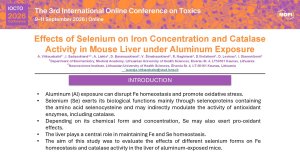
Introduction: Aluminum exposure induces oxidative stress and disrupts iron homeostasis. Selenium exerts its biological functions mainly through selenoproteins containing the amino acid selenocysteine and may indirectly modulate the activity of antioxidant enzymes, including catalase. However, depending on its chemical form, Se can also exert pro-oxidant effects. The liver plays a key role in Fe and Se homeostasis. The aim of this study was to evaluate the effects of different selenium forms on Fe homeostasis and catalase activity in mouse liver exposed to aluminum.
Methods: Experiments were performed on 4–6-week-old BALB/c mice, which were orally administered sodium selenite or selenomethionine (0.2 mg Se/kg bw), aluminum (100 mg Al/kg bw), or their combinations in tap water (License No. G2-80) for 8 weeks. Fe concentration was determined by inductively coupled mass spectrometry, and catalase activity was measured spectrophotometrically.
Results: Subacute aluminum administration increased Fe concentration in the liver of mice by 45% compared to control (p < 0.05). Selenomethionine increased Fe concentration by 30%, and sodium selenite by 17% (p < 0.05). Selenomethionine and sodium selenite in combination with aluminum significantly increased Fe concentration to 127% and 139% of control, respectively. Aluminum had no effect on catalase activity. Selenomethionine and sodium selenite increased catalase activity, but these changes were not statistically significant. Co-exposure to aluminum and selenomethionine increased catalase activity by 58% (p < 0.05), whereas co-exposure with sodium selenite did not alter catalase activity.
Conclusions: Subacute aluminum exposure most strongly disrupted hepatic Fe homeostasis, increasing its concentration. Both organic selenomethionine and inorganic sodium selenite also increased Fe levels, but the effect of selenomethionine was approximately two-fold greater than that of sodium selenite. Selenomethionine significantly reduced Fe concentration and increased catalase activity under aluminum exposure, whereas sodium selenite did not produce statistically significant changes in either parameter.
Keywords
Selenium
Iron
Catalase Activity
Mouse Liver
Aluminum Exposure
Poster
poster+slides_Austėja_Vitkauskaitė_IOCTO.pdf
Combined analysis of microplastic quantification and blood metabolomics for spotted seal mothers and their calves