Event submissions
Published
This submission belongs to the session S4. Weather and Climate Forecasting of the event The 1st International Online Conference on Forecasting
Published date
16 Sep, 2026
Academic Editor
'%3e%3cpath%20d='M12.6657%2010.9104C12.4185%2010.325%2012.0599%209.79327%2011.6097%209.34482C11.1609%208.89508%2010.6293%208.5365%2010.0442%208.28888C10.0389%208.28626%2010.0337%208.28495%2010.0285%208.28233C10.8446%207.69279%2011.3752%206.73249%2011.3752%205.64904C11.3752%203.8542%209.92103%202.39999%208.1262%202.39999C6.33136%202.39999%204.87715%203.8542%204.87715%205.64904C4.87715%206.73249%205.40774%207.69279%206.22393%208.28364C6.21869%208.28626%206.21345%208.28757%206.20821%208.29019C5.62129%208.5378%205.09463%208.89284%204.64265%209.34613C4.1929%209.79493%203.83432%2010.3266%203.58671%2010.9117C3.34345%2011.4845%203.21226%2012.0987%203.20023%2012.7209C3.19988%2012.7349%203.20233%2012.7488%203.20744%2012.7619C3.21255%2012.7749%203.22022%2012.7867%203.22998%2012.7968C3.23975%2012.8068%203.25142%2012.8147%203.26431%2012.8202C3.2772%2012.8256%203.29105%2012.8284%203.30504%2012.8284H4.09109C4.14874%2012.8284%204.19459%2012.7825%204.1959%2012.7262C4.2221%2011.7148%204.62823%2010.7676%205.34617%2010.0497C6.08899%209.30683%207.0755%208.89808%208.1262%208.89808C9.17689%208.89808%2010.1634%209.30683%2010.9062%2010.0497C11.6242%2010.7676%2012.0303%2011.7148%2012.0565%2012.7262C12.0578%2012.7838%2012.1037%2012.8284%2012.1613%2012.8284H12.9474C12.9613%2012.8284%2012.9752%2012.8256%2012.9881%2012.8202C13.001%2012.8147%2013.0126%2012.8068%2013.0224%2012.7968C13.0322%2012.7867%2013.0398%2012.7749%2013.0449%2012.7619C13.0501%2012.7488%2013.0525%2012.7349%2013.0522%2012.7209C13.0391%2012.0947%2012.9094%2011.4855%2012.6657%2010.9104ZM8.1262%207.9024C7.52486%207.9024%206.9589%207.6679%206.53312%207.24211C6.10733%206.81633%205.87283%206.25037%205.87283%205.64904C5.87283%205.0477%206.10733%204.48174%206.53312%204.05596C6.9589%203.63018%207.52486%203.39567%208.1262%203.39567C8.72753%203.39567%209.29349%203.63018%209.71927%204.05596C10.1451%204.48174%2010.3796%205.0477%2010.3796%205.64904C10.3796%206.25037%2010.1451%206.81633%209.71927%207.24211C9.29349%207.6679%208.72753%207.9024%208.1262%207.9024Z'%20fill='%235D1EE1'/%3e%3c/g%3e%3c/svg%3e) Sonia Leva
Sonia LevaCitation
KATIKALA JYOTHI, NIDAMANURI SRINU, DASARI BUJJI BABU, RAJASEKHAR MANDA, An Optimized Ensemble Machine Learning Framework for Multi-City AQI Forecasting in India: A Comparative Study of Feature Engineering and Hyperparameter Tuning, in Proceedings of The 1st International Online Conference on Forecasting, 21 September–22 September 2026, MDPI: Basel, Switzerland
Share
Email
Facebook
Twitter
LinkedIn
An Optimized Ensemble Machine Learning Framework for Multi-City AQI Forecasting in India: A Comparative Study of Feature Engineering and Hyperparameter Tuning
'%3e%3cpath%20d='M12.6647%2010.9104C12.4176%2010.325%2012.0589%209.7933%2011.6088%209.34485C11.16%208.89511%2010.6283%208.53653%2010.0432%208.28891C10.038%208.28629%2010.0327%208.28498%2010.0275%208.28236C10.8437%207.69282%2011.3743%206.73252%2011.3743%205.64907C11.3743%203.85423%209.92005%202.40002%208.12522%202.40002C6.33038%202.40002%204.87618%203.85423%204.87618%205.64907C4.87618%206.73252%205.40677%207.69282%206.22296%208.28367C6.21772%208.28629%206.21248%208.2876%206.20724%208.29022C5.62031%208.53783%205.09365%208.89287%204.64167%209.34616C4.19192%209.79496%203.83334%2010.3266%203.58573%2010.9117C3.34247%2011.4846%203.21128%2012.0987%203.19925%2012.721C3.1989%2012.735%203.20135%2012.7489%203.20646%2012.7619C3.21157%2012.7749%203.21924%2012.7868%203.22901%2012.7968C3.23877%2012.8068%203.25045%2012.8148%203.26334%2012.8202C3.27623%2012.8256%203.29007%2012.8284%203.30406%2012.8284H4.09012C4.14776%2012.8284%204.19362%2012.7825%204.19493%2012.7262C4.22113%2011.7148%204.62726%2010.7676%205.34519%2010.0497C6.08802%209.30686%207.07452%208.89811%208.12522%208.89811C9.17592%208.89811%2010.1624%209.30686%2010.9052%2010.0497C11.6232%2010.7676%2012.0293%2011.7148%2012.0555%2012.7262C12.0568%2012.7839%2012.1027%2012.8284%2012.1603%2012.8284H12.9464C12.9604%2012.8284%2012.9742%2012.8256%2012.9871%2012.8202C13%2012.8148%2013.0117%2012.8068%2013.0214%2012.7968C13.0312%2012.7868%2013.0389%2012.7749%2013.044%2012.7619C13.0491%2012.7489%2013.0515%2012.735%2013.0512%2012.721C13.0381%2012.0947%2012.9084%2011.4856%2012.6647%2010.9104ZM8.12522%207.90243C7.52388%207.90243%206.95792%207.66793%206.53214%207.24215C6.10636%206.81636%205.87185%206.2504%205.87185%205.64907C5.87185%205.04773%206.10636%204.48177%206.53214%204.05599C6.95792%203.63021%207.52388%203.3957%208.12522%203.3957C8.72655%203.3957%209.29252%203.63021%209.7183%204.05599C10.1441%204.48177%2010.3786%205.04773%2010.3786%205.64907C10.3786%206.2504%2010.1441%206.81636%209.7183%207.24215C9.29252%207.66793%208.72655%207.90243%208.12522%207.90243Z'%20fill='%235D1EE1'/%3e%3c/g%3e%3c/svg%3e)
KATIKALA JYOTHI 1
NIDAMANURI SRINU 2
DASARI BUJJI BABU 1
RAJASEKHAR MANDA 3
1. Department of Computer Science and Engineering, QIS College of Engineering and Technology (A), Vengamukkapalem, Ongole-523272, Andhra Pradesh, India
2. Department of Computer Science and Engineering, QIS College of Engineering and
Technology (A), Vengamukkapalem, Ongole-523272, Andhra Pradesh, India
3. Department of ECE, QIS College of Engineering and Technology (A), Vengamukkapalem, Ongole-523272, Andhra Pradesh, India
Abstract
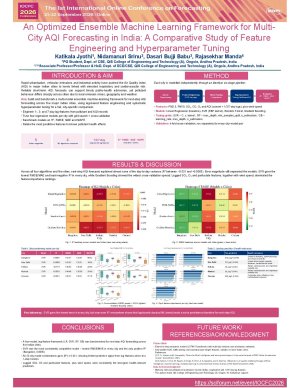
Air pollution has become one of the most pressing environmental challenges confronting India's rapidly expanding smart cities, with hazardous pollutant levels directly impacting public health, urban livability, and long-term sustainability. Accurate and timely forecasting of the Air Quality Index (AQI) is therefore not merely an academic pursuit but a public health necessity, enabling proactive interventions and informed policy decisions. This study develops and rigorously validates an optimized machine learning framework for multi-city AQI prediction, leveraging historical pollutant concentration data alongside key meteorological parameters such as temperature and wind speed. The proposed framework implements a comprehensive comparative analysis of four regression models, Linear Regression, Support Vector Machines, Random Forest, and Gradient Boosting, across four Indian cities representing diverse pollution profiles: Delhi, Visakhapatnam, Hyderabad, and Kolkata. A critical contribution of this work lies in its systematic approach to feature engineering, incorporating lag variables and seasonal indicators, coupled with extensive hyperparameter tuning using grid search optimization. This optimization process significantly enhanced model performance, with the Gradient Boosting model emerging as the most robust predictor, achieving an exceptional R² of 0.98 with a Root Mean Square Error (RMSE) of just 10.0 for Visakhapatnam, and an R² of 0.97 for Hyderabad. These metrics demonstrate substantial accuracy improvements over conventional statistical approaches and non-optimized machine learning baselines. The resulting framework offers a reliable, scalable, and data-driven decision-support tool for environmental agencies and urban policymakers. It facilitates timely public health advisories, supports the design of targeted pollution mitigation strategies, and empowers citizens with actionable air quality information. Ultimately, this research contributes to the broader vision of smarter, more resilient urban governance, fostering healthier and more sustainable ecosystems across India's evolving smart city landscape.
Keywords
Air Quality Index (AQI)
Machine Learning Framework
Ensemble Learning
Hyperparameter Optimization
Smart Cities
India
Feature Selection
Gradient Boosting
Random Forest
Urban Air Pollution
Poster
IOCTC 2026 AQI Forecasting Poster.pdf
Preliminary Comparative Evaluation of Time Series Models in Forecasting Crude Oil Exports in Saudi Arabia