Event submissions
Published
This submission belongs to the session S2. AI Forecasting & Large Language Models of the event The 1st International Online Conference on Forecasting
Published date
16 Sep, 2026
Academic Editor
'%3e%3cpath%20d='M12.6657%2010.9104C12.4185%2010.325%2012.0599%209.79327%2011.6097%209.34482C11.1609%208.89508%2010.6293%208.5365%2010.0442%208.28888C10.0389%208.28626%2010.0337%208.28495%2010.0285%208.28233C10.8446%207.69279%2011.3752%206.73249%2011.3752%205.64904C11.3752%203.8542%209.92103%202.39999%208.1262%202.39999C6.33136%202.39999%204.87715%203.8542%204.87715%205.64904C4.87715%206.73249%205.40774%207.69279%206.22393%208.28364C6.21869%208.28626%206.21345%208.28757%206.20821%208.29019C5.62129%208.5378%205.09463%208.89284%204.64265%209.34613C4.1929%209.79493%203.83432%2010.3266%203.58671%2010.9117C3.34345%2011.4845%203.21226%2012.0987%203.20023%2012.7209C3.19988%2012.7349%203.20233%2012.7488%203.20744%2012.7619C3.21255%2012.7749%203.22022%2012.7867%203.22998%2012.7968C3.23975%2012.8068%203.25142%2012.8147%203.26431%2012.8202C3.2772%2012.8256%203.29105%2012.8284%203.30504%2012.8284H4.09109C4.14874%2012.8284%204.19459%2012.7825%204.1959%2012.7262C4.2221%2011.7148%204.62823%2010.7676%205.34617%2010.0497C6.08899%209.30683%207.0755%208.89808%208.1262%208.89808C9.17689%208.89808%2010.1634%209.30683%2010.9062%2010.0497C11.6242%2010.7676%2012.0303%2011.7148%2012.0565%2012.7262C12.0578%2012.7838%2012.1037%2012.8284%2012.1613%2012.8284H12.9474C12.9613%2012.8284%2012.9752%2012.8256%2012.9881%2012.8202C13.001%2012.8147%2013.0126%2012.8068%2013.0224%2012.7968C13.0322%2012.7867%2013.0398%2012.7749%2013.0449%2012.7619C13.0501%2012.7488%2013.0525%2012.7349%2013.0522%2012.7209C13.0391%2012.0947%2012.9094%2011.4855%2012.6657%2010.9104ZM8.1262%207.9024C7.52486%207.9024%206.9589%207.6679%206.53312%207.24211C6.10733%206.81633%205.87283%206.25037%205.87283%205.64904C5.87283%205.0477%206.10733%204.48174%206.53312%204.05596C6.9589%203.63018%207.52486%203.39567%208.1262%203.39567C8.72753%203.39567%209.29349%203.63018%209.71927%204.05596C10.1451%204.48174%2010.3796%205.0477%2010.3796%205.64904C10.3796%206.25037%2010.1451%206.81633%209.71927%207.24211C9.29349%207.6679%208.72753%207.9024%208.1262%207.9024Z'%20fill='%235D1EE1'/%3e%3c/g%3e%3c/svg%3e) Alessandro Niccolai
Alessandro NiccolaiCitation
Suryasivaji Killi, Uncertainty-Aware Hybrid AI Forecasting for Multi-Location Inventory Redistribution: A Forecast-then-Optimize Framework, in Proceedings of The 1st International Online Conference on Forecasting, 21 September–22 September 2026, MDPI: Basel, Switzerland
Share
Email
Facebook
Twitter
LinkedIn
Uncertainty-Aware Hybrid AI Forecasting for Multi-Location Inventory Redistribution: A Forecast-then-Optimize Framework
'%3e%3cpath%20d='M12.6647%2010.9104C12.4176%2010.325%2012.0589%209.7933%2011.6088%209.34485C11.16%208.89511%2010.6283%208.53653%2010.0432%208.28891C10.038%208.28629%2010.0327%208.28498%2010.0275%208.28236C10.8437%207.69282%2011.3743%206.73252%2011.3743%205.64907C11.3743%203.85423%209.92005%202.40002%208.12522%202.40002C6.33038%202.40002%204.87618%203.85423%204.87618%205.64907C4.87618%206.73252%205.40677%207.69282%206.22296%208.28367C6.21772%208.28629%206.21248%208.2876%206.20724%208.29022C5.62031%208.53783%205.09365%208.89287%204.64167%209.34616C4.19192%209.79496%203.83334%2010.3266%203.58573%2010.9117C3.34247%2011.4846%203.21128%2012.0987%203.19925%2012.721C3.1989%2012.735%203.20135%2012.7489%203.20646%2012.7619C3.21157%2012.7749%203.21924%2012.7868%203.22901%2012.7968C3.23877%2012.8068%203.25045%2012.8148%203.26334%2012.8202C3.27623%2012.8256%203.29007%2012.8284%203.30406%2012.8284H4.09012C4.14776%2012.8284%204.19362%2012.7825%204.19493%2012.7262C4.22113%2011.7148%204.62726%2010.7676%205.34519%2010.0497C6.08802%209.30686%207.07452%208.89811%208.12522%208.89811C9.17592%208.89811%2010.1624%209.30686%2010.9052%2010.0497C11.6232%2010.7676%2012.0293%2011.7148%2012.0555%2012.7262C12.0568%2012.7839%2012.1027%2012.8284%2012.1603%2012.8284H12.9464C12.9604%2012.8284%2012.9742%2012.8256%2012.9871%2012.8202C13%2012.8148%2013.0117%2012.8068%2013.0214%2012.7968C13.0312%2012.7868%2013.0389%2012.7749%2013.044%2012.7619C13.0491%2012.7489%2013.0515%2012.735%2013.0512%2012.721C13.0381%2012.0947%2012.9084%2011.4856%2012.6647%2010.9104ZM8.12522%207.90243C7.52388%207.90243%206.95792%207.66793%206.53214%207.24215C6.10636%206.81636%205.87185%206.2504%205.87185%205.64907C5.87185%205.04773%206.10636%204.48177%206.53214%204.05599C6.95792%203.63021%207.52388%203.3957%208.12522%203.3957C8.72655%203.3957%209.29252%203.63021%209.7183%204.05599C10.1441%204.48177%2010.3786%205.04773%2010.3786%205.64907C10.3786%206.2504%2010.1441%206.81636%209.7183%207.24215C9.29252%207.66793%208.72655%207.90243%208.12522%207.90243Z'%20fill='%235D1EE1'/%3e%3c/g%3e%3c/svg%3e)
Suryasivaji Killi 1
1. Independent Researcher, Data Engineering, GMH Holdings, Jersey City, New Jersey, 07306
Abstract
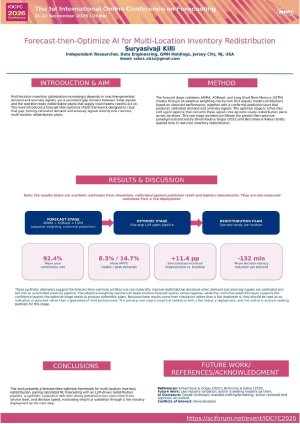
Multi-location inventory optimization increasingly depends on machine-generated demand and anomaly signals, yet a persistent gap remains between these signals and the operator-ready redistribution plans that supply chain teams need to act on. This work presents a forecast-then-optimize (F&O) framework designed to close that gap.
The forecast stage combines ARIMA, XGBoost, and Long Short-Term Memory (LSTM) models through an adaptive weighting mechanism that adjusts model contributions based on observed performance, together with a conformal prediction layer that produces calibrated demand and anomaly signals. The optimize stage is a five-step LLM agent pipeline that converts these signals into concrete, operator-ready redistribution plans across locations. This two-stage architecture is grounded in the established predict-then-optimize literature, following Elmachtoub and Grigas (2022) and Bertsimas and Kallus (2020), and is explicitly positioned as an instance of that paradigm applied to last-mile inventory redistribution.
The framework has not yet been validated in a live deployment. To assess its potential, we conducted a synthetic evaluation across five network scenarios calibrated against published retail and logistics benchmarks. These synthetic estimates indicate a mean plan correctness rate of 92.4%, a mean MAPE of 8.3% under stable demand (rising to 14.7% under peak-season variability, consistent with published ML ensemble benchmarks), a simulated service-level improvement of 11.4 percentage points over a no-action baseline, and a mean decision-latency reduction of 132 minutes per incident relative to a manual workflow. These figures are indicative estimates from simulation, not empirically measured outcomes, and are presented as such.
This session will discuss the framework's design rationale, its grounding in the predict-then-optimize literature, and the simulation methodology used to generate these indicative results. Empirical validation through a live industry deployment is identified as the primary direction for future work, and the author is actively seeking industry partners for this next stage.
Keywords
Hybrid forecasting
uncertainty quantification
conformal prediction
ARIMA
XGBoost
LSTM
adaptive weighting
inventory optimization
demand forecasting
time series forecasting
machine learning
forecast-then-optimize
Poster
slide-1.pdf
Decile Mean-Based Artificial Neural Network
Severity Trajectory Forecasting for UAV-Inspected Photovoltaic Systems Using Thermographic Threshold Crossing Rates