Event submissions
Published
This submission belongs to the session S1. Energy Forecasting and Analytics of the event The 1st International Online Conference on Forecasting
Published date
16 Sep, 2026
Academic Editor
'%3e%3cpath%20d='M12.6657%2010.9104C12.4185%2010.325%2012.0599%209.79327%2011.6097%209.34482C11.1609%208.89508%2010.6293%208.5365%2010.0442%208.28888C10.0389%208.28626%2010.0337%208.28495%2010.0285%208.28233C10.8446%207.69279%2011.3752%206.73249%2011.3752%205.64904C11.3752%203.8542%209.92103%202.39999%208.1262%202.39999C6.33136%202.39999%204.87715%203.8542%204.87715%205.64904C4.87715%206.73249%205.40774%207.69279%206.22393%208.28364C6.21869%208.28626%206.21345%208.28757%206.20821%208.29019C5.62129%208.5378%205.09463%208.89284%204.64265%209.34613C4.1929%209.79493%203.83432%2010.3266%203.58671%2010.9117C3.34345%2011.4845%203.21226%2012.0987%203.20023%2012.7209C3.19988%2012.7349%203.20233%2012.7488%203.20744%2012.7619C3.21255%2012.7749%203.22022%2012.7867%203.22998%2012.7968C3.23975%2012.8068%203.25142%2012.8147%203.26431%2012.8202C3.2772%2012.8256%203.29105%2012.8284%203.30504%2012.8284H4.09109C4.14874%2012.8284%204.19459%2012.7825%204.1959%2012.7262C4.2221%2011.7148%204.62823%2010.7676%205.34617%2010.0497C6.08899%209.30683%207.0755%208.89808%208.1262%208.89808C9.17689%208.89808%2010.1634%209.30683%2010.9062%2010.0497C11.6242%2010.7676%2012.0303%2011.7148%2012.0565%2012.7262C12.0578%2012.7838%2012.1037%2012.8284%2012.1613%2012.8284H12.9474C12.9613%2012.8284%2012.9752%2012.8256%2012.9881%2012.8202C13.001%2012.8147%2013.0126%2012.8068%2013.0224%2012.7968C13.0322%2012.7867%2013.0398%2012.7749%2013.0449%2012.7619C13.0501%2012.7488%2013.0525%2012.7349%2013.0522%2012.7209C13.0391%2012.0947%2012.9094%2011.4855%2012.6657%2010.9104ZM8.1262%207.9024C7.52486%207.9024%206.9589%207.6679%206.53312%207.24211C6.10733%206.81633%205.87283%206.25037%205.87283%205.64904C5.87283%205.0477%206.10733%204.48174%206.53312%204.05596C6.9589%203.63018%207.52486%203.39567%208.1262%203.39567C8.72753%203.39567%209.29349%203.63018%209.71927%204.05596C10.1451%204.48174%2010.3796%205.0477%2010.3796%205.64904C10.3796%206.25037%2010.1451%206.81633%209.71927%207.24211C9.29349%207.6679%208.72753%207.9024%208.1262%207.9024Z'%20fill='%235D1EE1'/%3e%3c/g%3e%3c/svg%3e) Michele Quercio
Michele QuercioCitation
Masud Kabir, Sami Ekici, Severity Trajectory Forecasting for UAV-Inspected Photovoltaic Systems Using Thermographic Threshold Crossing Rates, in Proceedings of The 1st International Online Conference on Forecasting, 21 September–22 September 2026, MDPI: Basel, Switzerland
Share
Email
Facebook
Twitter
LinkedIn
Severity Trajectory Forecasting for UAV-Inspected Photovoltaic Systems Using Thermographic Threshold Crossing Rates

Masud Kabir 1
'%3e%3cpath%20d='M12.6647%2010.9104C12.4176%2010.325%2012.0589%209.7933%2011.6088%209.34485C11.16%208.89511%2010.6283%208.53653%2010.0432%208.28891C10.038%208.28629%2010.0327%208.28498%2010.0275%208.28236C10.8437%207.69282%2011.3743%206.73252%2011.3743%205.64907C11.3743%203.85423%209.92005%202.40002%208.12522%202.40002C6.33038%202.40002%204.87618%203.85423%204.87618%205.64907C4.87618%206.73252%205.40677%207.69282%206.22296%208.28367C6.21772%208.28629%206.21248%208.2876%206.20724%208.29022C5.62031%208.53783%205.09365%208.89287%204.64167%209.34616C4.19192%209.79496%203.83334%2010.3266%203.58573%2010.9117C3.34247%2011.4846%203.21128%2012.0987%203.19925%2012.721C3.1989%2012.735%203.20135%2012.7489%203.20646%2012.7619C3.21157%2012.7749%203.21924%2012.7868%203.22901%2012.7968C3.23877%2012.8068%203.25045%2012.8148%203.26334%2012.8202C3.27623%2012.8256%203.29007%2012.8284%203.30406%2012.8284H4.09012C4.14776%2012.8284%204.19362%2012.7825%204.19493%2012.7262C4.22113%2011.7148%204.62726%2010.7676%205.34519%2010.0497C6.08802%209.30686%207.07452%208.89811%208.12522%208.89811C9.17592%208.89811%2010.1624%209.30686%2010.9052%2010.0497C11.6232%2010.7676%2012.0293%2011.7148%2012.0555%2012.7262C12.0568%2012.7839%2012.1027%2012.8284%2012.1603%2012.8284H12.9464C12.9604%2012.8284%2012.9742%2012.8256%2012.9871%2012.8202C13%2012.8148%2013.0117%2012.8068%2013.0214%2012.7968C13.0312%2012.7868%2013.0389%2012.7749%2013.044%2012.7619C13.0491%2012.7489%2013.0515%2012.735%2013.0512%2012.721C13.0381%2012.0947%2012.9084%2011.4856%2012.6647%2010.9104ZM8.12522%207.90243C7.52388%207.90243%206.95792%207.66793%206.53214%207.24215C6.10636%206.81636%205.87185%206.2504%205.87185%205.64907C5.87185%205.04773%206.10636%204.48177%206.53214%204.05599C6.95792%203.63021%207.52388%203.3957%208.12522%203.3957C8.72655%203.3957%209.29252%203.63021%209.7183%204.05599C10.1441%204.48177%2010.3786%205.04773%2010.3786%205.64907C10.3786%206.2504%2010.1441%206.81636%209.7183%207.24215C9.29252%207.66793%208.72655%207.90243%208.12522%207.90243Z'%20fill='%235D1EE1'/%3e%3c/g%3e%3c/svg%3e)
Sami Ekici 1
1. Department of Energy Systems Engineering, Firat University, 23200 Elazig, Türkiye.
Abstract
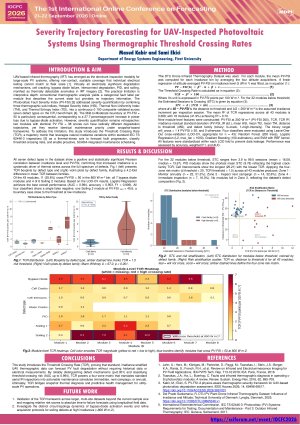
UAV-based infrared thermography provides snapshot severity assessments of photovoltaic (PV) modules but cannot directly indicate the rate at which a module is approaching a critical degradation threshold. This study introduces the Threshold Crossing Rate (TCR), a module-level thermographic trajectory descriptor derived from the linear response of the Photovoltaic Fault Severity Index (PV-FSI) across systematically varied irradiance conditions within a single inspection campaign, and evaluates its utility for forecasting whether and how rapidly a PV module will cross the operationally critical Mild-to-Moderate severity boundary at PV-FSI = 50. Using the DTU Drone Infrared Thermography Dataset (640 acquisitions, 43 modules, 7 defect types, 4 irradiance levels), TCR is derived from within-campaign irradiance variation as a controlled thermal-stress proxy, yielding a module-level feature matrix with 43 observations and 9 predictors. TCR values range from -0.09 to 12.02 PV-FSI points per 100 W m⁻² and differ significantly between defect families: crack-family defects (cell cracks, interconnects, PID, and glass cracks) exhibit a mean TCR of 1.07, while high-intensity family defects (bypass diode and soiling) exhibit a mean TCR of 4.48 (Mann–Whitney U = 67.0, p < 0.001), confirming that irradiance sensitivity is mechanistically stratified. Binary threshold crossing classification using Leave-One-Out cross-validation across four classifiers achieves an accuracy of 0.930-0.953, F1 of 0.870-0.909, and AUC of 0.963-0.994, with HSI mean (MDI = 0.269) and TCR (MDI = 0.226) identified as the dominant predictive features. For the 32 modules below threshold, an analytical Estimated Sessions to Crossing (STC) metric is derived from TCR and the current distance to threshold, and a four-zone risk stratification matrix is proposed that maps each module to a maintenance priority action, from annual monitoring to immediate inspection, without requiring additional sensing or supervised training beyond a standard IEC TS 62446-3 inspection campaign. These findings demonstrate that irradiance-stratified thermographic acquisitions, already standard in UAV-IRT protocols, contain sufficient information to support severity trajectory forecasting and proactive maintenance scheduling for utility-scale PV fleets.
Keywords
photovoltaic fault severity
UAV thermography
severity forecasting
threshold crossing rate
predictive maintenance
PV-FSI
irradiance stress proxy
Poster
Masud_Kabir_Poster_Presentation_IOCF.pdf
Uncertainty-Aware Hybrid AI Forecasting for Multi-Location Inventory Redistribution: A Forecast-then-Optimize Framework
Beyond Geographic Contiguity: A Hybrid Spatiotemporal Deep Learning–Spatial Econometric Framework for Detecting Functional Economic Networks in Algeria