Event submissions
Published
This submission belongs to the session S1. Energy Forecasting and Analytics of the event The 1st International Online Conference on Forecasting
Published date
16 Sep, 2026
Academic Editor
'%3e%3cpath%20d='M12.6657%2010.9104C12.4185%2010.325%2012.0599%209.79327%2011.6097%209.34482C11.1609%208.89508%2010.6293%208.5365%2010.0442%208.28888C10.0389%208.28626%2010.0337%208.28495%2010.0285%208.28233C10.8446%207.69279%2011.3752%206.73249%2011.3752%205.64904C11.3752%203.8542%209.92103%202.39999%208.1262%202.39999C6.33136%202.39999%204.87715%203.8542%204.87715%205.64904C4.87715%206.73249%205.40774%207.69279%206.22393%208.28364C6.21869%208.28626%206.21345%208.28757%206.20821%208.29019C5.62129%208.5378%205.09463%208.89284%204.64265%209.34613C4.1929%209.79493%203.83432%2010.3266%203.58671%2010.9117C3.34345%2011.4845%203.21226%2012.0987%203.20023%2012.7209C3.19988%2012.7349%203.20233%2012.7488%203.20744%2012.7619C3.21255%2012.7749%203.22022%2012.7867%203.22998%2012.7968C3.23975%2012.8068%203.25142%2012.8147%203.26431%2012.8202C3.2772%2012.8256%203.29105%2012.8284%203.30504%2012.8284H4.09109C4.14874%2012.8284%204.19459%2012.7825%204.1959%2012.7262C4.2221%2011.7148%204.62823%2010.7676%205.34617%2010.0497C6.08899%209.30683%207.0755%208.89808%208.1262%208.89808C9.17689%208.89808%2010.1634%209.30683%2010.9062%2010.0497C11.6242%2010.7676%2012.0303%2011.7148%2012.0565%2012.7262C12.0578%2012.7838%2012.1037%2012.8284%2012.1613%2012.8284H12.9474C12.9613%2012.8284%2012.9752%2012.8256%2012.9881%2012.8202C13.001%2012.8147%2013.0126%2012.8068%2013.0224%2012.7968C13.0322%2012.7867%2013.0398%2012.7749%2013.0449%2012.7619C13.0501%2012.7488%2013.0525%2012.7349%2013.0522%2012.7209C13.0391%2012.0947%2012.9094%2011.4855%2012.6657%2010.9104ZM8.1262%207.9024C7.52486%207.9024%206.9589%207.6679%206.53312%207.24211C6.10733%206.81633%205.87283%206.25037%205.87283%205.64904C5.87283%205.0477%206.10733%204.48174%206.53312%204.05596C6.9589%203.63018%207.52486%203.39567%208.1262%203.39567C8.72753%203.39567%209.29349%203.63018%209.71927%204.05596C10.1451%204.48174%2010.3796%205.0477%2010.3796%205.64904C10.3796%206.25037%2010.1451%206.81633%209.71927%207.24211C9.29349%207.6679%208.72753%207.9024%208.1262%207.9024Z'%20fill='%235D1EE1'/%3e%3c/g%3e%3c/svg%3e) Michele Quercio
Michele QuercioCitation
Shokhabbos Doliev, Sardorjon Salimjon ugli Samiev, Farrukh Dustmirzayevich Juraev, Golibjon Kholmuminovich Makhmatqulov, Javlonbek Khoshim ugli Khamraev, Forecasting Electricity Generation and Fossil Fuel Production in Uzbekistan Using Statistical and AI Models, in Proceedings of The 1st International Online Conference on Forecasting, 21 September–22 September 2026, MDPI: Basel, Switzerland
Share
Email
Facebook
Twitter
LinkedIn
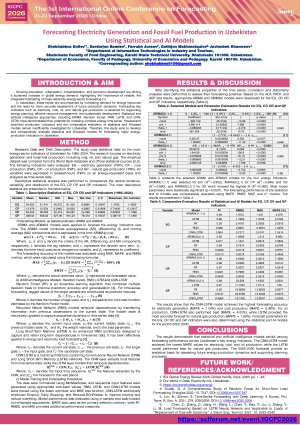
Forecasting Electricity Generation and Fossil Fuel Production in Uzbekistan Using Statistical and AI Models

Shokhabbos Doliev 1

Sardorjon Salimjon ugli Samiev 1
'%3e%3cpath%20d='M12.6647%2010.9104C12.4176%2010.325%2012.0589%209.7933%2011.6088%209.34485C11.16%208.89511%2010.6283%208.53653%2010.0432%208.28891C10.038%208.28629%2010.0327%208.28498%2010.0275%208.28236C10.8437%207.69282%2011.3743%206.73252%2011.3743%205.64907C11.3743%203.85423%209.92005%202.40002%208.12522%202.40002C6.33038%202.40002%204.87618%203.85423%204.87618%205.64907C4.87618%206.73252%205.40677%207.69282%206.22296%208.28367C6.21772%208.28629%206.21248%208.2876%206.20724%208.29022C5.62031%208.53783%205.09365%208.89287%204.64167%209.34616C4.19192%209.79496%203.83334%2010.3266%203.58573%2010.9117C3.34247%2011.4846%203.21128%2012.0987%203.19925%2012.721C3.1989%2012.735%203.20135%2012.7489%203.20646%2012.7619C3.21157%2012.7749%203.21924%2012.7868%203.22901%2012.7968C3.23877%2012.8068%203.25045%2012.8148%203.26334%2012.8202C3.27623%2012.8256%203.29007%2012.8284%203.30406%2012.8284H4.09012C4.14776%2012.8284%204.19362%2012.7825%204.19493%2012.7262C4.22113%2011.7148%204.62726%2010.7676%205.34519%2010.0497C6.08802%209.30686%207.07452%208.89811%208.12522%208.89811C9.17592%208.89811%2010.1624%209.30686%2010.9052%2010.0497C11.6232%2010.7676%2012.0293%2011.7148%2012.0555%2012.7262C12.0568%2012.7839%2012.1027%2012.8284%2012.1603%2012.8284H12.9464C12.9604%2012.8284%2012.9742%2012.8256%2012.9871%2012.8202C13%2012.8148%2013.0117%2012.8068%2013.0214%2012.7968C13.0312%2012.7868%2013.0389%2012.7749%2013.044%2012.7619C13.0491%2012.7489%2013.0515%2012.735%2013.0512%2012.721C13.0381%2012.0947%2012.9084%2011.4856%2012.6647%2010.9104ZM8.12522%207.90243C7.52388%207.90243%206.95792%207.66793%206.53214%207.24215C6.10636%206.81636%205.87185%206.2504%205.87185%205.64907C5.87185%205.04773%206.10636%204.48177%206.53214%204.05599C6.95792%203.63021%207.52388%203.3957%208.12522%203.3957C8.72655%203.3957%209.29252%203.63021%209.7183%204.05599C10.1441%204.48177%2010.3786%205.04773%2010.3786%205.64907C10.3786%206.2504%2010.1441%206.81636%209.7183%207.24215C9.29252%207.66793%208.72655%207.90243%208.12522%207.90243Z'%20fill='%235D1EE1'/%3e%3c/g%3e%3c/svg%3e)
Farrukh Dustmirzayevich Juraev 2
Golibjon Kholmuminovich Makhmatqulov 2
Javlonbek Khoshim ugli Khamraev 1
1. Department of Information Technologies in Industry and Tourism, Shahrisabz Faculty of Food Engineering, Karshi State Technical University. Shahrizabz 181306. Uzbekistan.
2. Department of Economics, Faculty of Pedagogy, University of Economics and Pedagogy. Karshi 180100. Uzbekistan.
Abstract
The global growth in population, industrial expansion, and the rapid advancement of digital technologies have significantly increased the demand for energy resources. In this context, accurately forecasting future changes in key energy sector indicators has become an essential tool for formulating energy policies, planning new investment projects, and ensuring the efficient utilization of energy resources. However, existing studies in the region have not sufficiently addressed the simultaneous forecasting of electricity generation and the production of oil, natural gas, and coal within a unified methodological framework, nor have they comprehensively evaluated the comparative performance of various statistical and artificial intelligence models. The aim of this study is to forecast electricity generation and fossil fuel production in Uzbekistan and to identify the most appropriate forecasting model for each indicator through a comparative assessment of ARIMA, Random Forest, RNN, LSTM, and CNN-LSTM models. The statistical characteristics of the energy sector indicators were examined using descriptive statistics, correlation and regression analyses, and stationarity tests. Forecasting was conducted using ARIMA, Random Forest, RNN, LSTM, and CNN-LSTM models, and their predictive performance was evaluated based on the R², RMSE, MAE, and MAPE metrics. The results indicate that the CNN-LSTM model achieved the highest forecasting accuracy for electricity generation (MAPE = 1.04%). For coal production, the CNN-LSTM model demonstrated the best predictive performance (MAPE = 5.46%), while the same model also provided the most accurate forecasts for oil production (MAPE = 4.00%). In the case of natural gas production, the LSTM model outperformed all other models (MAPE = 1.59%). These findings confirm the effectiveness of machine learning and deep learning approaches in forecasting key energy sector indicators. The results of this study provide valuable insights for the long-term sustainable development of the energy sector and the formulation of effective energy security strategies in Uzbekistan.
Keywords
electricity generation
fossil fuel production
ARIMA
Random Forest
RNN
LSTM
CNN-LSTM
forecasting
AI Models
Uzbekistan.
Poster
+Poster. Forecasting Electricity Generation and Fossil Fuel Production in Uzbekistan Using Statistical and AI Models.pdf
Nowcasting Monthly Consumption Indicators Using Credit Card Transactions: Evidence from Korea
Edge-Intelligent Forecasting of Renewable Energy Generation in Urban Smart Grids: An IoT-Enabled LSTM–Transformer Hybrid Framework