Event submissions
Published
This submission belongs to the session S1. Energy Forecasting and Analytics of the event The 1st International Online Conference on Forecasting
Published date
16 Sep, 2026
Academic Editor
'%3e%3cpath%20d='M12.6657%2010.9104C12.4185%2010.325%2012.0599%209.79327%2011.6097%209.34482C11.1609%208.89508%2010.6293%208.5365%2010.0442%208.28888C10.0389%208.28626%2010.0337%208.28495%2010.0285%208.28233C10.8446%207.69279%2011.3752%206.73249%2011.3752%205.64904C11.3752%203.8542%209.92103%202.39999%208.1262%202.39999C6.33136%202.39999%204.87715%203.8542%204.87715%205.64904C4.87715%206.73249%205.40774%207.69279%206.22393%208.28364C6.21869%208.28626%206.21345%208.28757%206.20821%208.29019C5.62129%208.5378%205.09463%208.89284%204.64265%209.34613C4.1929%209.79493%203.83432%2010.3266%203.58671%2010.9117C3.34345%2011.4845%203.21226%2012.0987%203.20023%2012.7209C3.19988%2012.7349%203.20233%2012.7488%203.20744%2012.7619C3.21255%2012.7749%203.22022%2012.7867%203.22998%2012.7968C3.23975%2012.8068%203.25142%2012.8147%203.26431%2012.8202C3.2772%2012.8256%203.29105%2012.8284%203.30504%2012.8284H4.09109C4.14874%2012.8284%204.19459%2012.7825%204.1959%2012.7262C4.2221%2011.7148%204.62823%2010.7676%205.34617%2010.0497C6.08899%209.30683%207.0755%208.89808%208.1262%208.89808C9.17689%208.89808%2010.1634%209.30683%2010.9062%2010.0497C11.6242%2010.7676%2012.0303%2011.7148%2012.0565%2012.7262C12.0578%2012.7838%2012.1037%2012.8284%2012.1613%2012.8284H12.9474C12.9613%2012.8284%2012.9752%2012.8256%2012.9881%2012.8202C13.001%2012.8147%2013.0126%2012.8068%2013.0224%2012.7968C13.0322%2012.7867%2013.0398%2012.7749%2013.0449%2012.7619C13.0501%2012.7488%2013.0525%2012.7349%2013.0522%2012.7209C13.0391%2012.0947%2012.9094%2011.4855%2012.6657%2010.9104ZM8.1262%207.9024C7.52486%207.9024%206.9589%207.6679%206.53312%207.24211C6.10733%206.81633%205.87283%206.25037%205.87283%205.64904C5.87283%205.0477%206.10733%204.48174%206.53312%204.05596C6.9589%203.63018%207.52486%203.39567%208.1262%203.39567C8.72753%203.39567%209.29349%203.63018%209.71927%204.05596C10.1451%204.48174%2010.3796%205.0477%2010.3796%205.64904C10.3796%206.25037%2010.1451%206.81633%209.71927%207.24211C9.29349%207.6679%208.72753%207.9024%208.1262%207.9024Z'%20fill='%235D1EE1'/%3e%3c/g%3e%3c/svg%3e) Sonia Leva
Sonia LevaCitation
Amira Feriani, Rethinking Short-Term Load Forecasting Evaluation Metrics for Isolated Microgrid Systems in the Global South, in Proceedings of The 1st International Online Conference on Forecasting, 21 September–22 September 2026, MDPI: Basel, Switzerland
Share
Email
Facebook
Twitter
LinkedIn
Rethinking Short-Term Load Forecasting Evaluation Metrics for Isolated Microgrid Systems in the Global South

Amira Feriani 1
1. Independent Researcher, Brussels 1200, Belgium
Abstract
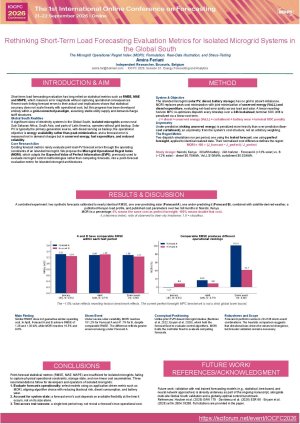
Short-term electricity load forecasting is a critical input to energy system operations, yet its evaluation has long relied on the statistical metrics RMSE, MAE, and MAPE, which measure error magnitude without capturing operational consequences. Recent work has begun addressing this gap for grid-connected systems, demonstrating that linking forecast errors to their actual cost implications produces fundamentally different model rankings than statistical metrics alone. This progress, however, has been developed entirely within a grid-centric paradigm: stable utility supply, demand charge tariff structures, and load as the primary source of uncertainty.
A significant and growing class of electricity systems in the Global South operates under fundamentally different conditions. In isolated and weak-grid microgrids, the predominant electrification pathway across rural Sub-Saharan Africa, South Asia, and parts of Latin America, there is no stable grid backup, no demand charge structure, and the operational objective is not peak minimization but energy availability. In these contexts, solar PV is frequently the primary generation source, diesel generators serve as backup, and the cost of a forecast error is measured not in demand charges but in unserved energy, fuel expenditure, and system reliability degradation.
We argue that the forecasting evaluation literature has an unaddressed structural gap: no application-driven metric exists that is calibrated to the operational realities of isolated microgrid systems in the Global South. This paper proposes the conceptual foundations for such a framework, built around three adaptations: redefining the operational objective from peak cost minimization to unserved energy and fuel cost minimization; extending uncertainty quantification beyond load to jointly account for solar generation variability; and adapting the underlying dispatch optimization to islanded microgrid architectures. We position this as a necessary complement to existing evaluation frameworks: one calibrated to systems where reliable electricity access, not peak cost minimization, defines operational success.
Keywords
Short-term load forecasting
Islanded microgrids
Operational metrics
Global South
Energy access
Poster
Feriani_IOCFC2026_MORI_Poster.pdf
Electrical Load Demand Forecasting using LSTM- Kolmogorov Arnold Network model for the Western Grid of India
Beyond the Predictability Desert: A Data-Driven Approach to 5-Week Temperature Forecasting