Event submissions
Published
This submission belongs to the session S1. Energy Forecasting and Analytics of the event The 1st International Online Conference on Forecasting
Published date
16 Sep, 2026
Academic Editor
'%3e%3cpath%20d='M12.6657%2010.9104C12.4185%2010.325%2012.0599%209.79327%2011.6097%209.34482C11.1609%208.89508%2010.6293%208.5365%2010.0442%208.28888C10.0389%208.28626%2010.0337%208.28495%2010.0285%208.28233C10.8446%207.69279%2011.3752%206.73249%2011.3752%205.64904C11.3752%203.8542%209.92103%202.39999%208.1262%202.39999C6.33136%202.39999%204.87715%203.8542%204.87715%205.64904C4.87715%206.73249%205.40774%207.69279%206.22393%208.28364C6.21869%208.28626%206.21345%208.28757%206.20821%208.29019C5.62129%208.5378%205.09463%208.89284%204.64265%209.34613C4.1929%209.79493%203.83432%2010.3266%203.58671%2010.9117C3.34345%2011.4845%203.21226%2012.0987%203.20023%2012.7209C3.19988%2012.7349%203.20233%2012.7488%203.20744%2012.7619C3.21255%2012.7749%203.22022%2012.7867%203.22998%2012.7968C3.23975%2012.8068%203.25142%2012.8147%203.26431%2012.8202C3.2772%2012.8256%203.29105%2012.8284%203.30504%2012.8284H4.09109C4.14874%2012.8284%204.19459%2012.7825%204.1959%2012.7262C4.2221%2011.7148%204.62823%2010.7676%205.34617%2010.0497C6.08899%209.30683%207.0755%208.89808%208.1262%208.89808C9.17689%208.89808%2010.1634%209.30683%2010.9062%2010.0497C11.6242%2010.7676%2012.0303%2011.7148%2012.0565%2012.7262C12.0578%2012.7838%2012.1037%2012.8284%2012.1613%2012.8284H12.9474C12.9613%2012.8284%2012.9752%2012.8256%2012.9881%2012.8202C13.001%2012.8147%2013.0126%2012.8068%2013.0224%2012.7968C13.0322%2012.7867%2013.0398%2012.7749%2013.0449%2012.7619C13.0501%2012.7488%2013.0525%2012.7349%2013.0522%2012.7209C13.0391%2012.0947%2012.9094%2011.4855%2012.6657%2010.9104ZM8.1262%207.9024C7.52486%207.9024%206.9589%207.6679%206.53312%207.24211C6.10733%206.81633%205.87283%206.25037%205.87283%205.64904C5.87283%205.0477%206.10733%204.48174%206.53312%204.05596C6.9589%203.63018%207.52486%203.39567%208.1262%203.39567C8.72753%203.39567%209.29349%203.63018%209.71927%204.05596C10.1451%204.48174%2010.3796%205.0477%2010.3796%205.64904C10.3796%206.25037%2010.1451%206.81633%209.71927%207.24211C9.29349%207.6679%208.72753%207.9024%208.1262%207.9024Z'%20fill='%235D1EE1'/%3e%3c/g%3e%3c/svg%3e) Alessandro Niccolai
Alessandro NiccolaiCitation
Shweta Singh, Anamika Yadav, Shubhrata Gupta, A novel Multi-Learner Stacking Ensemble Model for Short-Term Photovoltaic Power Forecasting, in Proceedings of The 1st International Online Conference on Forecasting, 21 September–22 September 2026, MDPI: Basel, Switzerland
Share
Email
Facebook
Twitter
LinkedIn
A novel Multi-Learner Stacking Ensemble Model for Short-Term Photovoltaic Power Forecasting
'%3e%3cpath%20d='M12.6647%2010.9104C12.4176%2010.325%2012.0589%209.7933%2011.6088%209.34485C11.16%208.89511%2010.6283%208.53653%2010.0432%208.28891C10.038%208.28629%2010.0327%208.28498%2010.0275%208.28236C10.8437%207.69282%2011.3743%206.73252%2011.3743%205.64907C11.3743%203.85423%209.92005%202.40002%208.12522%202.40002C6.33038%202.40002%204.87618%203.85423%204.87618%205.64907C4.87618%206.73252%205.40677%207.69282%206.22296%208.28367C6.21772%208.28629%206.21248%208.2876%206.20724%208.29022C5.62031%208.53783%205.09365%208.89287%204.64167%209.34616C4.19192%209.79496%203.83334%2010.3266%203.58573%2010.9117C3.34247%2011.4846%203.21128%2012.0987%203.19925%2012.721C3.1989%2012.735%203.20135%2012.7489%203.20646%2012.7619C3.21157%2012.7749%203.21924%2012.7868%203.22901%2012.7968C3.23877%2012.8068%203.25045%2012.8148%203.26334%2012.8202C3.27623%2012.8256%203.29007%2012.8284%203.30406%2012.8284H4.09012C4.14776%2012.8284%204.19362%2012.7825%204.19493%2012.7262C4.22113%2011.7148%204.62726%2010.7676%205.34519%2010.0497C6.08802%209.30686%207.07452%208.89811%208.12522%208.89811C9.17592%208.89811%2010.1624%209.30686%2010.9052%2010.0497C11.6232%2010.7676%2012.0293%2011.7148%2012.0555%2012.7262C12.0568%2012.7839%2012.1027%2012.8284%2012.1603%2012.8284H12.9464C12.9604%2012.8284%2012.9742%2012.8256%2012.9871%2012.8202C13%2012.8148%2013.0117%2012.8068%2013.0214%2012.7968C13.0312%2012.7868%2013.0389%2012.7749%2013.044%2012.7619C13.0491%2012.7489%2013.0515%2012.735%2013.0512%2012.721C13.0381%2012.0947%2012.9084%2011.4856%2012.6647%2010.9104ZM8.12522%207.90243C7.52388%207.90243%206.95792%207.66793%206.53214%207.24215C6.10636%206.81636%205.87185%206.2504%205.87185%205.64907C5.87185%205.04773%206.10636%204.48177%206.53214%204.05599C6.95792%203.63021%207.52388%203.3957%208.12522%203.3957C8.72655%203.3957%209.29252%203.63021%209.7183%204.05599C10.1441%204.48177%2010.3786%205.04773%2010.3786%205.64907C10.3786%206.2504%2010.1441%206.81636%209.7183%207.24215C9.29252%207.66793%208.72655%207.90243%208.12522%207.90243Z'%20fill='%235D1EE1'/%3e%3c/g%3e%3c/svg%3e)
Shweta Singh 1
Anamika Yadav 1
Shubhrata Gupta 1
1. Electrical Engineering Department, National Institute of Technology, Raipur, India
Abstract
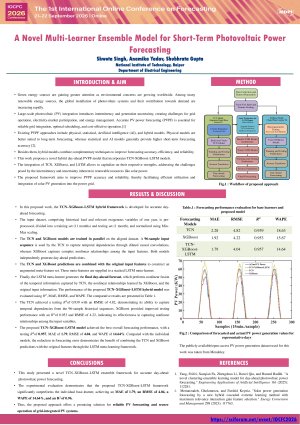
Short-term photovoltaic (PV) power generation forecasting facilitates efficient grid scheduling and dispatch, thereby enhancing energy management for grid-integrated PV systems and improving grid security. However, the inherent dependence of solar energy on dynamic weather conditions introduces substantial variability in PV power generation, posing considerable challenges to accurate forecasting and affecting the reliability, stability, and secure operation of the grid. Therefore, to address these issues, this work proposes a novel forecasting framework that combines a Temporal Convolution Network (TCN), Extreme Gradient Boosting (XGBoost) and a Long Short-Term Memory (LSTM) meta-learner model to enhance day-ahead PV power forecasting accuracy. In this proposed architecture, the TCN is employed to capture temporal sequential patterns in PV power generation, whereas XGBoost extracts nonlinear feature relationships. The input features and forecasts from the base learners are fused using an LSTM meta-learner to improve PV power forecasting accuracy.
Historical PV power generation and meteorological variables at a 15min temporal resolution were utilized as input features for the proposed forecasting framework, and the forecasting performance of the proposed and base learner models was evaluated using MAE (Mean Absolute Error), RMSE (Root Mean Square Error), WAPE (Weighted Absolute Percentage Error) and R2. The experimental evaluation demonstrates that the proposed TCN-XGBoost-LSTM framework significantly outperforms the individual base-learner forecasting models, achieving an MAE of 1.79, an RMSE of 4.04, a WAPE of 14.64%, and an R2 of 0.96. In contrast, the TCN and XGBoost base learners achieved an R2 of 0.939 and 0.953, respectively.
The results obtained exhibit the effectiveness of the proposed framework for short-term PV power generation forecasting, thereby supporting reliable renewable energy management and grid operation.
Keywords
Forecasting
PV Power
Ensemble model
Meta learning
Poster
Sciforum_SHWETA SINGH_NIT_RAIPUR.pdf
Forecasting-oriented changepoint detection
Artificial Neural Network Model for Forecasting Distributed Solar Photovoltaic Generation