Event submissions
Published
This submission belongs to the session S2. AI Forecasting & Large Language Models of the event The 1st International Online Conference on Forecasting
Published date
16 Sep, 2026
Academic Editor
'%3e%3cpath%20d='M12.6657%2010.9104C12.4185%2010.325%2012.0599%209.79327%2011.6097%209.34482C11.1609%208.89508%2010.6293%208.5365%2010.0442%208.28888C10.0389%208.28626%2010.0337%208.28495%2010.0285%208.28233C10.8446%207.69279%2011.3752%206.73249%2011.3752%205.64904C11.3752%203.8542%209.92103%202.39999%208.1262%202.39999C6.33136%202.39999%204.87715%203.8542%204.87715%205.64904C4.87715%206.73249%205.40774%207.69279%206.22393%208.28364C6.21869%208.28626%206.21345%208.28757%206.20821%208.29019C5.62129%208.5378%205.09463%208.89284%204.64265%209.34613C4.1929%209.79493%203.83432%2010.3266%203.58671%2010.9117C3.34345%2011.4845%203.21226%2012.0987%203.20023%2012.7209C3.19988%2012.7349%203.20233%2012.7488%203.20744%2012.7619C3.21255%2012.7749%203.22022%2012.7867%203.22998%2012.7968C3.23975%2012.8068%203.25142%2012.8147%203.26431%2012.8202C3.2772%2012.8256%203.29105%2012.8284%203.30504%2012.8284H4.09109C4.14874%2012.8284%204.19459%2012.7825%204.1959%2012.7262C4.2221%2011.7148%204.62823%2010.7676%205.34617%2010.0497C6.08899%209.30683%207.0755%208.89808%208.1262%208.89808C9.17689%208.89808%2010.1634%209.30683%2010.9062%2010.0497C11.6242%2010.7676%2012.0303%2011.7148%2012.0565%2012.7262C12.0578%2012.7838%2012.1037%2012.8284%2012.1613%2012.8284H12.9474C12.9613%2012.8284%2012.9752%2012.8256%2012.9881%2012.8202C13.001%2012.8147%2013.0126%2012.8068%2013.0224%2012.7968C13.0322%2012.7867%2013.0398%2012.7749%2013.0449%2012.7619C13.0501%2012.7488%2013.0525%2012.7349%2013.0522%2012.7209C13.0391%2012.0947%2012.9094%2011.4855%2012.6657%2010.9104ZM8.1262%207.9024C7.52486%207.9024%206.9589%207.6679%206.53312%207.24211C6.10733%206.81633%205.87283%206.25037%205.87283%205.64904C5.87283%205.0477%206.10733%204.48174%206.53312%204.05596C6.9589%203.63018%207.52486%203.39567%208.1262%203.39567C8.72753%203.39567%209.29349%203.63018%209.71927%204.05596C10.1451%204.48174%2010.3796%205.0477%2010.3796%205.64904C10.3796%206.25037%2010.1451%206.81633%209.71927%207.24211C9.29349%207.6679%208.72753%207.9024%208.1262%207.9024Z'%20fill='%235D1EE1'/%3e%3c/g%3e%3c/svg%3e) Sonia Leva
Sonia LevaCitation
Fahim Sufi, From Raw Crisis Counts to Forecast-Ready Signals: Network-Adjusted Statistical Learning from Heterogeneous News Streams, in Proceedings of The 1st International Online Conference on Forecasting, 21 September–22 September 2026, MDPI: Basel, Switzerland
Share
Email
Facebook
Twitter
LinkedIn
From Raw Crisis Counts to Forecast-Ready Signals: Network-Adjusted Statistical Learning from Heterogeneous News Streams

Fahim Sufi 1
1. Office of CTO, COEUS Institute, New Market, VA 22844, USA
Abstract
Introduction:
Forecasting crisis risk from online news streams requires careful separation between real signal variation and changes in the data acquisition process. Raw crisis news counts can be distorted by source selection, monitoring coverage, temporal unevenness, and severe event class imbalance. This study develops a network-adjusted statistical learning framework that transforms heterogeneous crisis news into acquisition-corrected and forecast-ready event signals.
Methods:
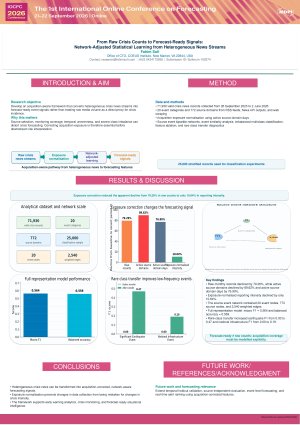
This study analyses 71,930 valid crisis news records, covering 20 event categories and 772 source domains, collected between 26 September 2023 and 02 June 2026 through RSS feeds, News API outputs, and web scraping. The framework integrates acquisition exposure normalization, source event bipartite network modeling, event similarity analysis, imbalanced multiclass classification, feature ablation, and rare class transfer diagnostics. Temporal inference is corrected using active source domain days, allowing observed reporting volume to be distinguished from changes in acquisition coverage.
Results:
The findings show that unadjusted crisis counts can substantially mislead forecasting-oriented interpretation. Mean monthly raw records declined by 79.26% from the baseline to the recent period, but active source domains declined by 89.62% and active source domain days by 76.90%. After exposure normalization, the decline in reporting intensity was only 10.64%. The source event network contained 20 event nodes, 772 source nodes, and 2,540 weighted edges, revealing structured relational information across crisis categories and sources. Classification experiments on 25,000 stratified records showed that the full representation model achieved the best macro F1 = 0.564 and balanced accuracy = 0.559. Rare class transfer improved Significant Earthquake Event classification from 0.00 to 0.47 F1 and National Infrastructure Event from 0.00 to 0.19 F1.
Conclusions:
This study contributes to AI forecasting by showing how heterogeneous crisis news streams can be converted into acquisition-corrected, network-aware, and statistically learnable signals. The framework supports early warning analytics, crisis monitoring, and forecast-ready situational intelligence without mistaking raw news volume for incident prevalence.
Keywords
AI Forecasting
Crisis Informatics
Forecast Ready Event Signals
Acquisition Exposure Normalisation
Source Event Networks
Rare Class Transfer Learning
Poster
IOCFC2026_Forecast_Ready_Crisis_Signals_Poster_v2.pdf
Improving Day-Ahead Market Price Forecasting through a Spatially Informed Clustering Framework
Forecasting Global Ocean Health from Multidimensional Sustainability Indicators: An Interpretable Random Forest Framework