Event submissions
Published
This submission belongs to the session S2. AI Forecasting & Large Language Models of the event The 1st International Online Conference on Forecasting
Published date
16 Sep, 2026
Academic Editor
'%3e%3cpath%20d='M12.6657%2010.9104C12.4185%2010.325%2012.0599%209.79327%2011.6097%209.34482C11.1609%208.89508%2010.6293%208.5365%2010.0442%208.28888C10.0389%208.28626%2010.0337%208.28495%2010.0285%208.28233C10.8446%207.69279%2011.3752%206.73249%2011.3752%205.64904C11.3752%203.8542%209.92103%202.39999%208.1262%202.39999C6.33136%202.39999%204.87715%203.8542%204.87715%205.64904C4.87715%206.73249%205.40774%207.69279%206.22393%208.28364C6.21869%208.28626%206.21345%208.28757%206.20821%208.29019C5.62129%208.5378%205.09463%208.89284%204.64265%209.34613C4.1929%209.79493%203.83432%2010.3266%203.58671%2010.9117C3.34345%2011.4845%203.21226%2012.0987%203.20023%2012.7209C3.19988%2012.7349%203.20233%2012.7488%203.20744%2012.7619C3.21255%2012.7749%203.22022%2012.7867%203.22998%2012.7968C3.23975%2012.8068%203.25142%2012.8147%203.26431%2012.8202C3.2772%2012.8256%203.29105%2012.8284%203.30504%2012.8284H4.09109C4.14874%2012.8284%204.19459%2012.7825%204.1959%2012.7262C4.2221%2011.7148%204.62823%2010.7676%205.34617%2010.0497C6.08899%209.30683%207.0755%208.89808%208.1262%208.89808C9.17689%208.89808%2010.1634%209.30683%2010.9062%2010.0497C11.6242%2010.7676%2012.0303%2011.7148%2012.0565%2012.7262C12.0578%2012.7838%2012.1037%2012.8284%2012.1613%2012.8284H12.9474C12.9613%2012.8284%2012.9752%2012.8256%2012.9881%2012.8202C13.001%2012.8147%2013.0126%2012.8068%2013.0224%2012.7968C13.0322%2012.7867%2013.0398%2012.7749%2013.0449%2012.7619C13.0501%2012.7488%2013.0525%2012.7349%2013.0522%2012.7209C13.0391%2012.0947%2012.9094%2011.4855%2012.6657%2010.9104ZM8.1262%207.9024C7.52486%207.9024%206.9589%207.6679%206.53312%207.24211C6.10733%206.81633%205.87283%206.25037%205.87283%205.64904C5.87283%205.0477%206.10733%204.48174%206.53312%204.05596C6.9589%203.63018%207.52486%203.39567%208.1262%203.39567C8.72753%203.39567%209.29349%203.63018%209.71927%204.05596C10.1451%204.48174%2010.3796%205.0477%2010.3796%205.64904C10.3796%206.25037%2010.1451%206.81633%209.71927%207.24211C9.29349%207.6679%208.72753%207.9024%208.1262%207.9024Z'%20fill='%235D1EE1'/%3e%3c/g%3e%3c/svg%3e) Alessandro Niccolai
Alessandro NiccolaiCitation
Fahim Sufi, Forecasting Global Ocean Health from Multidimensional Sustainability Indicators: An Interpretable Random Forest Framework, in Proceedings of The 1st International Online Conference on Forecasting, 21 September–22 September 2026, MDPI: Basel, Switzerland
Share
Email
Facebook
Twitter
LinkedIn
Forecasting Global Ocean Health from Multidimensional Sustainability Indicators: An Interpretable Random Forest Framework

Fahim Sufi 1
1. Office of CTO, COEUS Institute, New Market, VA 22844, USA
Abstract
Introduction:
Forecasting global ocean health is essential for identifying vulnerable marine systems before ecological decline becomes more difficult to reverse. Although the Ocean Health Index provides a widely used measure of marine ecosystem condition and human ocean benefits, its longitudinal structure remains underused for predictive modelling. This study develops an interpretable artificial intelligence framework for forecasting next-year ocean health performance and translating multidimensional sustainability indicators into risk-relevant decision intelligence.
Methods:
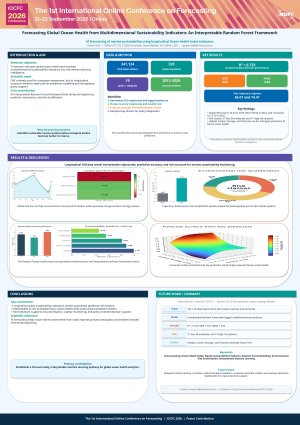
The study analyses 341,124 Ocean Health Index score observations covering 220 coastal countries and territories, 19 goals or subgoals, 6 score dimensions, and annual assessments from 2012 to 2025. The framework combines data harmonisation, longitudinal trajectory modelling, K-means country grouping, trajectory-based risk stratification, Random Forest forecasting, feature importance analysis, and country-specific policy diagnostics. The forecasting model used lagged goal and dimension-level predictors, while the contemporaneous overall index was excluded from the predictor set to avoid circular prediction.
Results:
The global Ocean Health Index rose from 71.85 in 2012 to 74.94 in 2019, declined to 69.50 in 2024, and partially recovered to 72.31 in 2025, remaining 2.63 points below its 2019 level. Country trajectories separated into two regimes with mean 2025 scores of 65.07 and 74.47, while risk stratification identified 51 low-risk, 98 moderate-risk, and 71 high-risk ocean health systems. The Random Forest model predicted next year OHI scores with R² = 0.723, MAE = 3.07, and RMSE = 4.03 on the temporal holdout sample. Habitat, carbon storage, and fisheries emerged as the strongest predictors of future ocean health.
Conclusions:
This study advances AI forecasting by demonstrating that multidimensional ocean sustainability indicators contain substantial predictive information about future marine system performance. The framework offers an interpretable basis for ocean health forecasting, risk prioritisation, and policy oriented environmental decision support.
Keywords
AI Forecasting
Ocean Health Index
Marine Sustainability Prediction
Random Forest Modelling
Environmental Risk Stratification
Interpretable Machine Learning
Poster
IOCFC2026_Ocean_Health_Forecasting_Poster.pdf
From Raw Crisis Counts to Forecast-Ready Signals: Network-Adjusted Statistical Learning from Heterogeneous News Streams
A Fourier-Guided Machine Learning Framework for District-Level Dew Point Comfort Forecasting Across 64 districts of Bangladesh (2025–2027)